

Key Takeaways
Why Repair Estimates Deserve More Than a Quick Glance
A repair estimate is a legally significant document. In most U.S. states, consumer protection laws governing auto repair require shops to provide written estimates, obtain customer authorization before exceeding a cost threshold, and return replaced parts on request. Understanding what you're looking at turns a routine authorization into an informed decision.
Repair costs are also a real part of the long-term expense of vehicle ownership — something our overview of the true cost of owning a vehicle covers in depth. Knowing how to read an estimate is one of the most practical tools a vehicle owner can develop.
Never Authorize Work Without a Written Estimate
In most U.S. states, auto repair shops are legally required to provide a written estimate before beginning work if the repair cost exceeds a certain threshold. Verbal estimates offer you little protection if a dispute arises. Always get the estimate in writing, and do not sign a blank or incomplete authorization form.
The sections below walk you through each category of charges you're likely to encounter, and the steps that follow give you a practical process for reviewing any estimate before you sign.
Written repair estimate from the shop
The primary document you'll review; every charge should appear on it before you authorize work.
Flat-rate labor time reference (e.g., Chilton or Mitchell guides)
Allows you to independently verify whether the labor hours quoted are in a typical range for the repair.
Smartphone or notepad
For noting questions, researching part numbers, and recording what was discussed with the service advisor.
How to Review Your Estimate Step by Step
What you will need
Locate the Labor Charges Section
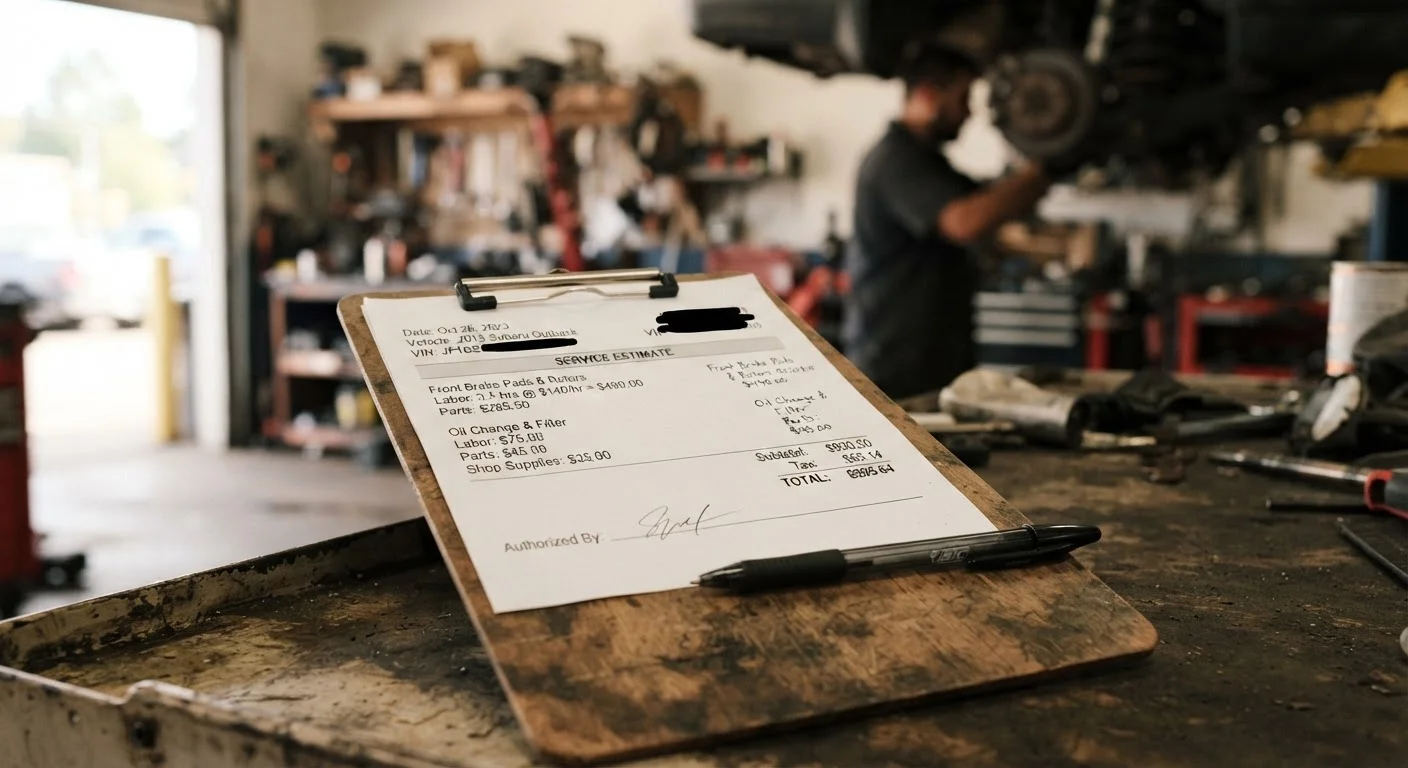
Labor is typically the largest line item on any estimate. Shops charge labor using a flat-rate system — a standardized time guide (such as Mitchell or Chilton) assigns a set number of hours to each repair operation, regardless of how long the technician actually takes. Your bill reflects the flat-rate hours multiplied by the shop's hourly labor rate.
Check that the labor description matches the actual repair being performed. If the estimate lists 2.5 hours for a water pump replacement, that's the industry-standard time for that job on your vehicle's engine, not necessarily the time your technician spent in the bay.
Review Every Parts Line Item
Each part listed should include a description, part number, quantity, and unit price. Pay attention to whether parts are labeled OEM (original equipment manufacturer), OE-equivalent, or aftermarket. These distinctions affect both cost and quality — and you generally have the right to request a different tier if the shop offers one.
Our guide on OEM, OE-equivalent, and aftermarket parts explains what each label means in practical terms before you approve a specific component.
Understand Shop Supply Fees
Shop supply fees (sometimes called shop materials or environmental fees) cover consumables used during the repair: rags, cleaning solvents, gasket sealer, wire ties, and similar items. These are typically charged as a percentage of the total labor cost or as a flat fee, and they appear on nearly every estimate.
These charges are legitimate, but they should be itemized or at least explained when you ask. If the fee seems disproportionately large relative to the scope of the work, request a breakdown.
Check for Diagnostic or Inspection Fees
If the shop performed a diagnostic scan or multi-point inspection before preparing the estimate, those hours may appear as their own line item. This is standard practice — diagnosing a check-engine code or identifying a noise takes technician time. Ask whether the diagnostic fee is waived or applied toward the repair cost if you approve the work, as many shops operate that way.
Scrutinize Any Additional Recommended Repairs
Estimates sometimes include recommended work beyond what you originally brought the vehicle in for. These may be genuinely necessary — or they may be items that can wait. Before approving add-on repairs, ask the advisor to explain the urgency and consequence of deferring each one.
Our article on evaluating surprise repair recommendations walks through how to assess these suggestions without feeling pressured.
Confirm the Warranty on Parts and Labor
Before signing authorization, ask what warranty the shop provides on both parts and labor. Reputable shops typically offer at least a 12-month or 12,000-mile guarantee on their work, though this varies. Warranty terms should be stated on the estimate or the shop's posted policies — get them in writing.
Bring Your Estimate Questions in Writing
Before you call or visit the shop to discuss an estimate, jot down each line item you don't understand. A prepared list keeps the conversation focused, ensures nothing gets glossed over, and signals to the advisor that you're an engaged customer who is paying attention.
If after reviewing an estimate you have remaining concerns about pricing, getting a second written estimate from another licensed shop is a reasonable and widely accepted practice. A trustworthy shop will not penalize you for asking.
Watch for Vague or Bundled Line Items
A line item listed simply as 'miscellaneous repairs' or 'general service' is a red flag. Every charge should have a specific description. If you cannot identify what a line item covers, ask the service advisor to break it out before you approve anything.
Keeping repair costs in perspective within your overall budget is worthwhile. Resources like the Budgeting Basics hub offer practical frameworks for planning around variable expenses like vehicle maintenance.