

Key Takeaways
Our Verdict
Rotation, balancing, and alignment are three distinct services that work together to extend tire life and maintain safe vehicle handling. None of them is redundant — each targets a specific mechanical issue, and skipping one doesn't mean the others will compensate. Understanding the difference helps drivers make informed decisions at the shop rather than guessing.
| Best for | Recommended |
|---|---|
| Drivers who put on high mileage annually | Regular rotation (every 5,000–7,500 miles) |
| Anyone noticing vibration at highway speeds | Wheel balancing |
| Vehicles that have hit a curb, pothole, or been in a minor collision | Alignment check |
| Drivers installing new tires | Balancing and alignment together |
What Tire Rotation Actually Does
Tire rotation means physically moving each tire to a different position on the vehicle — front-left to rear-left, rear-right to spare, and so on, depending on the pattern your vehicle's manufacturer recommends. The purpose is straightforward: tires wear unevenly depending on where they sit. Front tires carry more of the braking and steering load, while rear tires on front-wheel-drive vehicles wear differently than on rear-wheel-drive setups.
By rotating tires on a regular schedule — commonly every 5,000 to 7,500 miles, though your owner's manual is the authoritative source — you distribute wear more evenly across all four tires. The result is that all four tires tend to reach the end of their usable life at roughly the same time, rather than two wearing out prematurely and requiring replacement while the others still have significant tread remaining.
Rotation does nothing for vibration or steering pull. It's purely about managing where tread wear happens over time. If a shop recommends rotation and you're wondering whether it's necessary, understanding how to evaluate unexpected service recommendations can help you think through the decision calmly.
What Wheel Balancing Corrects
Balancing addresses a different problem entirely: uneven weight distribution in a tire-and-wheel assembly. Even a brand-new tire mounted on a rim may have slight weight imbalances — the valve stem, minor manufacturing variations, or imperfections in the rim itself can all contribute. At low speeds, this is imperceptible. At highway speeds, an imbalance as small as a quarter-ounce can cause noticeable vibration through the steering wheel or seat.
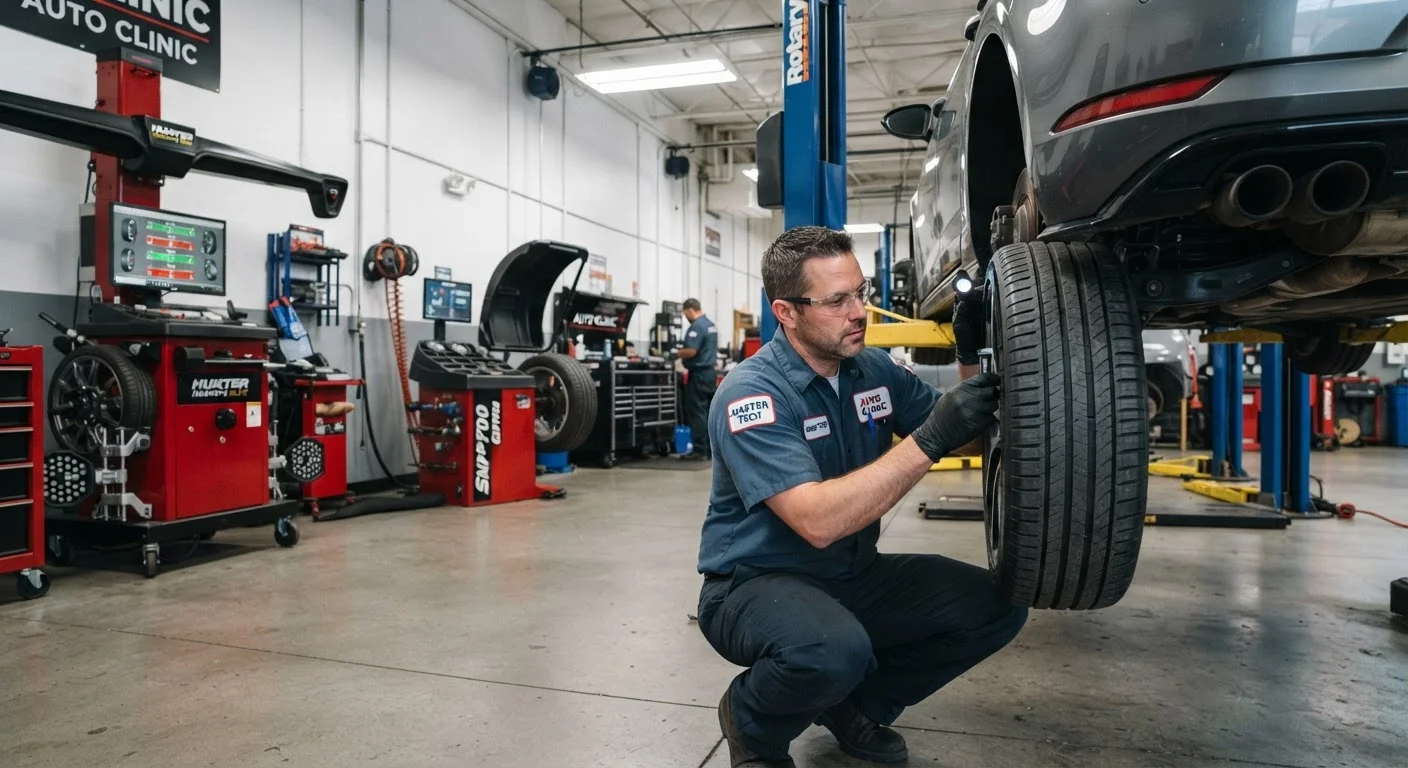
During a balancing service, a technician mounts the tire-and-wheel assembly on a spin-balance machine that identifies heavy spots. Small weights are then attached to the rim to counteract those imbalances. The process is fast and precise.
45%
Tires prematurely worn from improper inflation or misalignment
The National Highway Traffic Safety Administration has noted that a significant share of tire-related issues stem from neglected maintenance rather than manufacturing defects.
1/4 oz
Imbalance that can cause noticeable vibration
Industry technicians commonly note that imbalances as small as a quarter-ounce can produce perceptible steering wheel or seat vibration at highway speeds.
Balancing is typically recommended whenever new tires are installed, and periodically afterward — some manufacturers suggest every 12,000 to 15,000 miles or when vibration appears. Potholes and curb strikes can knock wheels out of balance between scheduled intervals. Unlike rotation, balancing doesn't change where a tire sits on the vehicle — it corrects how that tire spins.
What Alignment Does — and Doesn't Do
Alignment refers to the geometric angles at which your tires make contact with the road. The key measurements are camber (the inward or outward tilt of the tire when viewed from the front), toe (whether tires point inward or outward when viewed from above), and caster (the angle of the steering axis). When these angles drift out of specification, tires scrub against the road at an angle rather than rolling straight — causing rapid, uneven tread wear and affecting how the vehicle tracks down the road.
Misalignment is often caused by hitting a significant pothole, making hard contact with a curb, or gradual wear in suspension and steering components. A vehicle that drifts to one side or requires constant steering correction to go straight is a classic sign that alignment is worth checking.
| Rotation | Balancing | Alignment | |
|---|---|---|---|
| What it corrects | Uneven tread wear across positions | Weight imbalance in tire-wheel assembly | Incorrect wheel angle geometry |
| Main symptom when needed | Premature or uneven wear patterns | Vibration at highway speeds | Pulling, drifting, or rapid edge wear |
| Typical trigger | Every 5,000–7,500 miles | New tires or vibration onset | Impact, annual check, or uneven wear |
| What technician physically does | Moves tires to new positions | Attaches weights to rim | Adjusts suspension/steering angles |
| Affects vehicle handling? | Indirectly, over time | Yes — reduces vibration | Yes — corrects steering pull |
| Can substitute for the others? | No | No | No |
Alignment is adjusted using specialized equipment that measures current angles and allows a technician to bring them back within the manufacturer's specified range. It does not involve moving tires between positions (rotation) or correcting weight distribution (balancing). Skipping alignment when it's needed accelerates tire wear in ways no amount of rotation will fix. As a broader principle, deferred maintenance often costs significantly more than the original service when tire damage compounds over thousands of miles.
How the Three Services Work Together
These services are complementary, not interchangeable. A vehicle can have perfect alignment but unbalanced wheels. It can have balanced wheels with uneven wear from skipping rotation. And it can have freshly rotated tires that still scrub unevenly because the alignment is off.
The practical takeaway is that each service has its own diagnostic trigger and interval. Rotation follows mileage. Balancing is triggered by vibration or new tire installation. Alignment is checked after impacts, when steering feel changes, or when uneven wear patterns appear — and many shops recommend an annual check regardless.
If you're uncertain which service a shop is recommending and why, asking a technician to show you the wear pattern or measurement readings is entirely reasonable. Whether you use a dealership or an independent shop, both service options can handle these procedures competently — the key is finding a shop that explains what they found and why it matters.
This article is for general informational purposes. Service intervals and specifications vary by vehicle — always consult your owner's manual and a qualified mechanic for guidance specific to your vehicle.