

Key Takeaways
W-4 Tax Withholding
A W-4 is the IRS form you complete for your employer that tells them how much federal income tax to withhold from each paycheck. The amount withheld is sent directly to the IRS on your behalf throughout the year, so you're paying your tax bill in installments rather than one lump sum at filing time. The W-4 is not a one-and-done form — it can be updated whenever your financial situation changes.
The IRS overhauled the W-4 design in 2020, replacing personal allowances with a more direct dollar-amount system based on filing status, multiple jobs, dependents, and other income adjustments.
What the W-4 Actually Does
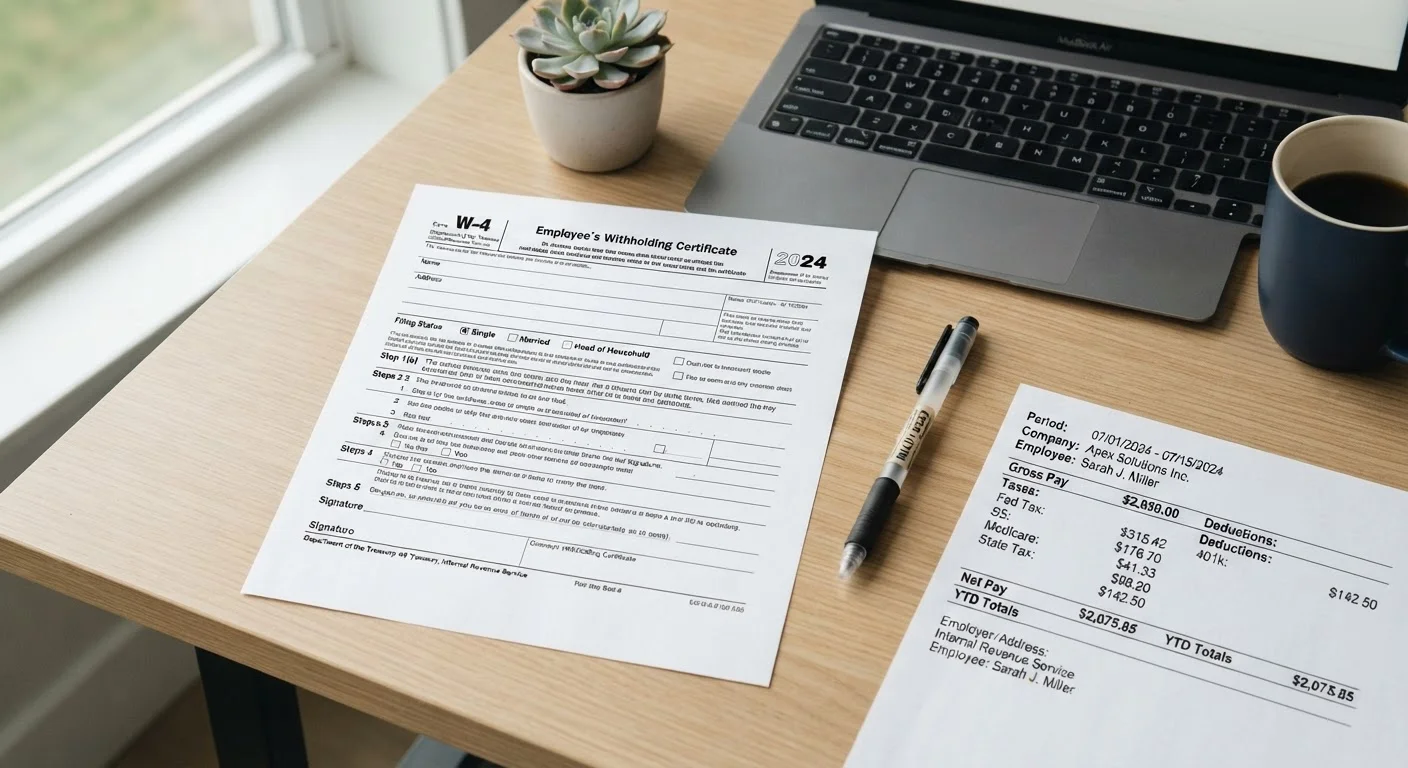
When you start a job, your employer hands you a W-4 — formally called the Employee's Withholding Certificate. Your answers on that form translate into a withholding amount that reduces each paycheck before you see it. Think of it as a running payment toward your annual federal income tax bill.
The math works like this: the IRS expects taxpayers to pay taxes as income is earned, not just at the April deadline. Withholding is the mechanism that keeps most employees in compliance automatically. At the end of the year, your W-2 form reports what was withheld, and when you file your return, that amount is compared to what you actually owed. The difference either comes back to you as a refund or results in a balance due.
Understanding what appears on each line of your paycheck is the foundation for using your W-4 effectively. Reading a Pay Stub: Every Line Explained breaks down every deduction and tax line in plain terms.
~73%
Americans who typically receive a tax refund
According to IRS filing statistics, roughly 73% of individual returns result in a refund, suggesting widespread over-withholding nationally.
$3,000+
Average federal income tax refund
IRS data consistently shows average refunds exceeding $3,000, reflecting how much excess withholding accumulates over a tax year.
2020
Year IRS redesigned the W-4 form
The IRS eliminated the old allowance-based system in 2020, replacing it with a more transparent dollar-amount approach aligned to the 2017 tax law changes.
Under-Withholding: The Hidden Tax Trap
Under-withholding happens when your employer withholds less tax than you actually owe during the year. The result: a tax bill at filing. For most people, that's an unwelcome surprise — but the consequences can go further than an inconvenient check to write.
The IRS can assess an underpayment penalty when the tax you owe at filing exceeds a certain threshold. Generally, you avoid this penalty if you've paid at least 90% of your current-year tax liability or 100% of last year's liability, whichever is smaller. If you fall short of either safe harbor, expect a penalty calculated on the underpaid amount.
Common causes of under-withholding include:
- Working multiple jobs without adjusting your W-4 to account for combined income pushing you into a higher bracket
- Freelance or side income that has no withholding attached to it
- Getting married and both spouses each claiming withholding as if single
- Failing to update your W-4 after claiming exemption in a prior year when it no longer applies
Check Your Withholding Mid-Year
You don't have to wait until tax season to know whether you're on track. Run a quick estimate using the IRS Tax Withholding Estimator at IRS.gov any time you have a recent pay stub available. Catching a withholding gap in July gives you six months to correct it — versus discovering it in April when the bill is already due.
Over-Withholding: Giving the IRS a Free Loan
A big refund can feel like found money, but it isn't. It's your own earnings returned to you — without interest — after you've essentially lent them to the federal government for up to 12 months. Over-withholding is common, and for some people it functions as a forced savings mechanism. That's a personal choice, but it's worth understanding the opportunity cost.
If instead you calibrate withholding so your refund is modest, the difference shows up in your regular paychecks. Directed into a high-yield savings account or used to pay down high-interest debt, that money works harder for you than it does sitting with the IRS. If unpredictable income or spending patterns make it hard to retain extra take-home pay, Why Your Paycheck Disappears Before the Month Ends addresses those structural habits.
“Withholding too much isn't a financial strategy — it's a timing mismatch. The goal is to match what you pay in to what you actually owe, so your money is working for you throughout the year rather than sitting idle.”
— IRS Publication 505 (Tax Withholding and Estimated Tax), Official IRS guidance on withholding and estimated tax obligations
When to Revisit Your W-4
Because the W-4 can be updated at any time, there's no reason to let an outdated form quietly create a problem. The following life events are reliable signals to pull out the form:
- Marriage or divorce — your combined or newly solo income changes your tax bracket exposure
- New child or dependent — credits and deductions can shift your liability meaningfully
- Starting or ending a second job — multiple income streams compound withholding complexity
- Significant raise or income change — moving brackets may require more withholding
- Major itemized deductions — large charitable contributions, significant mortgage interest, or heavy medical expenses can reduce what you owe
The IRS Tax Withholding Estimator (available at IRS.gov) walks you through current-year projections and tells you whether to adjust. It's free, requires no account, and takes about 10–15 minutes with your most recent pay stub and prior year's tax return handy. Building year-round financial habits that include a brief W-4 check can prevent most withholding surprises.
W-4 Changes Take Effect Quickly
Once you submit an updated W-4 to your employer, changes typically appear within one or two pay periods — not at the start of the next calendar year. There is no limit to how many times you can update your W-4. Keep a copy of any form you submit for your own records.