

Key Takeaways
Option A
High-Yield Savings Account
The higher-rate, often online-based savings option.
Best for: Savers who want their idle cash working harder and are comfortable banking digitally.
Option B
Traditional Savings Account
The familiar, branch-accessible staple of everyday banking.
Best for: Savers who prioritize in-person access, convenience with existing accounts, or simplicity over rate.
If you want your emergency fund to earn as much interest as possible
High-Yield Savings Account
Higher APYs mean your balance generates meaningfully more interest over time, even on modest sums — without taking on any additional risk.
If you prefer face-to-face service or already bank at a local institution
Traditional Savings Account
Keeping everything at one branch simplifies account management and gives you direct access to staff when questions arise.
If you're saving toward a specific short-term goal like a vacation or appliance
High-Yield Savings Account
Every fraction of a percent in APY adds up over months, so even a goal-specific account benefits from a higher rate.
If you frequently need to transfer funds quickly between checking and savings
Traditional Savings Account
Same-bank transfers between checking and savings at a traditional bank are often instant, avoiding the 1–3 day transfer window common with online banks.
How the Two Accounts Actually Work
Both account types serve the same fundamental purpose: holding money safely while earning modest interest. The meaningful differences lie in who offers them, what they pay, and how you access your funds.
A traditional savings account is offered by conventional banks and credit unions — the kind with physical branches you can walk into. These institutions carry higher overhead costs (staff, buildings, ATM networks), which is one reason interest rates on their savings products have historically remained low. The national average APY on traditional savings accounts has frequently hovered below 0.5%, though rates vary by institution and broader interest rate environment.
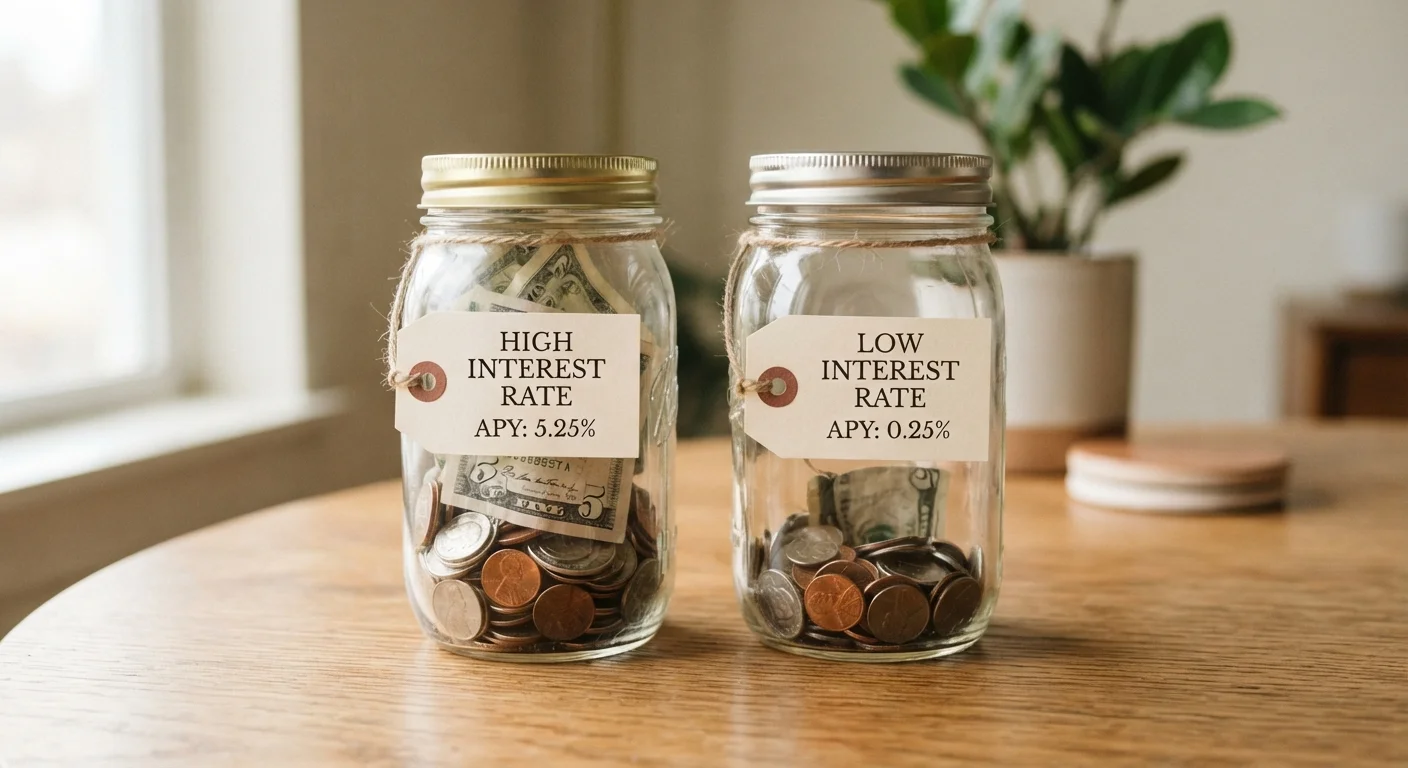
A high-yield savings account (HYSA) works identically in structure — your money sits in a federally insured account and earns interest — but typically at a significantly higher annual percentage yield (APY). These accounts are most commonly offered by online banks or online divisions of larger institutions, which operate with lower overhead and can pass that cost savings on as higher deposit rates.
Both account types are generally insured up to $250,000 per depositor per institution through the FDIC (for banks) or NCUA (for credit unions), making them low-risk options for holding cash you don't want to put at market risk. This is general information — verify your specific account's insurance status with your institution.
| Criterion | High-Yield Savings Account | Traditional Savings Account |
|---|---|---|
| Typical APY | Significantly higher (varies with rates) | Generally much lower |
| Where offered | Primarily online banks | Brick-and-mortar banks & credit unions |
| FDIC/NCUA insured | Yes (verify per institution) | Yes (verify per institution) |
| Transfer speed | 1–3 business days (external) | Often instant (same bank) |
| In-person access | Rarely available | Standard feature |
| Minimum balance | Often low or none | Varies; some require minimums |
| Rate stability | Can change frequently | Changes slowly; typically stays low |
Interest Mechanics: Where the Real Difference Shows Up
The gap in interest rates between the two account types isn't just a headline number — it compounds into a real dollar difference over time. Interest on savings accounts is typically calculated daily and credited monthly, meaning your balance earns interest on previously credited interest (compound interest). The higher the APY, the faster that compounding adds up.
~10x
Potential interest difference on same balance
A balance earning 4.5% APY vs. 0.45% APY generates roughly ten times more interest over one year, illustrating the compounding impact of rate differences.
$250,000
Standard FDIC/NCUA deposit insurance limit
Per depositor, per insured institution — applicable to both high-yield and traditional savings accounts at qualifying banks and credit unions.
1–3 days
Typical external transfer window for online banks
Most online banks require this window to move funds to an external checking account, which can affect access during urgent situations.
For example, $10,000 held at 0.45% APY for one year generates about $45 in interest. The same balance at 4.5% APY generates roughly $450 — ten times as much, with no additional effort or risk. For larger balances or longer time horizons, that gap becomes even more significant.
It's worth noting that savings account rates — particularly for high-yield accounts — can fluctuate with broader Federal Reserve interest rate movements. When the Fed raises rates, HYSA yields tend to rise; when it cuts rates, they tend to fall. Traditional savings account rates also adjust, but often more slowly and less dramatically in both directions.
For practical saving strategies that work regardless of rate environment, see our savings strategies that tend to stick over the long run.
Access, Convenience, and Everyday Usability
Interest rates matter, but so does how easily you can use the account day-to-day. Here's where traditional savings accounts often hold an edge.
With a traditional savings account at your existing bank, transfers between checking and savings are typically instant or near-instant. You can walk into a branch, speak with a teller, or use an ATM. If something goes wrong — a disputed transaction, a locked account — in-person help is available.
High-yield savings accounts, especially those at purely online banks, require more planning around access. Transfers to an external checking account commonly take one to three business days. There are usually no physical branches, and customer service happens by phone, chat, or email. For most routine saving, this isn't a problem — but if you need emergency liquidity immediately, a transfer lag can be frustrating.
Planning Around the Transfer Lag
If you keep a high-yield savings account at an online bank, consider maintaining a small liquidity buffer in your regular checking account. That way, an unexpected expense doesn't require you to wait on a transfer. Some online banks also offer linked checking accounts that can speed up internal transfers — worth checking when you're evaluating providers.
If you're working on building an emergency fund or saving toward multiple goals simultaneously, this access question matters. Our guide to saving for multiple goals at once without losing track explains how to structure accounts so you're not raiding one fund for another.
For savers on a tight budget just getting started, our piece on building a savings habit from a tight budget walks through how to make small, consistent contributions — whichever account type you choose.
This article is for general informational and educational purposes only and does not constitute personalized financial advice. Rates, terms, and insurance details vary by institution. Consult a licensed financial professional for guidance specific to your situation.