

Key Takeaways
Option A
Sinking Fund
The planned-expense savings bucket.
Best for: People who want to avoid budget surprises by setting aside money gradually for known, future costs.
Option B
Emergency Fund
The financial safety net for the unexpected.
Best for: Anyone who wants a cushion against job loss, medical bills, or sudden large expenses they couldn't have predicted.
If you're saving for a predictable future cost like a vacation or annual insurance premium
Sinking Fund
Sinking funds are purpose-built for expenses you can anticipate. Breaking the total into monthly contributions prevents a budget shock when the bill arrives.
If you want protection against job loss, major illness, or an unforeseen financial crisis
Emergency Fund
An emergency fund is your first line of defense against income disruption or sudden large expenses that you had no way to plan for.
If you're just starting out and can only fund one type right now
Emergency Fund
A basic emergency fund — even one month of essential expenses — provides critical protection before you layer in sinking funds for future goals.
If you're past the basics and want to stop putting regular expenses on a credit card
Sinking Fund
Sinking funds directly replace the habit of charging predictable costs to credit and paying interest, making them a powerful debt-reduction tool.
What Each Fund Actually Does
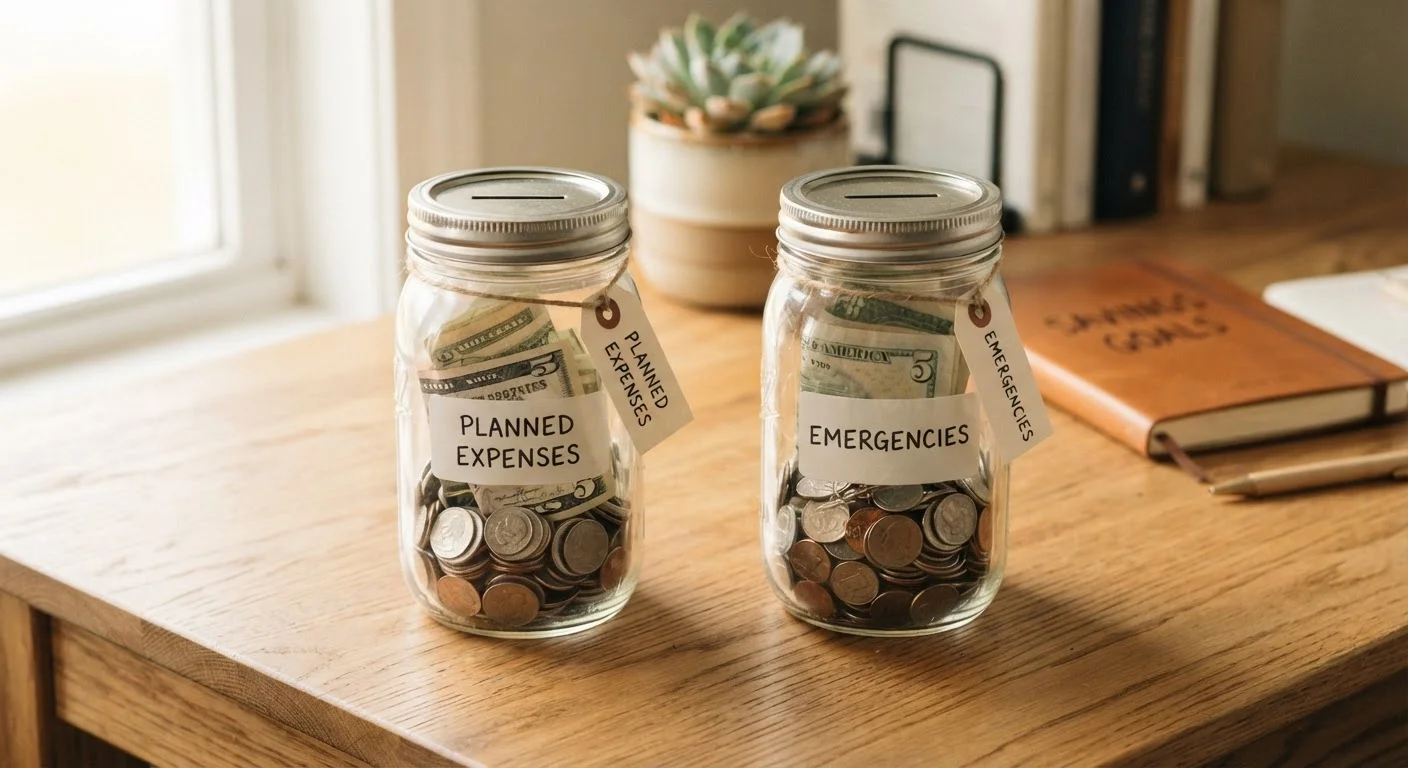
Both sinking funds and emergency funds are savings — but they answer completely different questions. A sinking fund answers: "What costs am I expecting later that I should be setting money aside for now?" An emergency fund answers: "What would I do if something went seriously wrong that I didn't see coming?"
A sinking fund is a dedicated pool of money you build gradually for a specific, anticipated expense. You know the car registration is due every year. You know the kids need school supplies in August. You know the roof has a finite lifespan. A sinking fund lets you spread those costs across many months so no single paycheck takes a hit. Learn more about how they work in our guide to sinking funds.
An emergency fund is fundamentally different: it exists for costs that are unexpected and often large — a layoff, an ER visit, a transmission failure on a car you rely on for work. This money isn't earmarked for anything specific. It just sits there, liquid and accessible, ready to absorb a financial shock without forcing you into debt. Our primer on building an emergency fund walks through how to get started at any income level.
| Criterion | Sinking Fund | Emergency Fund |
|---|---|---|
| Purpose | Planned, anticipated expenses | Unplanned financial crises |
| Predictability | Known in advance | Unknown timing and amount |
| Examples | Car registration, holidays, appliances | Job loss, medical emergency, major repair |
| Funding approach | Fixed monthly contributions toward a target | Ongoing contributions until buffer is reached |
| How often you use it | Regularly, as expenses occur | Rarely — only for genuine emergencies |
| Number of accounts | Often multiple (one per goal) | Typically one dedicated account |
| Priority in a starter budget | After a basic emergency fund is in place | First priority for financial stability |
Why Keeping Them Separate Matters
One of the most common — and costly — budgeting mistakes is treating these two funds as one account. When you do that, you'll likely drain your "emergency" savings for a holiday trip or annual car insurance bill, then find yourself unprepared when a genuine emergency hits.
Conversely, if you label every unexpected cost an "emergency," you'll never build a true safety net. A new set of tires isn't an emergency if your car is aging and you knew tires wear out. That belongs in a sinking fund for vehicle maintenance.
~57%
Americans unable to cover a $1,000 emergency from savings
A Bankrate survey found a majority of U.S. adults would need to borrow or charge an unexpected $1,000 expense — underscoring why a dedicated emergency fund matters.
3–6 months
Commonly cited emergency fund target
Financial educators broadly recommend saving three to six months of essential living expenses in an accessible account, though individual circumstances vary.
Separation also brings psychological clarity. Knowing your emergency fund is untouched gives you real confidence. Knowing your sinking fund for home repairs is growing toward its target gives you a sense of control. Together, they eliminate two of the most common reasons people feel financially anxious: fear of the unknown and dread of the predictable. For a deeper look at the reasoning behind standard emergency fund targets, see why the three-to-six month rule exists.
How to Run Both Funds in a Real Budget
Running both funds doesn't require a large income — it requires intentional allocation. A practical approach:
- Build a starter emergency fund first. A broadly cited starting target is one month of essential expenses. This baseline prevents you from going into debt over a single bad month before your sinking funds are established. Financial educators often suggest eventually growing this to three to six months of expenses, though the right amount varies by household.
- List your known irregular expenses. Think annually: taxes, insurance renewals, holiday spending, school supplies, car registration, subscriptions. Divide each total by 12 (or however many months until the expense) to get a monthly contribution.
- Open separate accounts or sub-accounts. Many online banks allow multiple savings buckets at no cost. Naming each account — "Car Repairs," "Annual Insurance," "Holiday" — makes the purpose concrete and reduces the temptation to raid funds.
- Automate transfers on payday. Treat contributions to both funds like fixed bills. If the money is moved automatically before you see it in checking, it tends to stay put.
The Budgeting Basics hub covers frameworks for structuring this kind of intentional savings system within a broader spending plan.
One Account or Many?
Some people keep all savings in one high-yield account and track buckets through a spreadsheet. Others open multiple sub-accounts. Either method can work — what matters is that your sinking fund money and emergency fund money are mentally (and ideally physically) distinct. Combining them without clear tracking often leads to overspending from whichever balance looks largest.
This article is for general informational purposes only and does not constitute personalized financial advice. For guidance specific to your situation, consider consulting a licensed financial professional.