

Key Takeaways
Compound Interest on Debt
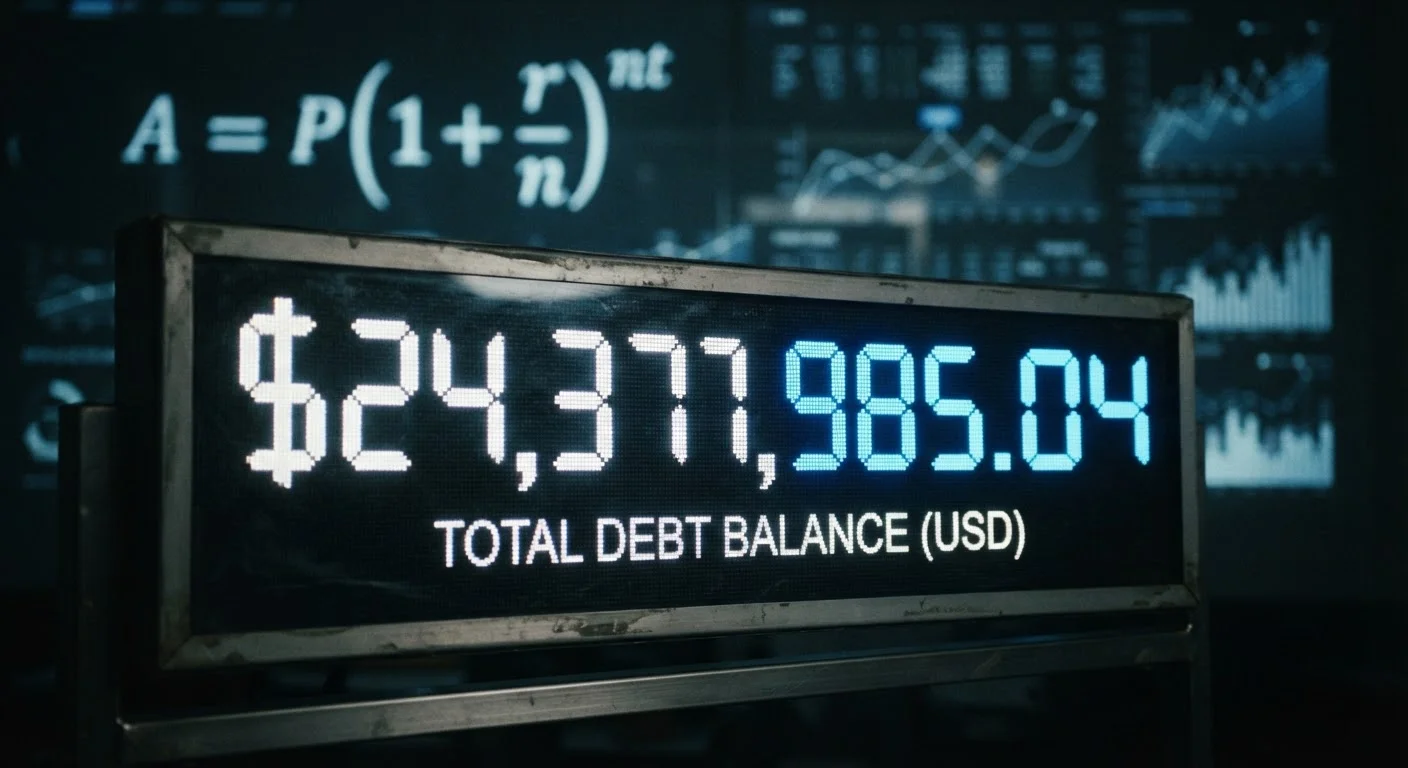
Compound interest means you're charged interest not just on the original amount you borrowed, but also on any unpaid interest that has already accumulated. Over time, this causes your balance to grow faster than a flat interest charge would. The longer you carry an unpaid balance, the more interest builds on top of interest — making the debt increasingly expensive to carry.
Compounding frequency matters: debt compounded daily (common with credit cards) grows faster than debt compounded monthly, even at the same annual percentage rate (APR).
The Mechanics: How Compounding Works Against You
When you borrow money, lenders charge interest on your balance. With compound interest, any unpaid interest gets added to your balance — and then interest is charged on that new, higher total. It's a cycle that feeds itself.
Most credit cards compound interest daily. Lenders divide your annual percentage rate (APR) by 365 to get a daily periodic rate, then apply that rate to your balance every single day. A card with an 22% APR has a daily rate of roughly 0.06%. That sounds tiny, but applied to a $3,000 balance every day for a year — with no payments — the math compounds into hundreds of dollars of extra charges.
The critical distinction: with simple interest, you only ever owe interest on what you originally borrowed. With compound interest, unpaid charges become part of the principal. You end up paying interest on your interest.
22%+
Average credit card APR in the US
The Federal Reserve tracks average credit card interest rates; rates above 20% have become common in recent years, amplifying compounding's effect on carried balances.
~$6,500
Average American credit card balance
According to Federal Reserve and industry survey data, many US households carry thousands of dollars in revolving credit card debt — a balance large enough for compounding to cause significant long-term cost.
10+ years
Time to pay off $5,000 at minimums only
Consumer finance analyses consistently show that paying only the minimum on a high-APR card with a $5,000 balance can take a decade or more, with total interest exceeding the original debt.
Why Minimum Payments Keep You Treading Water
Credit card issuers set minimum payments low — often 1–2% of the outstanding balance or a flat dollar amount, whichever is greater. At first glance this seems manageable. The problem is that on a high-APR card, much of that minimum payment goes directly toward covering accrued interest. Very little reduces the principal.
When principal barely shrinks, the base amount that interest compounds on stays large. That means the next billing cycle starts with a balance nearly as high as the one before — and the compounding clock resets from that elevated starting point. Over months and years, this dynamic is why a modest credit card balance can take a decade or more to pay off through minimums alone.
Pay Before Your Statement Closes
Credit card interest is typically calculated using your average daily balance — not just your end-of-month balance. Making an extra payment mid-cycle, before the billing period closes, lowers that average and reduces the interest charged for that month. Even a partial payment earlier in the month has a measurable effect over time.
Timing Matters More Than Most People Realize
One underappreciated truth about compound interest: when you pay matters, not just how much you pay. An extra $100 applied to your balance today eliminates $100 worth of principal that would have compounded interest charges against you for the remainder of the loan. The earlier in a debt's life that reduction happens, the more compounding cycles it short-circuits.
Consider two borrowers with identical $5,000 balances at 20% APR. One pays $50 extra per month starting immediately; the other waits a year before doing the same. The first borrower pays meaningfully less total interest — not because of the amount, but because of when those extra dollars entered the equation.
This is why financial educators consistently emphasize front-loading extra payments when possible. For a deeper look at structured repayment strategies that leverage this principle, see the debt avalanche and debt snowball methods.
Practical Steps to Limit Compounding's Damage
Understanding the mechanics translates into a few concrete habits that can meaningfully reduce how much interest you pay over time:
- Pay more than the minimum whenever possible. Even an extra $25–$50 per month reduces the compounding base and shortens payoff timelines.
- Make mid-cycle payments. Because credit cards compound daily, paying before your statement closes reduces the average daily balance — the figure interest is actually calculated on.
- Prioritize high-APR balances first. Compound interest is most damaging where rates are highest; reducing those balances quickly limits snowball growth.
- Understand your loan type. Verify whether your debt uses compound or simple interest — it changes the math significantly.
Some borrowers also explore consolidating high-rate debt into a lower-rate product. That approach has genuine trade-offs worth understanding before acting — see a clear-eyed look at debt consolidation for an honest assessment. And if you're juggling debt repayment alongside saving goals, managing savings and debt at the same time offers a framework for weighing both priorities.
Finally, be aware that certain habits quietly extend your timeline without you noticing — debt repayment pitfalls that extend the timeline breaks down the most common missteps.
This article provides general financial information for educational purposes and is not personalized financial advice. Consult a licensed financial professional for guidance specific to your circumstances.