

Key Takeaways
Built Environment and Family Health
Your built environment refers to the human-made spaces your family moves through every day — streets, sidewalks, parks, playgrounds, and how close you are to schools, shops, and services. Research in public health shows that these surroundings shape how much families move, how safe or stressed they feel, and how connected they are to their neighbors. While individual habits matter greatly, the physical spaces around us act as a quiet but powerful backdrop to everyday well-being.
Built environment research draws from urban planning, epidemiology, and environmental health. Key measures include park proximity, street connectivity, land-use mix, and neighborhood walkability — all linked to population-level health outcomes.
What the Built Environment Means for Your Family
"Built environment" might sound like planning jargon, but it describes something every family navigates daily: the streets, sidewalks, parks, playgrounds, and buildings that make up your neighborhood. Public health researchers have spent decades studying how these physical features — from sidewalk quality to the distance to the nearest green space — shape health behaviors in subtle but significant ways.
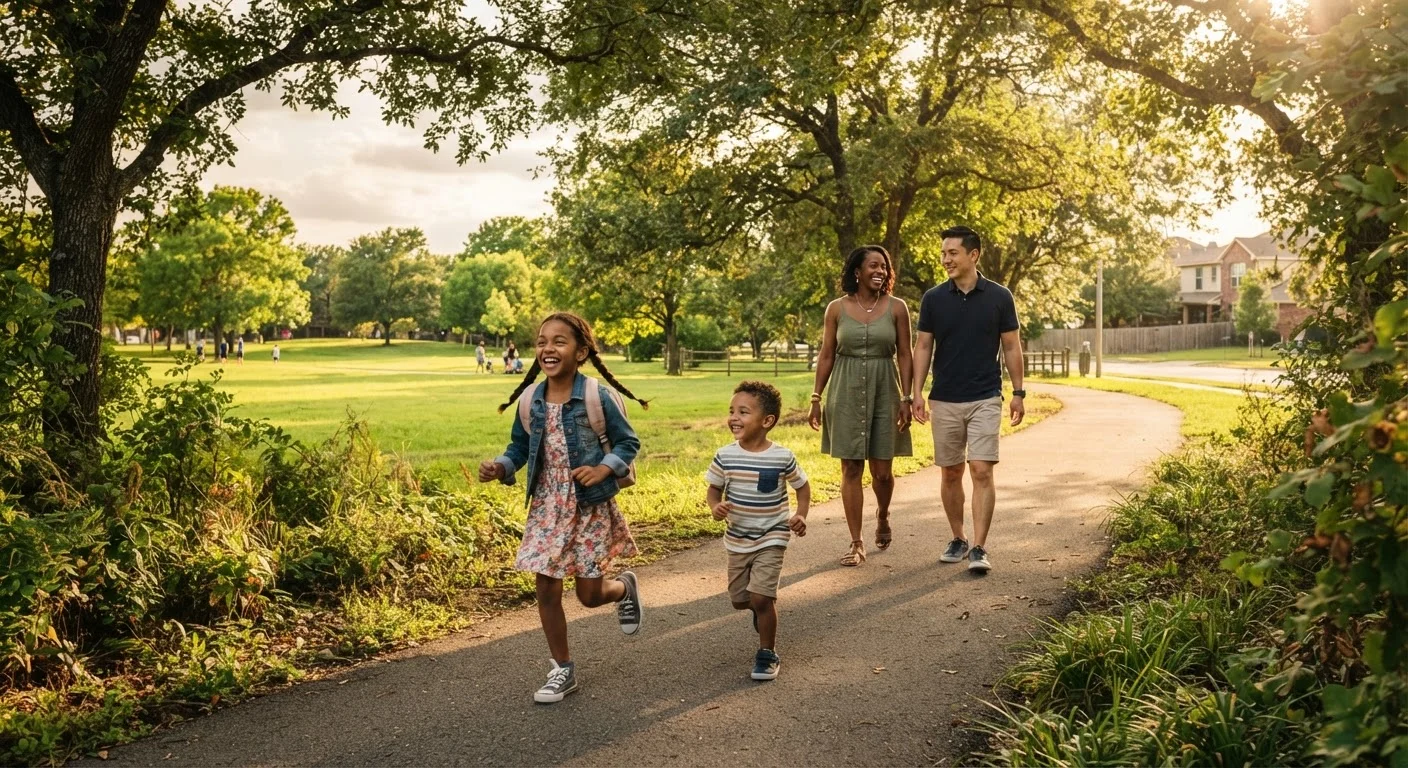
A child who can safely walk to school builds movement into her morning before anyone has thought about "exercise." A family with a park two blocks away is more likely to spend evenings outdoors together. These are not coincidences; they reflect how environment quietly shapes habit. For more on how everyday structure supports family health, see how family routines support well-being.
Green Space, Movement, and Mood
Across many studies, access to parks, trails, and natural areas is consistently associated with higher physical activity levels for both children and adults. Researchers also find that time spent in natural settings is linked to lower self-reported stress and improved mood — though these effects vary by individual, setting, and how much time is actually spent outdoors. No single study settles the question, but the overall body of evidence points in a consistent direction.
For children especially, unstructured outdoor play in natural settings may support attention and emotional regulation alongside physical development — a topic explored further in how to balance structured activities with free play.
~100 million
Americans without easy nearby park access
Research on urban green space access consistently finds that tens of millions of Americans live more than a 10-minute walk from any public park or recreational green space.
20 minutes
Outdoor time linked to lower stress in studies
Research published in environmental health journals suggests spending as little as 20 minutes in a natural setting may be associated with measurable reductions in stress markers, though individual results vary.
~2x more likely
Adults near parks to meet activity guidelines
Some public health studies have found adults living close to parks or trails are roughly twice as likely to meet weekly physical activity recommendations, though the effect varies by community context.
Neighborhood Safety and Mental Well-Being
Perceived and actual neighborhood safety shapes how families use outdoor space. When parents feel it is unsafe for children to play outside, or when poor lighting and heavy traffic discourage evening walks, families spend less time outdoors — reducing both physical activity and the kind of casual neighbor interaction that strengthens community bonds.
Research in social epidemiology suggests that neighborhoods with stronger social cohesion — where residents know and look out for one another — tend to show better health outcomes, even when accounting for income. Isolation compounds these effects considerably. What researchers know about social connection and mental health offers a deeper look at why community ties matter so much for everyday well-being.
Walkability and the Social Side of Health
Walkability describes how easily residents can reach daily destinations — schools, grocery stores, parks — on foot. Neighborhoods with connected sidewalks, safe crosswalks, and a mix of residential and commercial uses naturally build movement into everyday life without requiring extra motivation or planning.
These everyday trips also create brief social encounters — a chat with a neighbor, a shared school drop-off — that accumulate into what researchers call "social capital": the informal trust and connection that holds communities together. Families in walkable environments often find that health-supporting habits form more easily because the neighborhood does some of the heavy lifting. This connects closely to building sustainable health habits into the family calendar.
Working With What You Have
Not every family lives near a park or in a walkable neighborhood — and that is a real disparity, not a personal shortcoming. But environment is not a fixed destiny. Families can seek out regional parks, school playgrounds open on weekends, and community recreation centers to expand access to green and active spaces, even when they require a short drive.
Local advocacy — attending neighborhood planning meetings, supporting park and sidewalk funding initiatives — can gradually shift the built environment over time. Within the home, building routines that prioritize outdoor time and movement remains powerful regardless of surroundings. See family well-being across every life stage for a broader look at how environment fits into overall family health.
This article is for general informational purposes only and is not a substitute for medical, public health, or professional guidance tailored to your family's specific circumstances. Consult a qualified professional for advice relevant to your health and situation.