

Key Takeaways
Hotel Cancellation Policy
A hotel cancellation policy is a set of rules that determines what happens — financially and logistically — if you cancel, modify, or fail to show up for a reservation. It specifies deadlines for penalty-free cancellation, how much you'll be charged if you miss those deadlines, and whether any portion of your payment is refundable. These rules vary by hotel, rate type, and booking platform.
Cancellation policies are legally binding contract terms accepted at the time of booking. The rate type selected (e.g., flexible vs. non-refundable) typically determines which policy applies, even if multiple rate options were available.
The Three Core Policy Types and What Each Means
Most hotel reservations fall into one of three cancellation policy categories, and knowing the difference before you book can prevent a frustrating — and costly — surprise later.
Non-refundable: You pay in full at booking, and the charge stands regardless of whether you cancel, modify, or no-show. These rates are often priced lower than flexible options, but that discount comes with real financial risk if anything disrupts your travel.
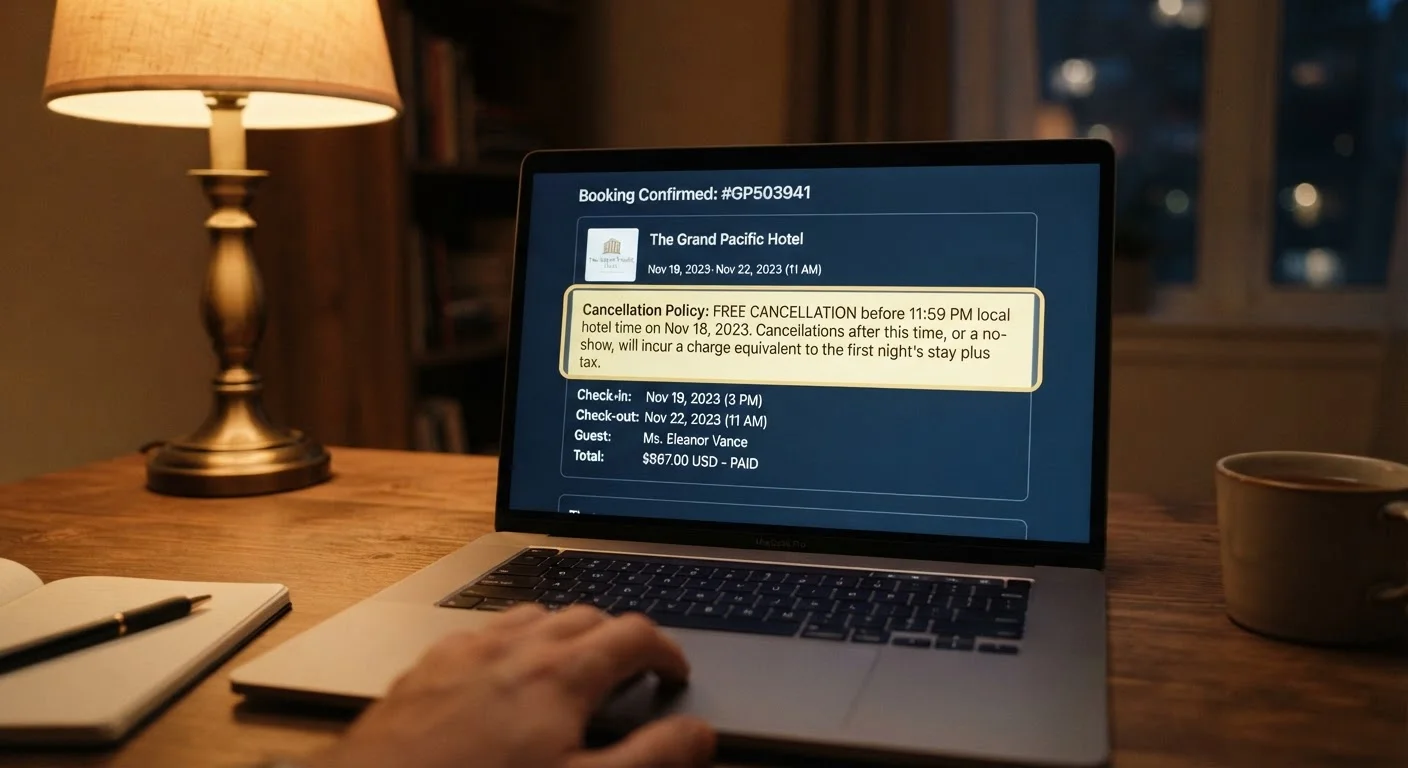
Flexible (or free cancellation): You can cancel without penalty before a set deadline — commonly anywhere from 24 hours to one week before check-in, depending on the property and season. After that window, a fee kicks in, typically one night's room rate.
Partial refund or tiered cancellation: The refund you receive depends on how far in advance you cancel. Cancel 30 or more days out and you might get 90% back; cancel within a week and you might receive only 50% — or nothing. These policies are common at resorts, boutique properties, and peak-season bookings.
For a broader look at how fine print shapes your options, see our guide to reading hotel listings without surprises.
24–72 hrs
Typical free-cancellation window before check-in
Most flexible hotel rates allow penalty-free cancellation within this range, though resort and peak-season bookings often require longer notice.
1 night
Common penalty for late cancellation
Many hotel policies charge the equivalent of one night's room rate when guests cancel after the deadline or fail to show up.
100%
Charge retained on non-refundable rates
Non-refundable bookings typically forfeit the entire payment regardless of when the cancellation occurs relative to the stay.
What the Policy Doesn't Automatically Cover
A common misconception is that a cancellation policy governs every possible disruption — it doesn't. Most standard policies do not account for flight cancellations, medical emergencies, severe weather, or personal circumstances unless the hotel explicitly states otherwise.
Similarly, booking modifications — like changing your check-in date or reducing your number of nights — are often treated as partial cancellations and can trigger fees depending on the rate type. Some properties also distinguish between room type changes and date changes, applying different rules to each.
No-show clauses deserve particular attention. If you simply don't arrive without contacting the hotel, many properties automatically charge the full reservation cost, even if the original cancellation policy offered a grace period. A quick phone call to the property can sometimes salvage a partial refund.
Call the Hotel Directly When Plans Change
If you're outside the cancellation window but facing a genuine emergency, calling the property directly — rather than going through a third-party platform — gives you the best shot at a goodwill exception. Front desk managers often have discretion that automated systems don't. Be polite, explain the situation clearly, and ask what options are available.
If you're weighing how cancellation risk factors into room-type decisions, our piece on all-inclusive vs. room-only trade-offs covers how policy structures differ across stay formats.
How to Protect Yourself Before and After Booking
The best time to understand the cancellation policy is before you click confirm — not when plans unravel. Here's what to focus on:
- Read the rate-specific terms: The hotel's general policy page and your specific rate's cancellation clause are not always the same thing. Always expand the booking details for the exact rate you're selecting.
- Note the deadline timezone: A cutoff listed as "11:59 PM" may refer to the hotel's local time, not yours. An international booking made from the East Coast may give you less buffer than it appears.
- Screenshot or save your confirmation: In the event of a dispute, having the exact terms shown at checkout is far more useful than a vague recollection.
- Consider travel insurance for high-stakes trips: Policies vary enormously in what cancellation scenarios they cover. Our article on cruise travel insurance coverage explains how to evaluate what a policy actually protects — principles that apply to hotel bookings as well.
Before your stay, confirm your reservation details directly with the property. Our pre-arrival confirmation checklist walks through exactly what to verify so nothing slips through the cracks.
Third-Party Bookings Add a Layer of Complexity
When you book through an online travel agency (OTA) rather than directly with the hotel, the OTA's own cancellation and refund process may sit between you and the property. This can affect how quickly refunds are processed and whether hotel-granted exceptions are honored. If flexibility matters to you, booking directly through the hotel's website often streamlines the cancellation process.