

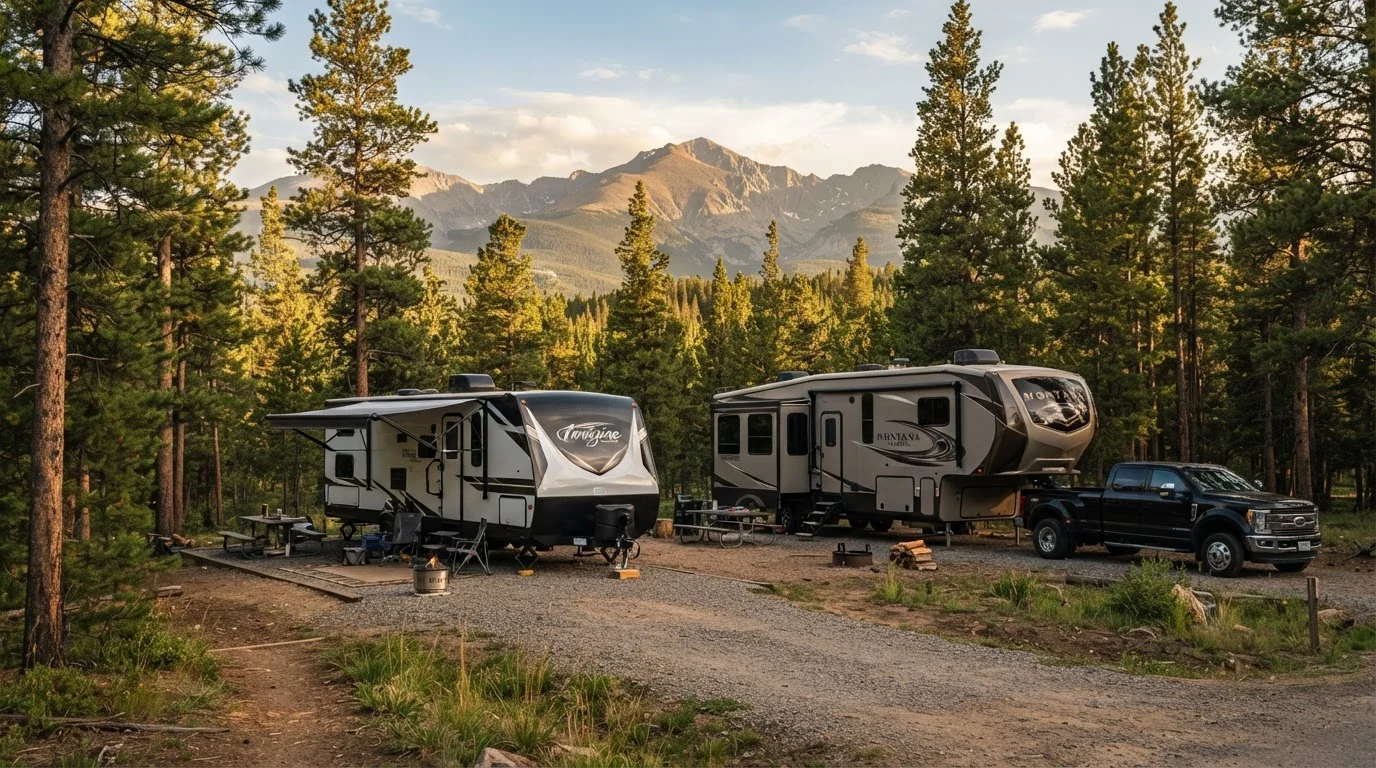
Key Takeaways
Option A
Travel Trailer
The flexible, widely accessible towable RV.
Best for: Campers who want a versatile rig they can tow with a variety of pickup trucks, SUVs, or even some larger crossovers.
Option B
Fifth Wheel
The spacious, stable choice for serious road travelers.
Best for: Full-timers and frequent long-haul campers who prioritize interior space, stability, and are already driving a capable full-size pickup truck.
If you want to tow with an SUV or half-ton truck
Travel Trailer
Travel trailers are compatible with a much broader range of tow vehicles, including many SUVs and half-ton pickups, giving you more flexibility without a dedicated truck upgrade.
If you plan to live in your RV full-time or take extended trips
Fifth Wheel
Fifth wheels offer more usable square footage, residential-style layouts, and better highway stability - all meaningful advantages for long-haul or full-time living.
If you're a first-time RV buyer on a tighter budget
Travel Trailer
Entry-level travel trailers carry lower purchase prices and don't require a specialized hitch system, reducing both upfront and setup costs.
If highway towing stability is a top priority
Fifth Wheel
The kingpin-and-hitch coupling transfers more weight over the truck's rear axle, making sway and fishtailing far less likely than with a ball-hitch trailer.
If you need to use your truck bed for hauling gear or equipment
Travel Trailer
Fifth wheel hitches occupy a significant portion of your truck bed permanently, while travel trailers free the bed entirely for other cargo.
How the Hitch Defines Everything
The single most important structural difference between a travel trailer and a fifth wheel is how each connects to its tow vehicle. A travel trailer couples to a standard ball-mount receiver hitch - the same hitch type used for boat trailers and utility trailers. This universality is one of the travel trailer's biggest practical advantages: almost any capable vehicle can be configured to tow one.
A fifth wheel, by contrast, uses a kingpin that locks into a specialized plate hitch mounted in the bed of a pickup truck. This design is borrowed directly from the commercial trucking industry. The coupling point sits over the rear axle of the truck, which distributes hitch weight more effectively and keeps the rig far more stable at highway speeds. The trade-off is that a fifth wheel is categorically incompatible with SUVs and demands a full-size or heavy-duty pickup.
Before purchasing either rig, verify your tow vehicle's Gross Vehicle Weight Rating (GVWR), payload capacity, and tow rating - not just the headline towing number. Our guide on RV towing capacity explains why getting these numbers wrong carries real safety consequences.
| Criterion | Travel Trailer | Fifth Wheel |
|---|---|---|
| Hitch type | Standard ball-mount receiver | Kingpin plate in truck bed |
| Compatible tow vehicles | SUVs, half-ton, and heavy-duty trucks | Full-size and heavy-duty pickups only |
| Highway stability | Good with sway control added | Excellent; over-axle coupling reduces sway |
| Floor plan variety | Single-level; wide size range | Bi-level; larger footprint typical |
| Truck bed use | Bed fully available | Hitch occupies significant bed space |
| Typical entry price | Lower; entry models under $20,000 | Higher; typically starts above $30,000 |
| Best suited for | Weekend campers, first-time buyers | Full-timers, extended travelers |
Space, Layout, and Livability
Fifth wheels have a structural upper hand when it comes to living space. The raised bi-level front section - which overhangs the truck bed - is typically used for the master bedroom, creating a degree of separation between sleeping and living areas that most travel trailers can't match. Vaulted ceilings, slide-outs, and residential-scale kitchens are more common at a given price point in the fifth wheel category.
Travel trailers range enormously in size, from compact teardrop units under 15 feet to full-size models exceeding 35 feet. Many mid-size travel trailers include slide-outs and comfortable amenities, but floor plans tend to be single-level, which limits layout creativity in shorter units. For weekend campers and couples, this is rarely a concern. For families or full-timers, the fifth wheel's extra vertical dimension can feel meaningfully different in daily use.
Anyone seriously weighing the RV lifestyle - whether full-timing or seasonal camping - should read our honest look at the rewards and trade-offs before committing to a rig type.
11.2M
RV-owning households in the U.S.
According to the RV Industry Association, approximately 11.2 million U.S. households owned an RV as of recent years, with towable units representing the majority of that total.
~72%
Share of RV shipments that are towables
The RV Industry Association consistently reports that towable RVs - including travel trailers and fifth wheels - account for roughly 70-75% of annual industry shipments.
35 ft+
Maximum length common in fifth wheels
Many fifth wheel models reach 35 to 40 feet in total length, rivaling entry-level Class A motorhomes in floor plan size and amenities.
Cost, Maneuverability, and Practical Ownership
Travel trailers generally carry lower sticker prices than comparable fifth wheels, and the absence of a specialized hitch system reduces setup costs. Entry-level travel trailers can be found well under $20,000, while fifth wheels typically start higher and scale up quickly with amenities. That said, prices vary widely within both categories, so comparing specific floor plans on an equivalent feature basis is more useful than relying on category averages.
On the road, travel trailers require more attention to sway management, particularly in crosswinds or when passed by large trucks. Weight-distribution hitches and sway-control devices help, but they add cost and setup time. Fifth wheels track more predictably due to their over-axle coupling, which many drivers find less stressful on long highway runs.
Backing and maneuvering a fifth wheel in tight campground spaces can feel more intuitive for some drivers because the pivot point is closer to the center of the truck. Travel trailers pivot at the rear bumper, which amplifies turning radius challenges. Neither is inherently easier - both require practice - but the geometry differs in ways that affect campsite selection.
First-time buyers should also be aware of common misconceptions before signing. Our piece on RV myths that trip up first-time buyers covers assumptions about towing, costs, and depreciation that frequently surprise new owners. If you're also exploring motorized options, Class A, B, and C motorhomes explains a completely different segment of the RV market worth understanding for context.