

Key Takeaways
Why AWD Myths Persist
All-wheel drive has become one of the most heavily marketed features on passenger vehicles, and that visibility has created a cloud of misunderstanding around what the technology actually does. Consumers are regularly sold on AWD as a blanket solution for bad weather, rough terrain, and uncertain road conditions — but the engineering tells a more nuanced story.
Understanding the real capabilities and real limits of AWD matters for safety. Drivers who overestimate the system's abilities tend to take risks in conditions where restraint is warranted. The myths below represent the most consequential misunderstandings, corrected with what the engineering and data actually support.
If you're working through a broader vehicle-type decision, matching a vehicle to your actual driving life is a useful starting point before zeroing in on drivetrain.
Myth
AWD lets you drive normally in snow and ice — the system handles it.
Fact
AWD improves traction during acceleration, but it has no effect on braking distance or cornering grip on ice.
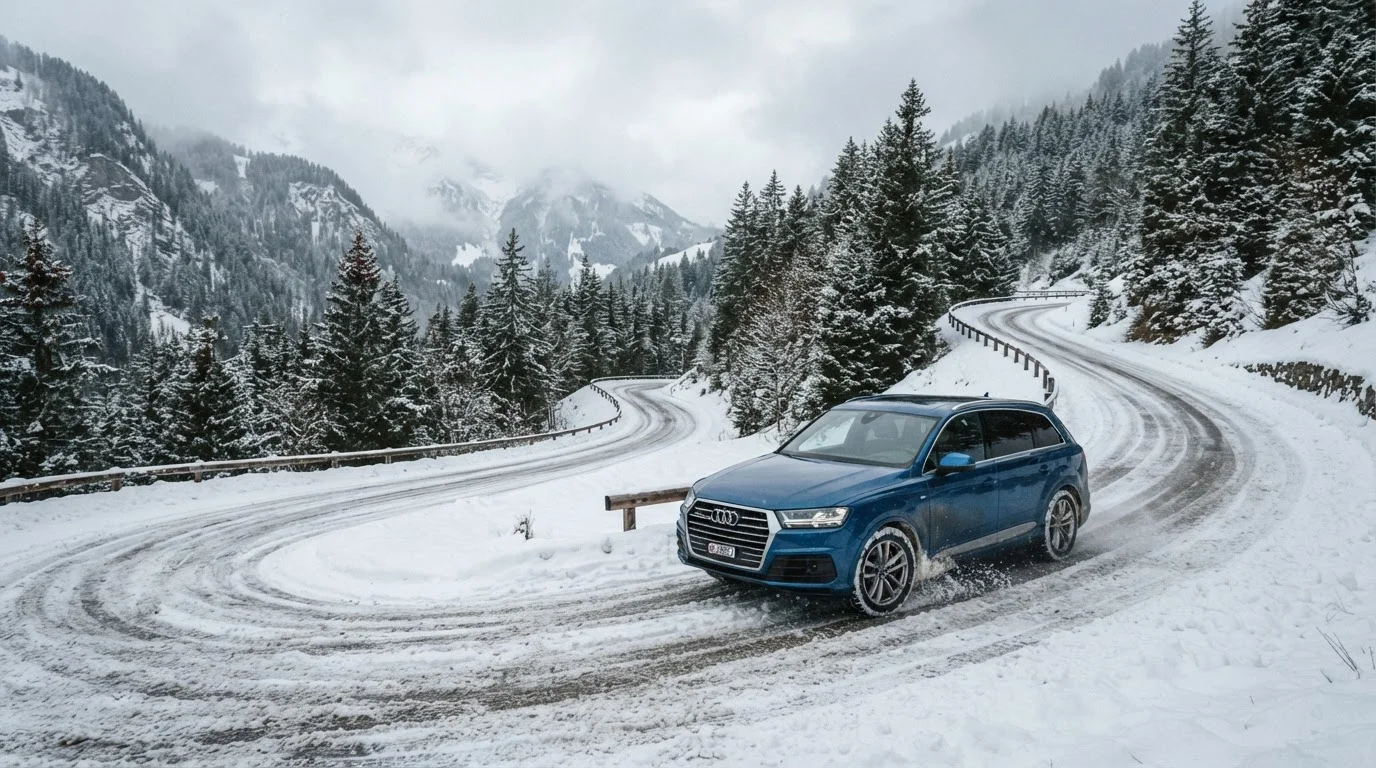
This is the most dangerous AWD myth because it directly affects driving behavior. Studies and crash data consistently show that AWD-equipped vehicles are overrepresented in certain winter accidents because their drivers maintain higher speeds and follow distances appropriate for dry roads. The system cannot overcome the physics of a vehicle sliding on ice — once you're braking or in an uncontrolled skid, AWD provides no advantage. Tire compound and tread pattern are far more influential on ice and packed snow than drivetrain configuration.
Myth
AWD and 4WD are basically the same thing.
Fact
AWD and four-wheel drive are distinct systems designed for different purposes and operating conditions.
Traditional 4WD systems — common on trucks and body-on-frame SUVs — typically lock front and rear axles together and are designed for low-speed, high-torque situations like rock crawling or deep mud. They are generally not intended for continuous use on dry pavement. AWD systems, by contrast, are designed for continuous on-road use, automatically varying torque distribution in response to traction conditions. Some modern systems blur the line, but the two terms are not interchangeable. Treating a part-time 4WD truck as equivalent to an AWD crossover can lead to both mechanical damage and unsafe operation.
Myth
Winter tires are unnecessary if you have AWD.
Fact
Winter tires on a two-wheel-drive vehicle routinely outperform AWD vehicles fitted with all-season tires in snow and ice.
Tire compound is the single most important variable in cold-weather traction. Winter tires use a softer rubber formulation that stays pliable below 45°F, along with tread patterns specifically designed to bite into snow and channel slush. All-season tires sacrifice peak cold-weather performance for year-round versatility. Independent testing has repeatedly demonstrated that a front-wheel-drive car on dedicated winter tires achieves shorter braking distances and better directional stability in snow than an AWD vehicle on all-season tires. AWD and winter tires together offer the best outcome — but if forced to choose one, tire selection has the larger safety impact.
Myth
AWD makes a vehicle capable off-road.
Fact
AWD improves grip on loose surfaces but does not provide the ground clearance, approach angles, or hardware needed for genuine off-road use.
A crossover SUV with AWD is not an off-road vehicle. True off-road capability depends on a combination of factors: ground clearance (the space between the lowest vehicle component and the ground), approach and departure angles, suspension travel, skid plates to protect the undercarriage, and often a low-range transfer case for steep climbs. Most AWD crossovers have none of these. They can handle unpaved dirt roads or light trails with confidence, but attempting technical terrain — rocky descents, deep ruts, significant water crossings — risks vehicle damage and getting stuck. The AWD badge is not a proxy for off-road equipment.
Myth
AWD has no downsides compared to front- or rear-wheel drive.
Fact
AWD systems add weight, increase fuel consumption, cost more to purchase, and can require additional maintenance.
The mechanical components required to drive all four wheels — additional driveshafts, a center differential or transfer case, electronic control units — add weight and complexity. That added weight works against fuel efficiency. AWD vehicles typically consume more fuel than comparable two-wheel-drive models, and that gap widens in city driving. Initial purchase price is higher, and if components fail outside warranty, repairs can be costly. For drivers in mild climates who rarely encounter snow or unpaved roads, the practical benefit of AWD may be outweighed by its ongoing costs. This is a genuine trade-off, not a flaw — but it should factor into the purchase decision.
What AWD Genuinely Contributes — and Where It Stops
AWD's legitimate advantage is in power delivery. By distributing engine torque across multiple wheels, the system reduces wheelspin during acceleration — particularly useful when pulling away from a stop on wet pavement, light snow, or loose gravel. Modern electronically controlled AWD systems can shift torque between axles or individual wheels within milliseconds, which meaningfully improves stability during cornering as well.
But AWD does nothing to improve braking. Once a vehicle is in motion, stopping depends entirely on tire-to-road friction and the anti-lock braking system (ABS) — both of which are the same whether the vehicle is AWD or front-wheel drive. This is the critical boundary that marketing rarely emphasizes.
~25–40%
Braking distance increase on snow vs. dry pavement
Vehicle dynamics research consistently shows stopping distances increase dramatically on packed snow regardless of drivetrain configuration.
1–3 MPG
Typical AWD fuel economy penalty vs. 2WD
The U.S. Department of Energy notes AWD vehicles generally consume more fuel than equivalent two-wheel-drive models due to added mechanical load and weight.
AWD systems also add weight, mechanical complexity, and fuel consumption. They are part of what's broadly called the powertrain — understanding exactly what the powertrain covers matters when reading warranties or evaluating service costs. More components mean more potential maintenance, and not all AWD systems are created equal in durability or capability.
For most everyday drivers — commuters, suburban families, light travelers — AWD is a convenience feature that provides a modest but real improvement in wet-weather acceleration. It becomes genuinely valuable in specific contexts: long unplowed driveways, mountain passes, or regions with frequent heavy snowfall. Outside those scenarios, the technology is often purchased more for peace of mind than practical necessity.
This article is for general informational purposes only. Always consult a qualified automotive professional regarding vehicle systems, maintenance, and driving safety decisions specific to your situation.