

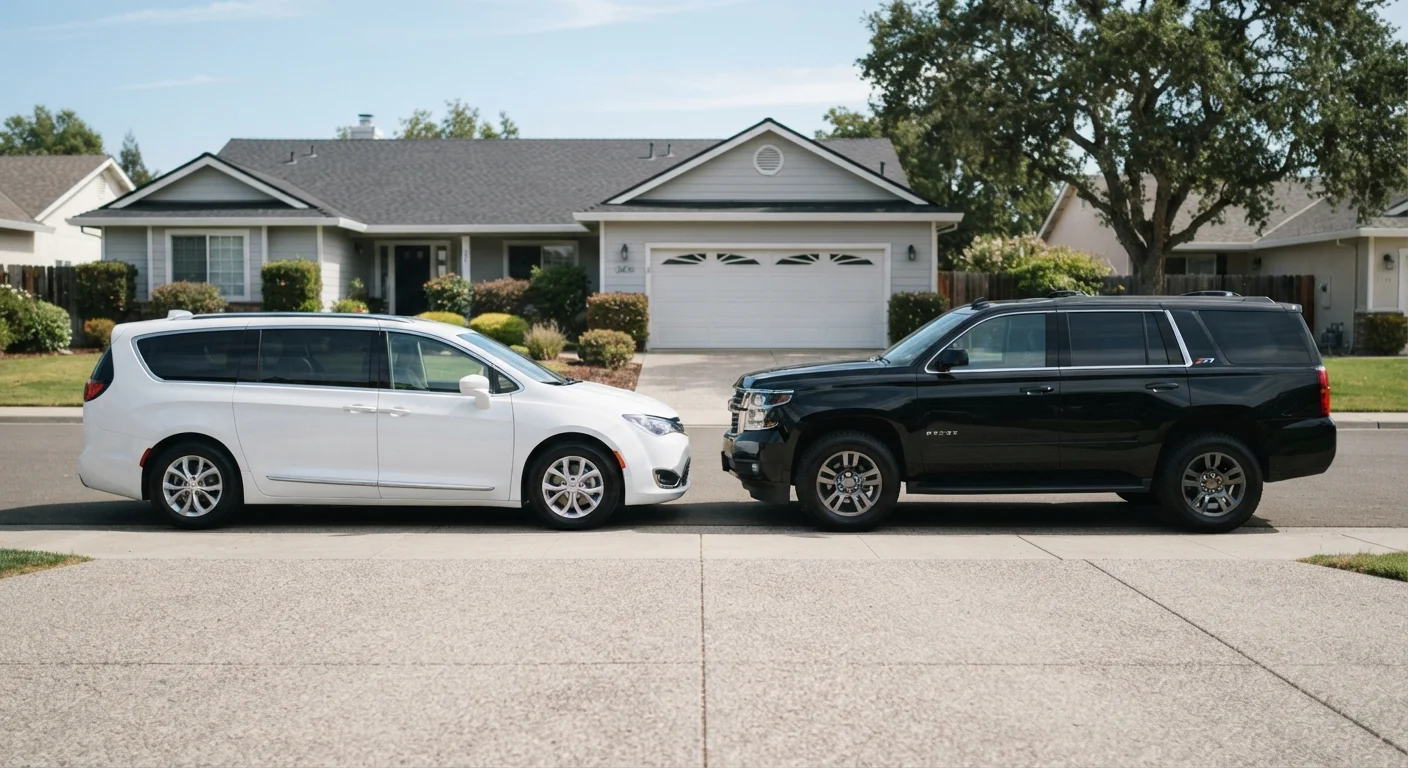
Key Takeaways
Option A
Minivan
The purpose-built family hauler.
Best for: Families who prioritize maximum interior space, easy passenger access, and day-to-day practicality over style or towing.
Option B
Three-Row SUV
The versatile, lifestyle-forward people mover.
Best for: Families who want a vehicle that handles road trips, light towing, or optional all-wheel drive without giving up seven-plus passenger seating.
If you frequently haul a full load of kids, gear, and groceries
Minivan
Sliding doors, a flat floor, and class-leading cargo volume behind the third row make daily loading and unloading far less stressful.
If you regularly tow a boat, trailer, or camper
Three-Row SUV
Body-on-frame three-row SUVs and many crossover-based models offer substantially higher tow ratings than any current minivan on the market.
If you drive in snow, off-road terrain, or need all-wheel drive
Three-Row SUV
All-wheel drive and four-wheel drive are widely available on three-row SUVs, while minivan AWD options remain limited in the segment.
If keeping long-term ownership costs low matters most
Minivan
Minivans tend to have lower base prices, better fuel efficiency, and lower insurance costs compared to similarly sized three-row SUVs.
If versatility for road trips, camping, and lifestyle use is the priority
Three-Row SUV
Three-row SUVs offer more configuration flexibility, roof rack compatibility, and the capability to handle a wider range of driving environments.
The Core Difference: Purpose vs. Versatility
Minivans and three-row SUVs occupy the same market niche — moving a large family — but they reach that goal by entirely different design philosophies. A minivan is engineered from the ground up to maximize interior space, convenience, and passenger comfort within a modest exterior footprint. A three-row SUV, whether it rides on a car-based unibody platform or a traditional truck frame, prioritizes a broader capability envelope at the cost of some interior efficiency.
For a fuller overview of how these body styles fit within the broader automotive landscape, see our guide to vehicle categories. Understanding those distinctions helps clarify why two vehicles that seat seven can feel so different in daily use.
| Criterion | Minivan | Three-Row SUV |
|---|---|---|
| Seating capacity | 7–8 passengers typical | 7–9 passengers typical |
| Third-row adult usability | Generally good | Varies widely; often limited |
| Rear door type | Sliding (power standard) | Conventional hinged |
| Cargo behind third row | Typically 30–35 cu ft | Typically 15–25 cu ft |
| Typical tow rating | ~3,500 lbs | 3,500–8,500+ lbs |
| AWD/4WD availability | Limited in current market | Widely available |
| Fuel economy | Generally better | Generally lower |
| Base price (segment) | Generally lower | Generally higher |
Interior Space and Passenger Access
This is where the minivan's advantage is clearest. Sliding rear doors eliminate the need to swing a wide door into adjacent cars in a parking lot — a genuine, daily-life benefit. The flat floor between the second and third rows allows passengers to step through easily and lets rear-seat configurations (captain's chairs or bench) sit lower, improving headroom. Third-row legroom in a well-designed minivan is genuinely adult-usable, something that cannot be said for many three-row SUVs where the rearmost seat is better suited to children.
Three-row SUVs vary considerably by platform. Larger, truck-based models can rival the minivan in raw volume, but their raised floor, narrower body, and conventional hinged doors make the third row harder to reach and the second row harder to reconfigure. Crossover-based three-row SUVs are often even more constrained — trading cargo space behind the third row for a sleeker exterior profile. If third-row usability for adults is a genuine requirement, the minivan has a structural advantage that no amount of premium trim can fully overcome in a competitor.
~33 cu ft
Typical minivan cargo space behind third row
EPA cargo volume figures show most current minivans offer substantially more behind-third-row space than competing three-row crossover SUVs.
3,500 lbs
Common minivan maximum tow rating
This figure is typical for current production minivans, while similarly priced three-row SUVs often exceed 5,000 lbs of rated tow capacity.
24–28 MPG
Typical combined fuel economy range for minivans
EPA estimates for current minivans in combined driving generally outperform three-row SUVs of comparable passenger capacity.
Capability: Towing, AWD, and Off-Road Use
Here the three-row SUV reclaims ground. Most minivans offer modest tow ratings — typically in the 3,500-pound range — sufficient for a small trailer or pop-up camper but not a full-size boat or travel trailer. Three-row SUVs, particularly body-on-frame models, can tow substantially more, with some rated above 8,000 pounds. That gap is structural; it reflects fundamental differences in platform design rather than a feature that can be added as an option.
All-wheel drive tells a similar story. While some minivans have offered AWD systems historically, availability in the current market has narrowed considerably. Three-row SUVs offer AWD or 4WD across a wide range of configurations, making them the practical choice for families in snowy regions or those who occasionally venture onto unpaved roads. For families weighing this against other utility-vehicle formats, understanding the difference between SUVs and crossovers can help clarify what capability trade-offs each platform actually involves.
Ownership Costs and Practicality
Minivans typically carry lower base prices than comparable three-row SUVs and generally return better fuel economy — largely because they move a similar passenger count in a lighter, more aerodynamically efficient package. Insurance costs, while they vary by region, driver history, and provider, tend to track with vehicle value and repair costs, both of which tend to favor the minivan.
The practical features that make a minivan a minivan — power sliding doors, fold-flat second and third rows, built-in vacuum systems on some models, and abundant cubbies — are difficult to replicate in an SUV format without compromises. Families doing school runs, sports equipment hauling, and road trips often find these details compound over time into a meaningful quality-of-life difference. For families exploring other large-vehicle formats, passenger and cargo van configurations are worth understanding as an alternative. And if you're thinking through your specific driving patterns more broadly, matching a vehicle type to how you actually use it offers a useful practical framework.
Stigma vs. Substance: The Perception Gap
Surveys consistently show that many families resist minivans primarily for image reasons rather than practical shortcomings. Automotive researchers have noted for years that the minivan outperforms the three-row SUV on most objective family-utility metrics, yet SUV sales dominate. It's worth separating the vehicle's reputation from what it actually does — and deciding based on how your family lives, not how the vehicle looks from the curb.