

Key Takeaways
Option A
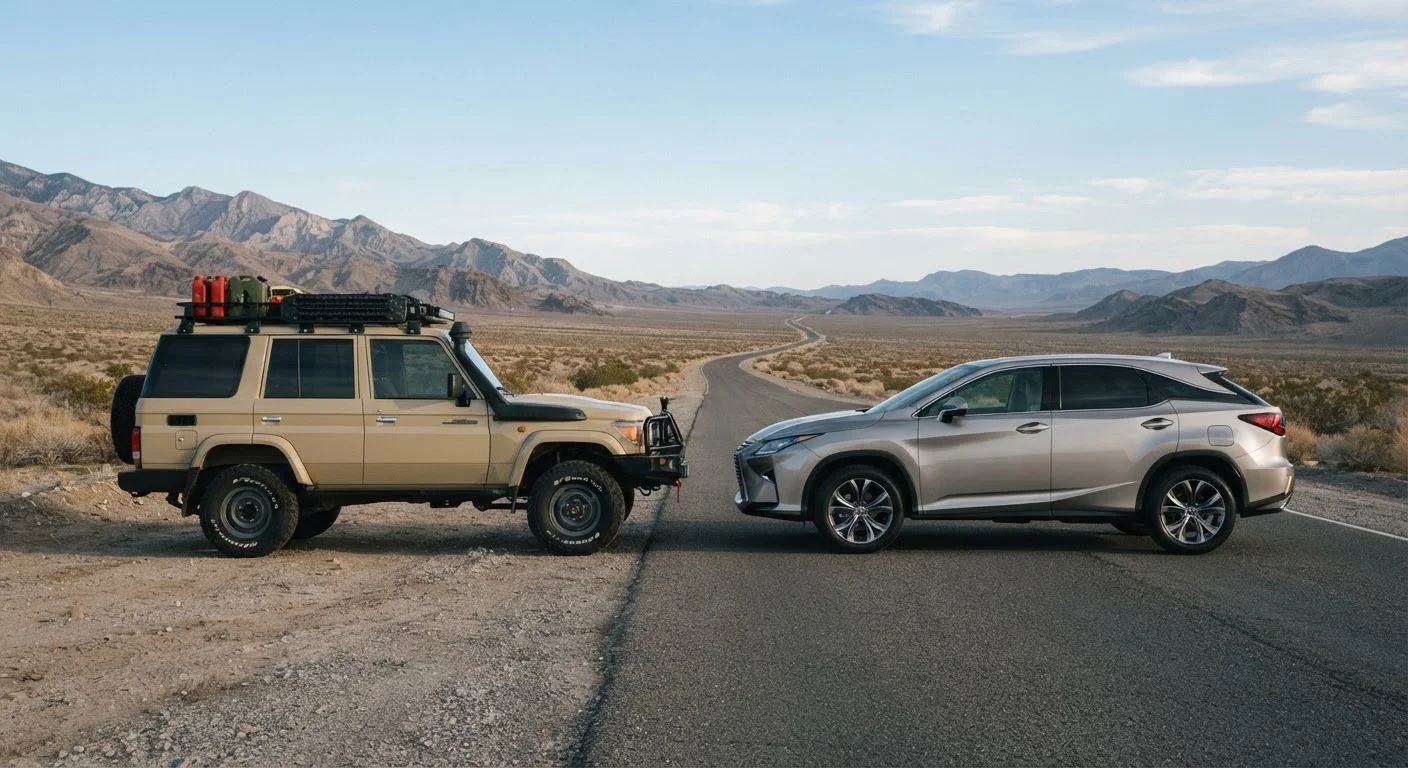
Traditional SUV
The rugged, truck-based workhorse.
Best for: Drivers who need serious towing capacity, off-road capability, or maximum payload in demanding conditions.
Option B
Crossover (CUV)
The car-based, everyday-versatile option.
Best for: Commuters and families who want SUV-like space and ground clearance with a more car-like ride and fuel economy.
If you regularly tow trailers, boats, or heavy loads
Traditional SUV
Body-on-frame construction provides the structural rigidity and higher tow ratings that serious hauling demands.
If you want daily driving comfort and better fuel economy
Crossover (CUV)
Unibody construction reduces weight and improves ride quality, making crossovers more efficient and comfortable for commuting and family errands.
If you plan to go off-road on challenging terrain regularly
Traditional SUV
Truck-based SUVs with solid rear axles and low-range four-wheel drive are purpose-built for serious off-road conditions.
If you need three-row seating for a growing family
Crossover (CUV)
Many three-row crossovers offer generous interior packaging and easy ingress/egress without the bulk of a full-size truck-based SUV.
If you want the most versatile all-around vehicle for mixed use
Crossover (CUV)
For most everyday drivers, crossovers strike the best balance of space, efficiency, and handling without the trade-offs of a truck-based platform.
The Core Difference: How They're Built
The single most important distinction between a traditional SUV and a crossover isn't size, badge, or price — it's the platform underneath. A traditional SUV is built on a body-on-frame architecture, the same type used by pickup trucks. The body and the chassis are two separate structures bolted together. Examples of true body-on-frame SUVs include the Ford Expedition, Chevrolet Tahoe, and Toyota Land Cruiser.
A crossover utility vehicle (CUV), on the other hand, uses a unibody construction — the body and frame are a single integrated structure, just like a sedan or hatchback. This is why many automotive experts technically classify crossovers as car-derived vehicles despite their taller profile and available all-wheel drive.
This foundational difference cascades into nearly every performance and comfort characteristic that follows. For a broader look at how these categories fit into the overall vehicle landscape, see our guide to vehicle categories.
| Criterion | Traditional SUV | Crossover (CUV) |
|---|---|---|
| Construction | Body-on-frame | Unibody |
| Platform origin | Truck-based | Car-based |
| Towing capacity | Higher (often 8,000+ lbs) | Moderate (typically 1,500–5,000 lbs) |
| Off-road capability | Purpose-built for rugged terrain | Light to moderate conditions |
| Ride comfort | More vibration, stiffer ride | Smoother, more car-like |
| Fuel efficiency | Lower mpg due to added weight | Generally more efficient |
| Handling & maneuverability | Heavier, less nimble | More agile in urban settings |
| Typical examples | Expedition, Tahoe, Land Cruiser | RAV4, CR-V, Grand Cherokee |
Capability, Ride, and Real-World Trade-Offs
Body-on-frame SUVs carry meaningful advantages for demanding tasks. Their separate chassis can handle greater stress, which translates to higher tow ratings — often 8,000 lbs or more for full-size models. They also tend to support low-range four-wheel-drive systems and solid rear axles that are better suited to serious off-road use.
The trade-off is ride quality and efficiency. Because the body and frame aren't integrated, more vibration transfers to occupants, and the added weight hurts fuel economy. Parking and maneuvering a full-size body-on-frame SUV in urban environments can also be cumbersome.
Crossovers flip those priorities. Lighter weight and a stiffer integrated structure improve handling, reduce road noise, and allow for better fuel efficiency — a meaningful consideration over years of ownership. Most crossovers offer all-wheel drive for light-to-moderate conditions, but their AWD systems are optimized for traction on wet or snowy roads rather than rock crawling or deep mud.
~75%
Share of U.S. 'SUV' sales that are crossovers
Industry analysts consistently note that the majority of vehicles sold under the SUV label in the U.S. use unibody construction, not traditional truck-based frames.
5–8 MPG
Typical fuel economy gap between full-size SUVs and crossovers
EPA fuel economy data regularly shows a significant efficiency difference between body-on-frame full-size SUVs and comparably sized unibody crossovers in the same segment.
If your household needs include hauling a travel trailer or navigating genuine backcountry trails, the capability gap matters. For most suburban and urban drivers, however, crossovers provide adequate versatility without the compromises. If you're also evaluating family-specific configurations, our minivan vs. three-row SUV comparison covers additional trade-offs worth considering.
What the Market Actually Calls an 'SUV'
Here's where terminology gets confusing: the vast majority of vehicles currently advertised as SUVs in the U.S. are, by technical definition, crossovers. Models like the Toyota RAV4, Honda CR-V, Ford Explorer (post-2011 redesign), and Jeep Grand Cherokee (current generation) all ride on unibody platforms. Automakers and consumers alike use 'SUV' as a catch-all term because it has broader market appeal.
This matters when you're shopping, because two vehicles with near-identical exterior styling and 'SUV' branding can have entirely different underlying architectures — and therefore very different capability profiles. Reading the specification sheet for tow rating, ground clearance, and drivetrain type gives you a clearer picture than the model name alone.
Why Automakers Blur the Line
Using the 'SUV' label is largely a marketing decision. Research shows American consumers respond more positively to 'SUV' than 'station wagon' or 'crossover,' even when the mechanical difference is significant. Automakers adopted the term broadly starting in the late 1990s and early 2000s as car-based utility vehicles grew in popularity. Being aware of this distinction helps you cut through the branding and evaluate what you're actually getting.
Once you've identified which platform type fits your needs, the next step is matching those specs to how you actually drive. Our article on matching a vehicle type to your lifestyle offers a practical framework for doing exactly that.