

Key Takeaways
Option A
Timing Belt
The scheduled-replacement component with a hard deadline.
Best for: Owners who want a lighter, quieter system and are diligent about following manufacturer service intervals.
Option B
Timing Chain
The durable, oil-bathed system designed to last the engine's lifetime.
Best for: High-mileage drivers who want fewer scheduled replacements, provided engine oil is changed consistently.
If you follow maintenance schedules carefully and own a newer four-cylinder
Timing Belt
Many modern fuel-efficient engines use belts by design. If you track your intervals, the risk of unexpected failure is low.
If you're buying a high-mileage used vehicle and want fewer surprise repairs
Timing Chain
A chain-driven engine that has received regular oil changes typically needs no timing service, reducing one major unknown in your ownership costs.
If you've purchased a used car and don't know its service history
Timing Belt
In a belt-equipped engine, the prudent move is to replace the belt immediately if history is unknown — a relatively predictable cost versus the risk of catastrophic failure.
If you drive significant miles annually and want minimal scheduled powertrain service
Timing Chain
Chains eliminate recurring belt-replacement costs and are well-suited to engines that accumulate high annual mileage with consistent oil maintenance.
What Each Component Actually Does
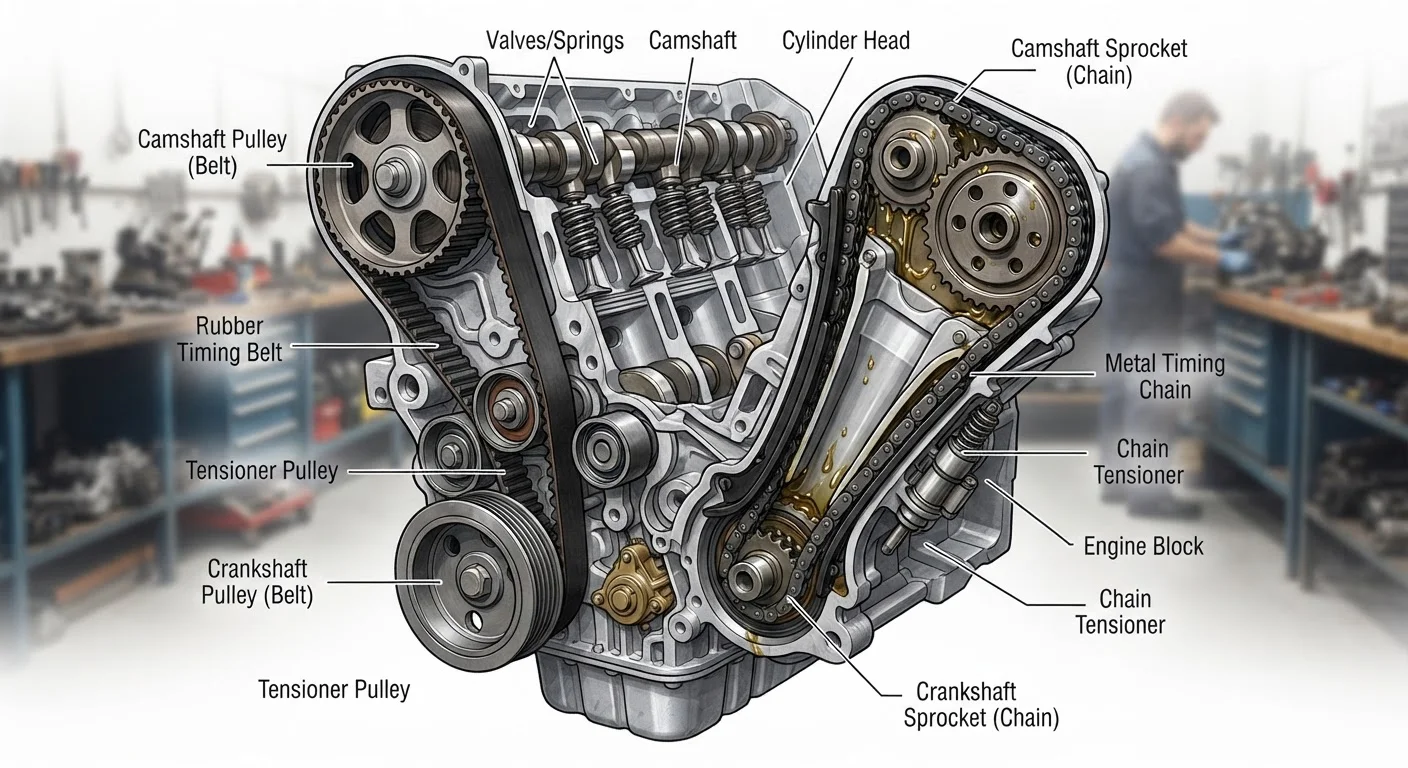
Both a timing belt and a timing chain perform the same fundamental job: they synchronize the crankshaft and camshaft so that the engine's valves open and close at exactly the right moment in the combustion cycle. Get that timing wrong — even slightly — and the engine runs poorly. Get it catastrophically wrong, and valves and pistons collide.
The difference is in material and design. A timing belt is a toothed rubber belt that runs on the outside of the engine. Because it operates dry (no oil contact), it's lighter, quieter, and less expensive to manufacture. A timing chain is a metal link chain — similar in concept to a bicycle chain — that runs inside the engine and is lubricated by the engine's oil supply. This integration with the oiling system is precisely why chains are built to last much longer under normal conditions.
To understand how these components fit into the broader mechanical picture, it helps to know what the powertrain actually includes — the timing system sits at its core.
| Criterion | Timing Belt | Timing Chain |
|---|---|---|
| Material | Reinforced rubber, toothed | Metal links |
| Location | External, behind plastic cover | Internal, inside engine block |
| Lubrication | Runs dry (no oil contact) | Oil-lubricated continuously |
| Typical service interval | 60,000–100,000 miles or 5–7 years | No scheduled replacement (oil-dependent) |
| Failure mode | Sudden snap; often catastrophic | Gradual stretch; often gives warning |
| Noise level | Quieter in operation | Slightly louder; rattle signals wear |
| Primary maintenance dependency | Replacement interval adherence | Consistent oil change discipline |
The High-Mileage Stakes: When Each System Becomes a Risk
At high mileage, the differences between these two systems become consequential rather than academic.
Timing belts age in two ways: through mileage and through time. The rubber degrades from heat cycling and ozone exposure, meaning a belt that has sat on a low-mileage vehicle for eight years can be just as compromised as one that has covered 90,000 miles. Most manufacturers specify a replacement interval of 60,000 to 100,000 miles or five to seven years, whichever comes first. Missing this window isn't a gamble worth taking in an interference engine — a design where the piston and valve occupy the same space at different points in the cycle. In an interference engine, belt failure typically means immediate, severe internal damage.
Timing chains wear differently. They stretch gradually over time rather than snapping, and the most common cause of premature stretching is irregular or neglected oil changes. Dirty, degraded oil fails to lubricate the chain tensioners and guides adequately. Symptoms of a worn chain include a rattling noise on startup, a check engine light for camshaft timing codes, or rough idle. Unlike a belt failure, a chain often gives warning before reaching a critical point — though that warning should not be ignored.
60K–100K
Miles: typical timing belt replacement interval
Most manufacturers specify replacement by mileage or elapsed time (commonly 5–7 years), whichever comes first.
~$500–$1,000+
Typical timing belt replacement cost (parts and labor)
Costs vary significantly by engine complexity; an interference engine repair after belt failure can run several times this amount.
2 types
Engine designs affected differently by timing failure
Interference engines suffer immediate valve damage on belt failure; non-interference engines stall but typically avoid internal damage.
The lesson for high-mileage owners is straightforward: with a belt system, the service interval is non-negotiable; with a chain system, oil discipline is the equivalent obligation. Either way, deferred attention compounds costs. As explored in our piece on why deferred maintenance tends to cost more than the original repair, small delays in scheduled service routinely turn into much larger bills.
How to Find Out Which System Your Vehicle Has
There's no universal rule linking engine type to timing system. Manufacturers use both designs across different models and model years, and the same engine family has sometimes shifted from one system to the other across generations.
The most reliable methods to determine which your vehicle uses:
- Owner's manual: If a timing belt replacement interval is listed in the scheduled maintenance section, you have a belt. If no such interval exists, a chain is likely.
- Underhood inspection: A timing belt cover is usually a plastic shroud on the front or side of the engine. A timing chain is housed inside the engine block itself and won't be visible externally.
- Manufacturer service documentation: Factory service manuals and reputable online databases (such as those maintained by professional technicians) list the engine's timing configuration.
If you've recently purchased a used vehicle, confirming this detail is worthwhile early. For belt-equipped engines with unknown service history, budgeting for immediate replacement is prudent — the cost of a belt job is a fraction of the cost of an engine that has suffered interference damage.
Timing system service is one component of a broader maintenance picture. Our complete overview of scheduled vehicle maintenance covers the other key intervals that matter as mileage accumulates.
Water Pump and Belt: Often Done Together
On many belt-driven engines, the water pump is also driven by the timing belt. When a mechanic has the belt cover open for a replacement, labor costs to swap the water pump simultaneously are marginal. Since water pump failure can destroy a new belt, many technicians and manufacturer service schedules recommend replacing both at the same interval. Confirm what your vehicle's service documentation recommends before authorizing work.