

| Federal Law Requiring Label | Automobile Information Disclosure Act (1958) |
| Common Name | Monroney label |
| Fuel Economy Testing Authority | U.S. Environmental Protection Agency (EPA) |
| Crash Safety Rating Sources | NHTSA and IIHS |
| Who Can Remove the Sticker | Only the vehicle purchaser (buyer) |
| VIN Length | 17 characters |
What Is the Monroney Label?
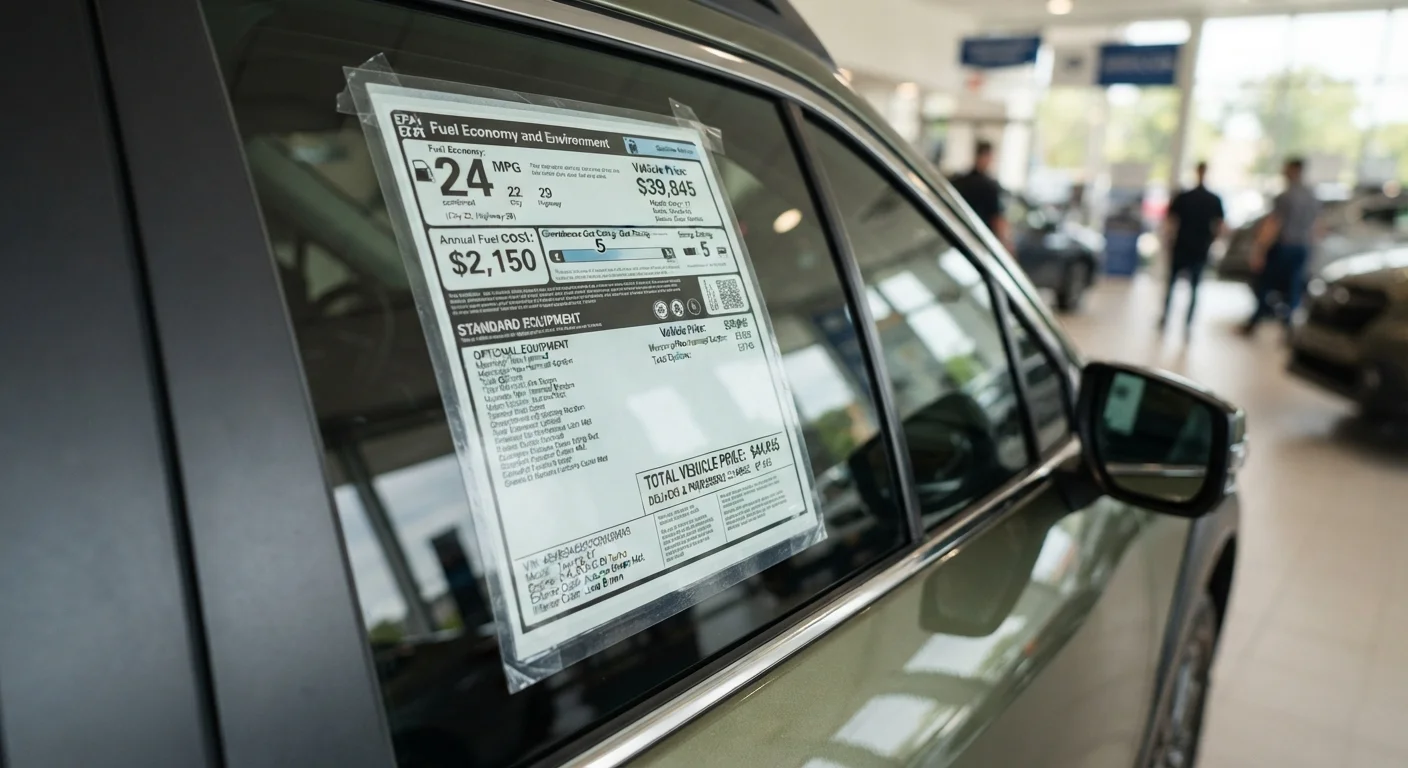
The window sticker you see on every new car at a dealership isn't a marketing piece — it's a federally mandated disclosure document. Officially called the Monroney label, after the senator whose 1958 legislation required it, the sticker must be affixed to the vehicle's window and can only be removed by the buyer. It covers everything from the vehicle's base price to its fuel economy to its standard safety features.
Understanding each section before you set foot on the lot can save you from confusion — and help you compare vehicles accurately. For a broader look at what else can surprise you during the buying process, see what often catches car shoppers off guard at the dealership.
| Federal Law Requiring Label | Automobile Information Disclosure Act (1958) |
| Common Name | Monroney label |
| Fuel Economy Testing Authority | U.S. Environmental Protection Agency (EPA) |
| Crash Safety Rating Sources | NHTSA and IIHS |
| Who Can Remove the Sticker | Only the vehicle purchaser (buyer) |
| VIN Length | 17 characters |
Section-by-Section Breakdown
Vehicle Description and Model Information
At the top of the sticker you'll find the manufacturer's name, the model year, make, model, and trim level. This section also includes the Vehicle Identification Number (VIN) — a 17-character code unique to that specific vehicle. The VIN encodes the country of assembly, manufacturer, vehicle type, engine, and a sequential production number. If you want to run a vehicle history report, this is the number you'll use. For vintage vehicles, the VIN structure works differently — see decoding a classic car's VIN and build sheet for context.
Standard Equipment
This section lists every feature included in the base vehicle at that trim level — things like the engine type, transmission, safety systems, and interior materials. It's the factory baseline before any packages are added.
Optional Equipment and Packages
Here you'll see every add-on the dealer ordered for this specific vehicle, along with individual prices. Packages (grouped options sold together) are listed with a package name and a combined price. This is one of the most important sections for comparison shopping: two vehicles with the same trim level can differ significantly depending on what packages were ordered.
Manufacturer's Suggested Retail Price (MSRP)
The MSRP — sometimes called the sticker price — is the sum of the base vehicle price plus all optional equipment. It is the manufacturer's suggested price, not a fixed selling price. Dealers may sell above or below MSRP depending on market conditions and vehicle availability.
Fuel Economy and Environment
This section is regulated and tested by the U.S. Environmental Protection Agency (EPA). It shows estimated miles per gallon (MPG) for city, highway, and combined driving cycles, as well as an estimated annual fuel cost based on a standard assumption of miles driven and fuel price. A fuel economy comparison bar shows how this vehicle ranks among similar vehicles in its class. Electric and plug-in hybrid vehicles show equivalent figures such as MPGe (miles per gallon equivalent) and electric range.
Monroney Label
The federally required window sticker on every new vehicle sold in the United States. It discloses the vehicle's pricing, equipment, fuel economy, and other key facts.
MSRP
Manufacturer's Suggested Retail Price — the price the manufacturer recommends the vehicle be sold for, including base price and optional equipment. It is a suggestion, not a fixed price.
VIN
Vehicle Identification Number — a unique 17-character code assigned to every vehicle that encodes details about its origin, manufacturer, and specifications.
EPA Fuel Economy Rating
Standardized fuel efficiency estimates produced by the U.S. Environmental Protection Agency through controlled laboratory testing. City, highway, and combined MPG figures are displayed on the Monroney label.
Destination Charge
A fixed fee charged by the manufacturer to cover the cost of transporting a vehicle from the assembly plant to the dealership. It is the same for all buyers and is not negotiable.
Addendum Sticker
A dealer-added label placed alongside the Monroney sticker that lists additional accessories or fees. Unlike the Monroney label, its contents are not federally mandated and may be negotiable.
Safety Ratings
If the vehicle has been tested, this section may display crash test ratings from the National Highway Traffic Safety Administration (NHTSA) or the Insurance Institute for Highway Safety (IIHS). Ratings are not always included at the time of initial sale if testing hasn't been completed. Always verify the most current ratings directly on the NHTSA or IIHS websites.
Destination Charge
At the bottom of the sticker, the destination and delivery charge represents the fixed cost the manufacturer charges to ship the vehicle from the assembly plant to the dealership. This fee is non-negotiable and is the same for every buyer of that vehicle at any dealership nationwide.
Knowing the body style and vehicle category listed on the sticker also helps you interpret the fuel economy comparisons correctly — a plain-English map of vehicle categories can help if you're unsure where a vehicle fits.
Dealer-Added Addenda Stickers
A separate sticker — sometimes called an addendum sticker — may appear alongside or overlapping the Monroney label. This is not part of the federal disclosure; it is added by the dealership and typically lists additional dealer-installed accessories, market adjustment fees, or documentation charges. Unlike the Monroney label, the fees on an addendum sticker are generally negotiable.
Be aware that items on an addendum sticker (such as paint protection film, nitrogen-filled tires, or wheel locks) may have been added without your request and may be priced above retail value. Review each line carefully and ask the dealer which items, if any, can be removed or credited. For a full picture of what else to watch for at the dealership, this guide on common dealership surprises is worth reading before you visit.