

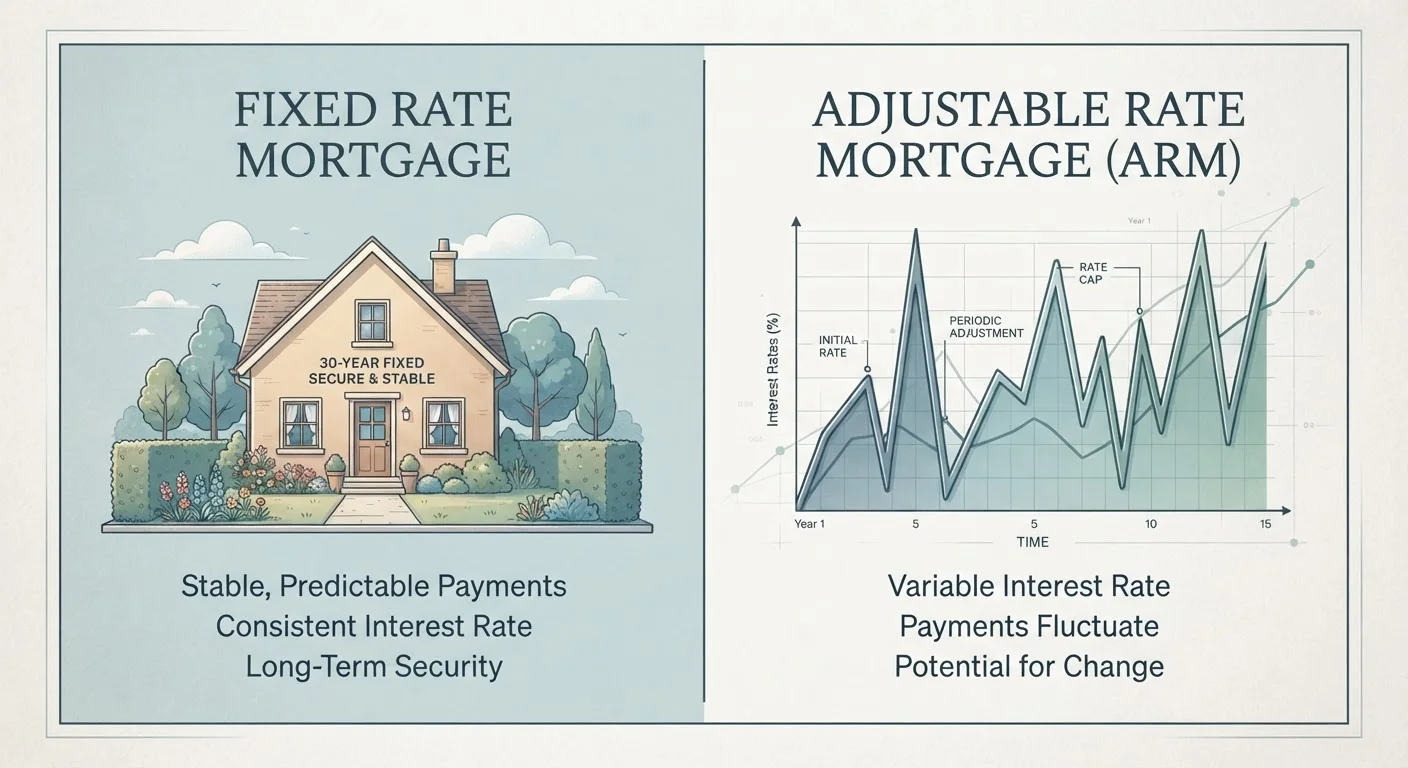
Key Takeaways
Option A
Fixed-Rate Mortgage
The predictable, stability-first choice.
Best for: Buyers who plan to stay long-term and want a consistent monthly payment regardless of market conditions.
Option B
Adjustable-Rate Mortgage (ARM)
The flexible, short-horizon alternative.
Best for: Buyers who expect to move or refinance within a few years and want to take advantage of a lower initial rate.
If you plan to stay in the home for more than seven years
Fixed-Rate Mortgage
Locking in a rate protects you from market fluctuations over a long horizon and makes budgeting straightforward for decades.
If you expect to sell or refinance within five to seven years
Adjustable-Rate Mortgage (ARM)
A lower introductory rate can reduce your monthly payment during the years you actually own the home, before any adjustment kicks in.
If your income is variable or your budget is tight
Fixed-Rate Mortgage
Payment certainty removes the risk of an unexpected rate increase straining your finances at a difficult time.
If you anticipate significant income growth in the near future
Adjustable-Rate Mortgage (ARM)
Starting with a lower payment and absorbing potential increases later can make sense if your earnings are expected to rise substantially.
How Each Mortgage Structure Works
A fixed-rate mortgage carries the same interest rate from your first payment to your last. Whether your loan term is 15 or 30 years, the portion of your monthly payment covering principal and interest never changes — only property taxes and insurance (usually collected in escrow) can shift over time. This predictability makes it easier to plan a household budget year after year. See our full breakdown of homeownership costs to understand what sits outside your mortgage payment.
An adjustable-rate mortgage (ARM) works differently. It opens with a fixed introductory period — commonly 5, 7, or 10 years — during which your rate is set. After that period ends, the rate adjusts periodically (often annually) based on a benchmark market index, such as the Secured Overnight Financing Rate (SOFR), plus a lender-set margin. ARMs are typically written as two numbers separated by a slash: a 5/1 ARM has a 5-year fixed period followed by annual adjustments; a 7/6 ARM adjusts every six months after year seven.
Understanding how your rate is calculated during the adjustable phase — index plus margin — helps you evaluate realistic worst-case scenarios before signing. This is very different from how auto loan interest works, where the rate is fixed at origination for the life of the loan.
| Criterion | Fixed-Rate Mortgage | Adjustable-Rate Mortgage (ARM) |
|---|---|---|
| Interest rate over time | Stays the same throughout the loan | Fixed initially, then adjusts periodically |
| Initial rate level | Typically higher at origination | Typically lower during introductory period |
| Monthly payment stability | Principal and interest never change | Can increase or decrease after fixed period |
| Common loan terms | 15 or 30 years | 30-year loan with 5, 7, or 10-year fixed phase |
| Rate caps | Not applicable | Initial, periodic, and lifetime caps apply |
| Best planning horizon | Long-term ownership (7+ years) | Short-to-medium term (under 7 years) |
| Risk level for borrower | Low — no rate surprise risk | Moderate to higher after adjustment begins |
Rate Caps, Risk, and What Can Actually Change
The most important safeguard on any ARM is its rate cap structure. Caps limit how much your interest rate can increase, and they work in three layers:
- Initial cap: the maximum increase at the first adjustment (commonly 2%).
- Periodic cap: the maximum increase at each subsequent adjustment (commonly 2%).
- Lifetime cap: the maximum increase over the entire loan (commonly 5–6%).
For example, if you start with a 6% rate on a 5/1 ARM and the caps are 2/2/5, your rate could rise to no more than 8% at year six and no more than 11% ever. Calculating that ceiling against your budget before you borrow is essential.
What Happens If Rates Fall During an ARM's Adjustable Phase?
Rate adjustments can move in either direction. If the benchmark index drops, your ARM rate — and monthly payment — could decrease at the next adjustment. This is a potential upside that fixed-rate borrowers do not benefit from without refinancing. However, falling rates are not guaranteed, and refinancing a fixed-rate loan also remains an option if rates decline significantly.
Because payment amounts on an ARM can change, this loan type intersects directly with how you categorize fixed versus variable household expenses. Once you enter the adjustable phase, your mortgage payment moves from fixed to variable in your budget — a meaningful shift for anyone managing tight cash flow.
Which Mortgage Type Fits Your Situation
The right structure depends less on which rate looks lower today and more on your personal timeline, income stability, and risk tolerance.
30 years
Most common fixed-rate mortgage term in the US
The 30-year fixed mortgage has historically been the most widely used home loan product among American borrowers, according to Freddie Mac data.
~1–1.5%
Typical initial rate advantage of a 5/1 ARM vs. 30-year fixed
ARM introductory rates have historically run below comparable fixed rates, though the spread varies with broader market conditions.
5–6%
Standard lifetime rate cap on most ARM products
Federal regulations require that consumer ARMs include lifetime and periodic caps; exact limits depend on the specific loan agreement.
Consider a fixed-rate mortgage if:
- You plan to own the home for many years and want certainty.
- Your income is stable but not expected to grow dramatically.
- Current rates align with your long-term budget and you want to lock them in.
Consider an ARM if:
- You have a clear, realistic plan to sell or refinance before the introductory period ends.
- You need a lower initial payment to qualify or to preserve cash flow early in ownership.
- You are financially positioned to absorb a higher payment if rates rise.
Before choosing, it helps to already have a mortgage pre-approval in hand, which will clarify how lenders are evaluating your credit profile and what rate ranges you realistically qualify for. The rent-or-own decision itself also shapes this choice — weighing renting against buying may reveal that neither mortgage type is the right move yet.
This article is for general informational and educational purposes only and does not constitute personalised financial or mortgage advice. Mortgage products, rates, and terms vary by lender and by individual financial profile. Consult a licensed mortgage professional or financial adviser before making decisions about your own home financing.