

Key Takeaways
The Safety Checks That Slip Through the Cracks
Homeownership comes with a long to-do list, and the tasks that feel invisible — the ones with no obvious symptom when they're neglected — tend to fall to the bottom. Home safety checks fit that description almost perfectly. A smoke detector with a dead battery looks exactly the same as a working one. A GFCI outlet that's lost its protection resets without complaint. A carbon monoxide detector past its service life gives no warning that it's no longer reliable.
The result is that millions of American homes carry risks their owners don't know about. The good news: most of these checks are fast, free or low-cost, and require no special tools or trades. This list walks through the safety measures homeowners most commonly skip — and explains what's actually at stake.
For a broader picture of upkeep tasks to build into your schedule, see the seasonal home maintenance checklist that covers inspections year-round.
Test smoke detectors monthly — and replace them on schedule
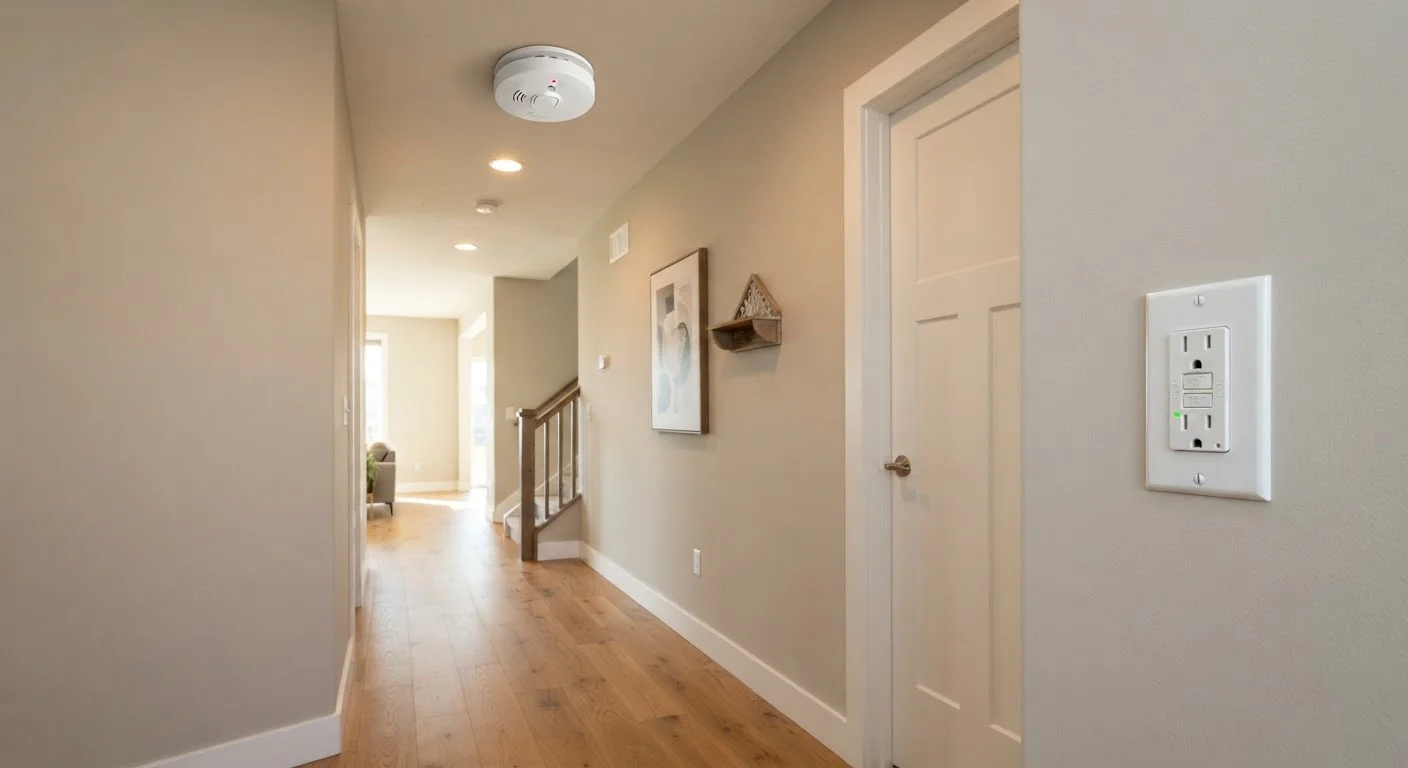
Most homeowners know smoke detectors exist. Far fewer test them monthly as recommended, and almost nobody tracks the detector's age. Smoke detectors have a rated service life of approximately 10 years from the manufacture date (printed on the back of the unit). After that point, the sensing chamber degrades and response time slows — even if the unit still chirps when you press the test button.
The test button only confirms that the alarm circuit and horn work. It does not verify that the sensor itself can detect actual smoke particles. Replace any detector that is 10 or more years old, and test all units monthly by pressing and holding the test button until the alarm sounds.
Placement matters too. Building codes generally require detectors inside every sleeping room, outside each sleeping area, and on every level of the home including basements. Check your local code if you're unsure — requirements vary by jurisdiction and construction date.
The test button checks the horn, not the sensor — age is what determines true reliability.
Add and maintain carbon monoxide detectors
Carbon monoxide (CO) is colorless and odorless — the only reliable warning is a functioning detector. CO is produced by fuel-burning appliances: furnaces, water heaters, gas ranges, fireplaces, and attached garage vehicles. Most CO poisoning incidents occur during winter months when homes are sealed and heating systems are running at full load.
CO detectors should be installed on every level of the home and near sleeping areas, following the manufacturer's placement guidelines. Like smoke detectors, they have a finite service life — typically 5 to 7 years — and should be replaced accordingly. If your home has interconnected smoke alarms, verify whether they also include CO sensing or whether separate units are needed.
Many jurisdictions now require CO detectors by law in homes with attached garages or fuel-burning appliances. Check your local requirements and keep the manufacturer's documentation if you rent out any portion of your home.
CO detectors expire in 5–7 years — most homeowners don't know when theirs was installed.
Test and locate every GFCI outlet in the home
Ground Fault Circuit Interrupter (GFCI) outlets are designed to cut power within milliseconds when they detect current leaking — such as when a device contacts water or a person receives a shock. They are required by the National Electrical Code in bathrooms, kitchens, garages, basements, and outdoor locations in new construction, but older homes may have them only in select areas or not at all.
Each GFCI outlet has a test and reset button in the center. Press the test button: power to that outlet (and any outlets downstream on the same circuit) should cut off immediately. Press reset to restore power. If the outlet doesn't cut off when tested, it has failed and should be replaced by a licensed electrician.
Walk every wet or high-risk area of your home and verify GFCI protection is present and functional. A standard outlet in a bathroom or near a kitchen sink that lacks GFCI protection represents a real shock hazard.
A GFCI outlet that doesn't cut off when tested has failed and offers no protection.
Inspect your electrical panel for warning signs
Your home's electrical panel (breaker box) is not something to open and modify without qualifications — but there are visible checks any homeowner can do safely from the outside. Look for breakers that appear discolored, feel warm to the touch, or don't hold their position when reset. These are signs of potential overloading or internal failure.
Also note whether any circuit is protected by a breaker that trips repeatedly. Frequent tripping usually signals either an overloaded circuit or a fault in the wiring — not a problem solved by forcing the breaker back to the on position. A licensed electrician should evaluate any panel that shows these signs.
If your home has a Federal Pacific Stab-Lok panel or a Zinsco panel (identifiable by the brand name on the panel door), be aware that these older panel types have been associated with documented reliability concerns. Consult a licensed electrician about your options if you have one.
Repeatedly tripping breakers signal a real problem — resetting them repeatedly doesn't fix it.
Check fire extinguisher charge and placement
A fire extinguisher is only useful if it's accessible, fully charged, and the person reaching for it knows how to operate it. Most home extinguishers use a pressure gauge with a green zone indicating proper charge. Check the gauge at least annually; if the needle is outside the green zone or the pin or tamper seal is missing, replace or recharge the unit.
For most households, a multi-purpose dry chemical extinguisher rated ABC is appropriate for kitchens and garages — it can handle ordinary combustibles, flammable liquids, and electrical fires. Store it where you can reach it in 30 seconds or less from the most likely ignition points, but not directly over a stove where heat or fire could block access.
Extinguishers also have a manufacturer-recommended service interval, typically every 6 years for a basic inspection and every 12 years for a full internal examination. Check the label on your unit for specifics.
An uncharged extinguisher in a kitchen cabinet is no different from having no extinguisher at all.
Verify dryer vent clearance and condition
Clothes dryer fires are among the more common and preventable home fires in the US. The leading cause, according to the US Fire Administration, is failure to clean lint from the vent path. Lint is highly flammable, and it accumulates in the duct that carries hot exhaust from the dryer to the exterior of the home.
Clean the lint trap after every load — most homeowners do. What's less common is cleaning the entire vent duct at least annually. Disconnecting the duct at the back of the dryer and using a dryer vent cleaning brush to clear accumulated lint from the full run is a DIY-accessible task. Check that the exterior vent flap opens freely when the dryer is running and closes fully when it's not (a stuck-open flap lets pests and cold air in).
If your dryer vent run is longer than about 25 feet, has multiple bends, or is made of flexible plastic accordion-style duct, those are risk factors worth addressing — a licensed HVAC technician can assess the installation.
Cleaning only the lint trap is not enough — the full duct run needs annual clearing.
Building These Checks Into a Lasting Routine
The challenge with safety checks isn't complexity — it's consistency. Tying each check to a recurring event (a holiday, a seasonal task, a bill payment cycle) is one of the most reliable ways to make sure they actually happen. Some families use daylight saving time transitions as a cue to test smoke and CO detectors; others fold these checks into a broader spring or fall walkthrough.
Make a simple home safety log
A single sheet of paper (or a note on your phone) listing each device, its installation date, last test date, and replacement schedule removes all the guesswork. When you replace a smoke detector or extinguisher, write the date on a small piece of tape on the unit itself. Five minutes of record-keeping now prevents a lot of uncertainty later.
If you're in your first year of homeownership, what maintenance actually looks like can help you build the habit from the start. And since water damage is the other leading cause of costly home incidents, pairing these checks with a look at how water enters the home makes for a well-rounded annual review.
This article is for general informational purposes only. For work involving electrical systems, gas lines, or structural components, consult a licensed professional and verify local permit requirements before proceeding.