

Key Takeaways
Why Documentation Matters for Renters
A maintenance problem left unaddressed can escalate from inconvenience to health hazard — and without documentation, it can also become a financial dispute when you move out. Landlords who claim a tenant caused damage have a much harder case to make when the tenant has a timestamped paper trail showing the issue was reported promptly and ignored.
Renters who log and report systematically are also better positioned under tenant protection laws. Most states have implied warranty of habitability requirements — a landlord's legal obligation to keep a unit livable — but those protections are easier to invoke when you can show a clear timeline. Documentation isn't about being combative; it's about being prepared.
Part of the American Renter's Complete Handbook addresses exactly how renters can protect themselves through the full arc of a tenancy, from move-in inspections to dispute resolution.
What you will need
What You'll Need Before You Start
Gathering the right tools before an issue arises means you can act quickly when one appears. The items below take minutes to set up and can save significant time and stress later.
Smartphone with camera
Captures timestamped photos and video of the maintenance issue as evidence.
Email account
Creates a searchable, dated written record of all communications with your landlord.
Dedicated folder (digital or physical)
Stores all documentation — photos, emails, texts, and receipts — in one organized place.
Certified mail service
Provides legal proof that a formal written notice was delivered to your landlord.
Build a Simple Maintenance Log from Day One
Create a dedicated folder — digital or physical — the moment you move in. Log every issue, date, and landlord response in a consistent format. Our guide on keeping a home maintenance log explains exactly what to record and why it matters over time.
Step-by-Step: How to Document and Report a Maintenance Issue
Follow these steps in order. The goal is to create a clear, timestamped record that begins the moment you notice a problem and continues through resolution — or escalation, if needed.
Photograph and describe the issue immediately
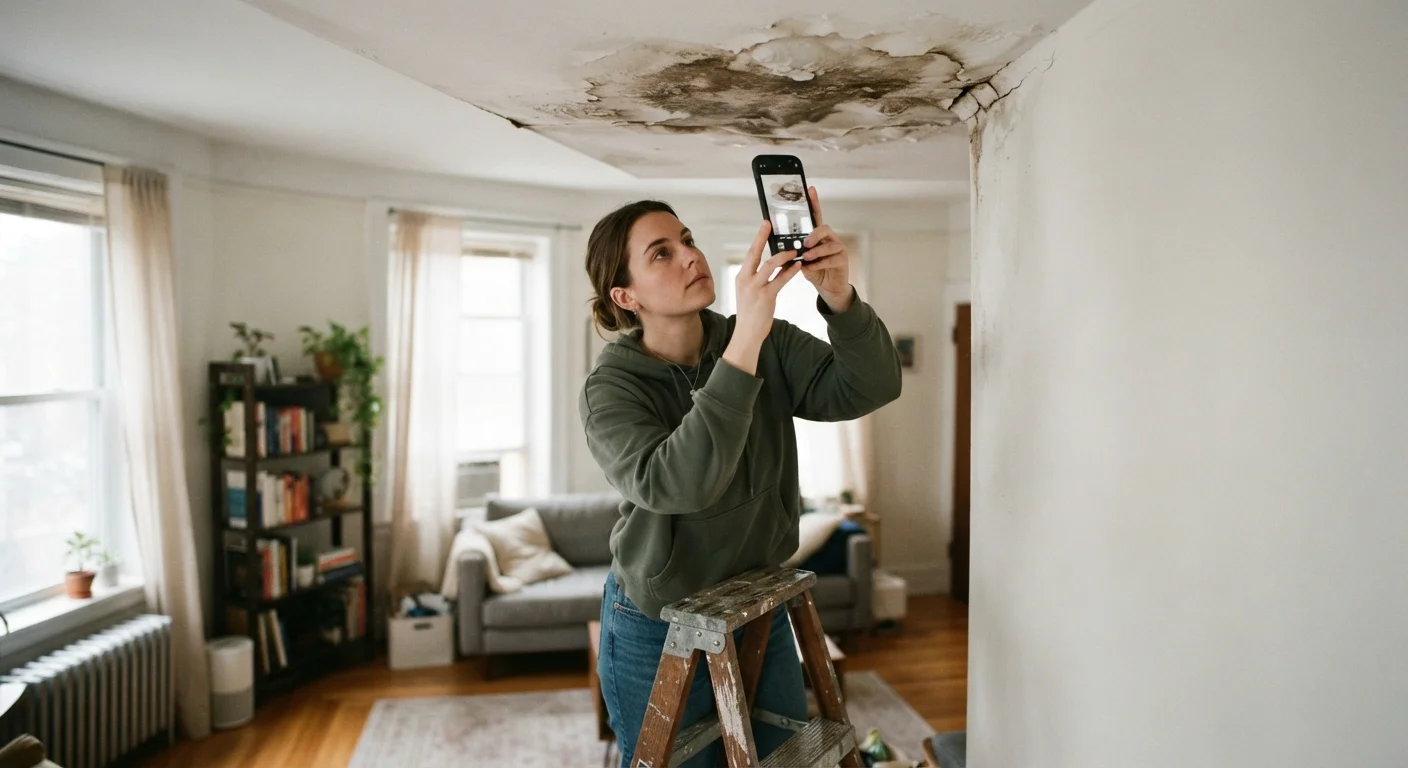
As soon as you notice a problem — a leaking pipe, broken heating unit, mold growth, or pest intrusion — document it before anything changes. Take multiple photos from different angles and at least one wide shot that establishes context (which room, which wall). Most smartphone cameras embed the date and time in image metadata automatically.
Write a brief written description alongside the photos: what you observed, when you first noticed it, and any immediate impact on habitability or safety. Specific details matter far more than dramatic language.
Review your lease before contacting the landlord
Your lease likely specifies how maintenance requests should be submitted — some landlords require a dedicated portal, others prefer email. Knowing the required process protects you; if you skip a required step, a landlord may use that to dispute whether proper notice was given. Also check for any clauses that define your responsibilities versus the landlord's.
Submit a written maintenance request
Send your request by email or text so there is an automatic timestamp. Include: the specific location of the problem (unit number, room), a factual description of the issue, when you first noticed it, and any safety concerns it creates. Attach your photos directly to the message.
Keep the tone professional. A neutral, factual request is more likely to receive a prompt response than an emotional one — and it reads better if the record ever reaches a third party.
For more guidance on effective landlord communication, see communicating with your landlord.
Log the request and any landlord response
Add an entry to your maintenance log immediately after sending the request. Record the date, method of contact, a summary of what you reported, and what — if anything — the landlord replied. Update this log each time the situation changes: a repair is scheduled, delayed, or completed.
This running log is the backbone of any future dispute resolution. Think of it the way vehicle owners track service history — a documented timeline is far more credible than a remembered one. For a broader look at record-keeping habits, our article on vehicle maintenance records illustrates why consistent documentation pays off over time.
Follow up in writing if there is no response
If you have not received an acknowledgment within a reasonable window — typically 24–48 hours for urgent issues, 5–7 business days for non-urgent ones — send a polite follow-up. Reference your original message by date and reattach your photos. Note in your log that a follow-up was necessary.
If the issue affects heating, hot water, structural safety, or other habitability essentials, say so explicitly. Many states have specific timelines for landlords to address habitability problems, and naming the concern on the record helps establish urgency.
Send a formal written notice if the issue remains unresolved
If follow-ups produce no result, escalate to a formal letter sent via email and, optionally, certified mail with return receipt. State the issue clearly, reference previous communications with dates, and specify a reasonable deadline for repair. Keep the language factual.
This letter is a key document if you later need to contact a housing authority or seek legal remedies. Certified mail creates independent proof of delivery that email cannot always replicate.
Escalate to local housing authorities if necessary
When a landlord consistently fails to respond, you have legitimate options beyond private communication. Most cities and counties have a housing inspection or code enforcement office that accepts tenant complaints. Filing a complaint triggers an official inspection and creates a public record — both meaningful forms of pressure.
Tenant rights organizations in your area can guide you through local processes at no cost. Some areas also have housing courts where renters can seek orders requiring repairs. Review the full renter's resource at The American Renter's Complete Handbook for an end-to-end overview of your options at each stage of a tenancy.
Never Withhold Rent Without Legal Guidance
Some states permit rent withholding or repair-and-deduct remedies when landlords fail to fix habitability issues, but the rules are strict and vary significantly by jurisdiction. Acting without understanding local law can put you in default on your lease. Always consult a tenant rights organization or licensed attorney before taking that step.
Common Mistakes Renters Make — and How to Avoid Them
Verbal Requests Offer Little Protection
A phone call or in-person conversation is easy to deny. If your landlord asks you to call with problems, follow up every call with a written summary sent by email or text. This converts an informal exchange into a documented record.
Beyond relying on verbal communication, renters often make a few other missteps that weaken their position. Waiting too long to report a visible problem can suggest you didn't consider it serious, even if the issue worsened on its own. Sending vague descriptions without specifics or photos gives a landlord room to dispute the severity. And discarding old communications — deleting emails or clearing text threads — removes evidence you may need months later.
Treat your rental maintenance records with the same care a homeowner would bring to tracking upkeep on a property they own. Renters who move into homeownership later will find those habits even more useful — our overview of your first year as a homeowner shows how maintenance tracking evolves when you're responsible for the whole structure.
This article is for general informational purposes only and does not constitute legal advice. Landlord-tenant laws vary by state and locality. Consult a licensed attorney or local tenant rights organization for guidance specific to your situation.