

Key Takeaways
Option A
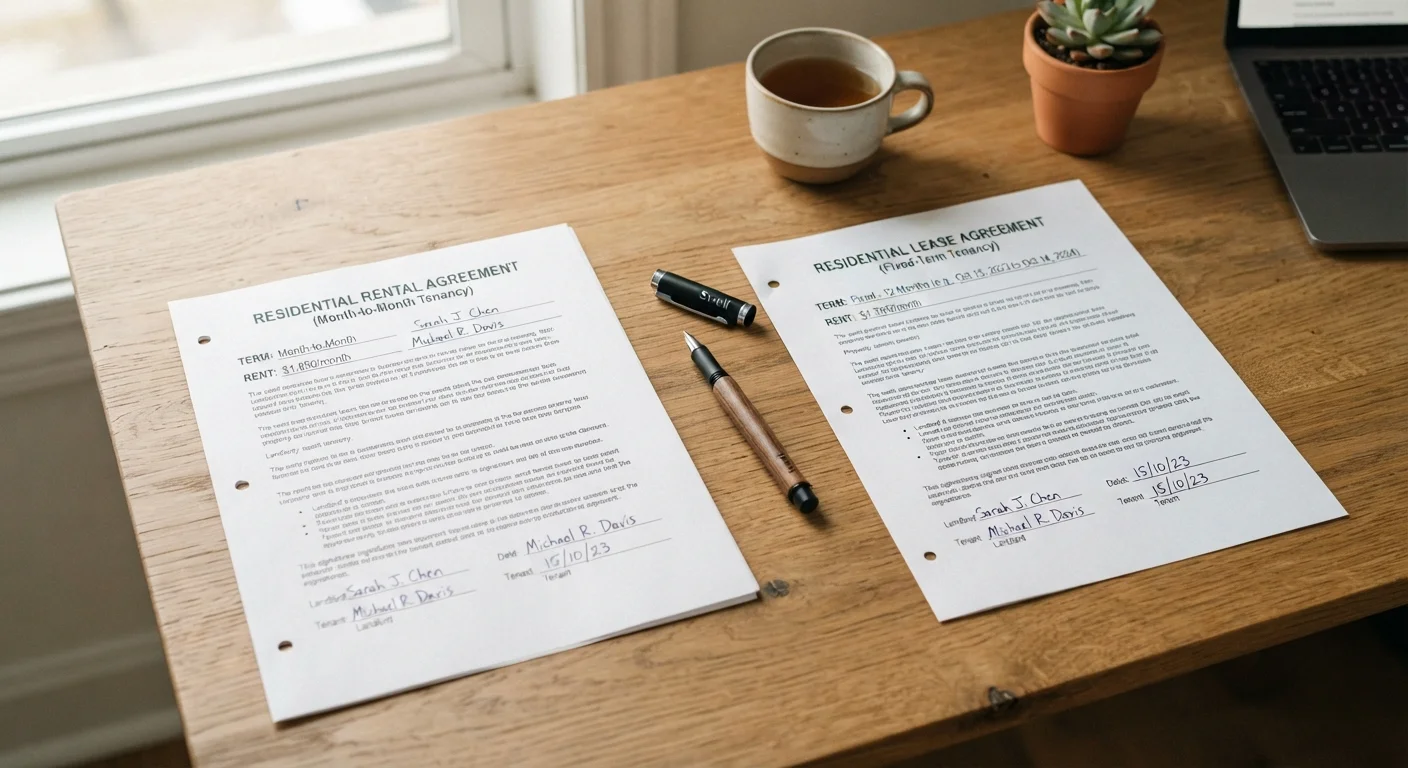
Month-to-Month Lease
The flexible, short-horizon rental arrangement.
Best for: Renters who need geographic flexibility, are between life stages, or cannot commit to a year-long stay.
Option B
Fixed-Term Lease
The stable, budget-predictable long-term agreement.
Best for: Renters who have settled on a location, want locked-in rent, and plan to stay for at least 12 months.
If you're relocating for work or expect to move within 6 months
Month-to-Month Lease
The higher monthly cost is offset by avoiding early-termination fees and the freedom to leave on short notice.
If you've found a neighborhood you love and want budget certainty
Fixed-Term Lease
Locking in rent for 12 months or longer shields you from increases and provides a stable housing foundation.
If you're planning to buy a home within the next year or two
Fixed-Term Lease
A 12-month lease gives you a defined savings runway while keeping housing costs predictable. See our comparison of renting vs. buying for the bigger picture.
If you're a first-time renter still learning your preferences
Month-to-Month Lease
Lower commitment lets you assess the unit, landlord, and neighborhood before signing a longer agreement.
How Each Lease Type Works
A fixed-term lease is a legally binding agreement covering a set period — most commonly 12 months — during which both you and the landlord agree on the rent amount, responsibilities, and rules. Neither party can unilaterally change the terms before the lease ends. At expiration, it typically converts to a month-to-month arrangement unless renewed.
A month-to-month lease (sometimes called a periodic tenancy) renews automatically each month without a fixed end date. Either party can terminate the agreement with proper notice — commonly 30 days in most states, though some require 60 days depending on how long you've lived there. The key advantage is adaptability; the key risk is that same adaptability working against you.
Before signing either type, review every clause carefully. Our guide on what's actually in a lease agreement walks through the legal language you'll encounter and what it means in practice.
| Criterion | Month-to-Month Lease | Fixed-Term Lease |
|---|---|---|
| Typical duration | Renews each month indefinitely | Set period, usually 12 months |
| Monthly rent cost | Often 10–25% higher premium | Standard market rate, locked in |
| Rent increases | Possible with each renewal notice | Generally not allowed mid-term |
| Tenant flexibility | Leave with 30–60 days notice | Penalties for early exit |
| Landlord can terminate | Yes, with required notice period | Only for cause before term ends |
| Housing security | Lower — landlord can end tenancy | Higher — protected for full term |
| Budget predictability | Less predictable month to month | Highly predictable for lease term |
| Best market conditions | Slower or oversupplied markets | Tight, high-demand rental markets |
Cost Differences: What You Actually Pay
The most immediate trade-off is financial. Landlords typically charge a premium of 10–25% above the standard monthly rate for month-to-month arrangements to compensate for the uncertainty of not knowing when a unit will turn over. On a $1,500/month apartment, that could mean paying $150–$375 more each month.
Fixed-term leases lock your rent in for the lease duration. Even in a rising rental market, your landlord generally cannot raise your rate mid-lease unless the agreement specifically allows it — which is worth verifying before signing.
~20%
Typical month-to-month rent premium
Industry estimates commonly cite a 10–25% premium over fixed-term rates for month-to-month arrangements, reflecting the landlord's turnover risk.
30–60 days
Common termination notice period
Most U.S. states require landlords to give month-to-month tenants 30 days notice to vacate; several states require 60 days for longer-tenured renters.
1–3 months
Typical early termination penalty
Fixed-term lease early-exit clauses frequently require payment of one to three months' rent, depending on the agreement and local law.
However, fixed-term leases carry early termination costs. Most agreements include an early termination clause requiring you to pay one to three months' rent as a penalty, continue paying rent until a replacement tenant is found, or both. If your circumstances change unexpectedly, these costs can be substantial. If you need an exit strategy, also look at our breakdown of subletting vs. lease takeover as a potential path out of a fixed-term commitment.
Stability, Security, and Landlord Rights
A fixed-term lease offers housing security: your landlord cannot ask you to vacate before the term ends without legal cause (non-payment, lease violations, etc.). This matters in tight rental markets where inventory is limited and finding a new place on short notice is stressful and costly.
Month-to-month tenants are more exposed. A landlord who wants to sell the property, renovate, or rent to a different tenant simply has to provide the required notice — and you must move. In many states, that notice period is just 30 days. That's not much runway if you need to find a new home, arrange movers, and transfer utilities.
Local Laws Can Change the Calculus
Some cities — including several in California, New York, Oregon, and New Jersey — have rent stabilization or just-cause eviction ordinances that restrict a landlord's ability to terminate a month-to-month tenancy without a qualifying reason. These rules can significantly improve a month-to-month tenant's security. Check your city or county's specific tenant protection laws before assuming standard state rules apply to you.
Landlord rights and required notice periods vary significantly by state and sometimes by city. Rent control ordinances in some cities limit how and when landlords can terminate month-to-month tenancies or raise rent. Always check your local landlord-tenant laws or consult a tenant rights organization before signing.
Choosing Based on Your Life Stage
The right lease type depends less on the lease itself and more on where you are in life. Ask yourself a few concrete questions:
- Is your job secure and location-stable? If a transfer, layoff, or career change is realistic within a year, month-to-month gives you an exit without penalty.
- Are you planning a major life change? Getting married, having a child, or buying a home all affect how much space you'll need. A fixed-term lease can lock you into a unit that no longer fits.
- How is your local rental market? In high-demand cities, month-to-month units are rare and expensive. In slower markets, landlords may offer flexible terms more readily.
- Do you have pets? Finding pet-friendly rentals takes time; the costs and restrictions around renting with pets can also affect which lease type is feasible.
If you're on the path to homeownership, a 12-month lease can also function as a structured savings period. For a broader comparison of the financial trade-offs, see our article on renting vs. buying. Separately, if you're thinking about how fixed vs. variable structures affect long-term costs, the same logic applies to mortgages — our piece on fixed-rate vs. adjustable-rate mortgages covers that comparison in depth.
This article is for general informational purposes only and does not constitute legal or financial advice. Lease terms, landlord-tenant laws, and notice requirements vary by state and locality. Consult a licensed attorney or tenant rights organization for guidance specific to your situation.