

Key Takeaways
Why Most Budgets Don't Survive Month Two
Most budgets fail for a handful of predictable, design-level reasons — not discipline failures. They are built on optimistic guesses: "$150 a month on groceries" when the real average is closer to $420. They ignore irregular expenses like car repairs, annual renewals, or holiday spending that inevitably arrive and blow the plan. And once created, they sit untouched until the next financial pressure hits.
The fix does not require overhauling your lifestyle. It requires building your budget on actual data, leaving realistic room for how your money flows, and scheduling a regular review so small problems get caught before they compound. Understanding why most budgets fall apart in the early weeks can help you avoid the most common traps from the start.
This walkthrough covers each step of the process — from gathering real numbers to making the monthly review a sustainable habit rather than a chore you dread.
What You Need Before You Start
Gather everything before you sit down with your numbers. Budgets built on estimates tend to collapse quickly; budgets built on actual statements hold up. You will need at least two months of bank and credit card records — most financial institutions let you download these as PDFs or spreadsheets — along with a clear picture of your monthly take-home pay and a complete list of any recurring automatic charges.
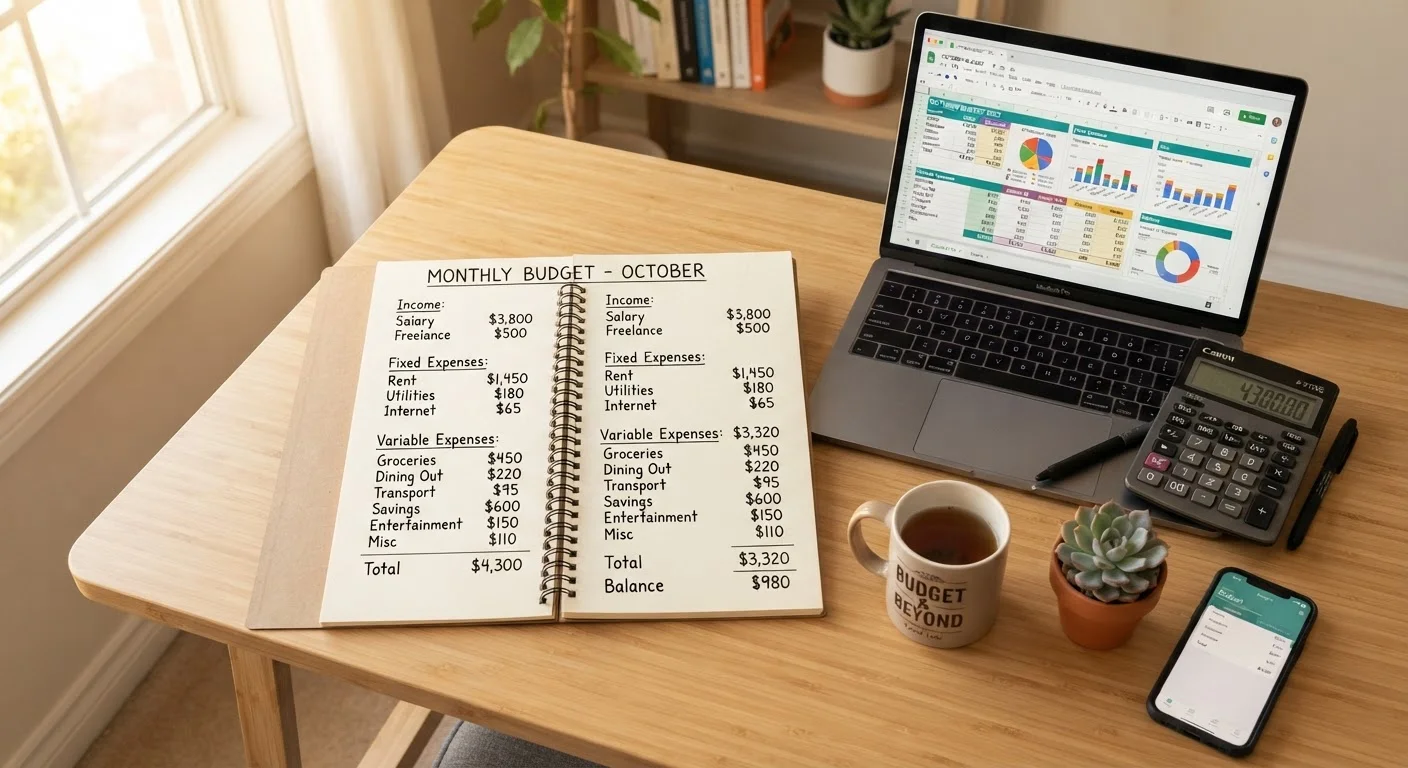
What you will need
Bank and credit card statements
To identify your actual fixed and variable spending patterns across multiple months rather than relying on estimates.
Spreadsheet software
To lay out income, expenses, and category limits in a single organized view that is easy to update each month.
Budgeting app
To automate transaction categorization and provide real-time visibility into spending throughout the month.
Calculator
To quickly compute monthly averages across spending categories when reviewing multiple months of statements.
If you would like to do a thorough review of your spending before building the budget, the spending audit guide walks through that categorization process in detail.
Build Your Monthly Budget Step by Step
Follow the steps below in order. Each one builds on the last, so resist the urge to jump to allocating limits before you have your actual spending numbers confirmed. The goal is a budget grounded in reality — one that gives you an honest picture of where your money goes and a workable plan for where you want it to go.
Calculate your monthly take-home income
Your starting number is net pay — what actually lands in your bank account after taxes, retirement contributions, and any other payroll deductions. If you are paid bi-weekly, multiply one paycheck by 26, then divide by 12. If income varies month to month, use the lowest monthly amount from the past six months as a conservative baseline.
List every fixed expense
Fixed expenses stay the same every month: rent or mortgage, car payment, minimum loan payments, insurance premiums, and any locked-in subscriptions. Write them all down and subtract the total from your monthly take-home income. What remains is your working budget for variable spending and savings.
Track actual variable spending from real statements
Pull two to three months of bank and credit card statements and categorize every transaction: groceries, dining out, gas, clothing, entertainment, household supplies. Average each category across those months. These real averages — not guesses — become the foundation for your spending limits in the next step.
Apply a budgeting framework to what remains
A widely referenced starting point is the 50/30/20 guideline, which allocates roughly 50% of take-home pay to needs, 30% to wants, and 20% to savings and debt repayment. Use this as a diagnostic, not a rigid rule — your situation may call for different proportions depending on income level, housing costs, and debt obligations. This is general educational guidance, not personalized financial advice.
Assign savings before discretionary spending
Before you fill in entertainment, clothing, or dining limits, add savings as a non-negotiable line item — even if the amount is modest. Treating savings like any other bill means it does not get crowded out at the end of the month. For strategies when cash is tight, see Building a Savings Habit From a Tight Budget.
Set realistic per-category limits
Using your averages from Step 3, assign monthly limits to each variable spending category. Do not cut aggressively on the first pass — if you have averaged $550 on groceries, budgeting $250 is not a plan, it is a setup for failure. Start with limits close to your real averages and trim them gradually over the following months as habits shift.
Choose a tracking method you will actually use
There is no universally correct system. A spreadsheet gives full control; a budgeting app automates categorization; a notebook works for those who prefer analog. The best method is the one you will open during the month — not the most sophisticated one. Budgeting by Hand vs. Budgeting with an App walks through the practical trade-offs of each approach.
Schedule a weekly 10-minute check-in
Set a recurring 10-minute appointment — same day, same time each week — to compare actual spending against your budget. You are looking for early drift: a category already 75% spent with two weeks remaining, or an unexpected charge that did not get categorized. Catching problems mid-month means a small adjustment, not a total reset at month's end.
Review, adjust, and reset each month
At the end of every month, go through each category: what came in over, what came in under, and whether your income changed. Update limits based on what you learned, then reset for the next month. Our monthly budget reset checklist provides a structured way to close out the month and set up the next one without starting from scratch.
Pay Yourself First — Every Month
The most reliable way to build savings is to treat the transfer as automatic and non-negotiable, not something you do with whatever is left at month's end. Set up a recurring transfer on payday, even for a small amount. Over time, you naturally adjust your spending to what remains rather than trying to save what you did not spend.
Keeping the Budget Alive After Month One
Building the initial budget takes the most effort. Maintaining it costs far less — but requires consistency.
At the end of every month, sit down for 20 minutes and compare what you planned against what you actually spent. If dining out ran $80 over, do not immediately slash the limit in half. First, ask whether it was an unusual month or a sign your original limit was unrealistic. Honest adjustments that reflect real patterns keep the budget working; punishing overreactions invite you to quit.
Plan ahead for costs that do not appear every month. Sinking funds — small monthly contributions earmarked for irregular but predictable costs like car maintenance, medical expenses, or annual bills — are one of the most effective tools for preventing budget blowouts. Our monthly budget reset checklist provides a repeatable template for closing out each month and setting up the next.
If your income varies significantly from month to month, the strategies in Budgeting on an Irregular Income offer approaches built for variable-income situations.
Don't Slash Spending Limits in Month One
Cutting variable spending dramatically at the start — halving your grocery budget or eliminating dining out entirely — creates pressure that usually leads to blowing the budget and abandoning it. Extreme first-month limits are one of the most common reasons people quit within a few weeks. Start close to your real averages and tighten gradually as your habits change.
This article provides general financial information for educational purposes only and does not constitute personalized financial advice. Consider consulting a licensed financial professional for guidance specific to your situation.