

Key Takeaways
Minimum Payment
A minimum payment is the smallest amount a credit card issuer requires you to pay each billing cycle to keep your account in good standing. Paying only this amount avoids a late fee, but it does not prevent interest from accumulating on the remaining balance. Over time, this can turn a manageable debt into a much larger one.
Minimum payments are typically calculated as a small percentage of your outstanding balance (often 1–3%) or a fixed dollar floor (commonly $25–$35), whichever is greater — meaning they shrink as the balance decreases, which extends repayment timelines dramatically.
How Minimum Payments Are Calculated
Credit card issuers typically calculate your minimum payment using one of two methods: a flat percentage of your outstanding balance (usually 1–3%), or a fixed dollar amount floor — whichever is greater. On a $3,000 balance with a 2% minimum, that works out to $60. As you pay down the balance, the minimum shrinks proportionally — so you're paying less and less each month in absolute terms.
That shrinking number feels like progress. It isn't. A smaller required payment just means the clock keeps ticking longer. The structure is not designed to eliminate debt quickly; it's designed to keep your account active and interest accruing.
How APR Affects the Math
The higher your card's APR, the larger the share of each minimum payment that disappears into interest. A card at 29% APR leaves far less of each payment working on principal than one at 15%. If you carry a balance, the interest rate on your card matters enormously — more so than most people realize when they first open an account.
Where Your Money Actually Goes Each Month
Consider a $3,000 balance at a 20% annual percentage rate (APR) — close to the national average for credit cards carrying a balance. In the first month, roughly $50 of interest accrues. If your minimum payment is $60, only about $10 actually reduces your balance. The remaining $50 simply covers the cost of borrowing.
This math repeats the following month — on a balance that is now $2,990 instead of $3,000. The change is almost imperceptible. Meanwhile, compound interest keeps working against you — each month's unpaid interest becoming part of the balance that next month's interest is calculated on.
~10+ years
Typical payoff timeline at minimum-only payments
A $3,000 balance at roughly 20% APR, paid at the calculated minimum each month, can take well over a decade to fully repay under standard amortization math.
1–3%
Common minimum payment as share of balance
Most major card issuers set minimums at 1–3% of the outstanding balance or a fixed floor (often $25–$35), whichever is greater — by design, a very small fraction of what is owed.
~$50
Monthly interest on $3,000 at 20% APR
At 20% annual interest, a $3,000 balance accrues roughly $50 in interest in the first month alone — often consuming the vast majority of a typical minimum payment.
The Real Timeline and Cost of Minimum-Only Payments
Running that same $3,000 balance at 20% APR through a standard amortization calculation reveals a stark picture: paying only the minimum each month could take well over 10 years to repay the balance in full, and total interest paid would likely exceed the original amount borrowed.
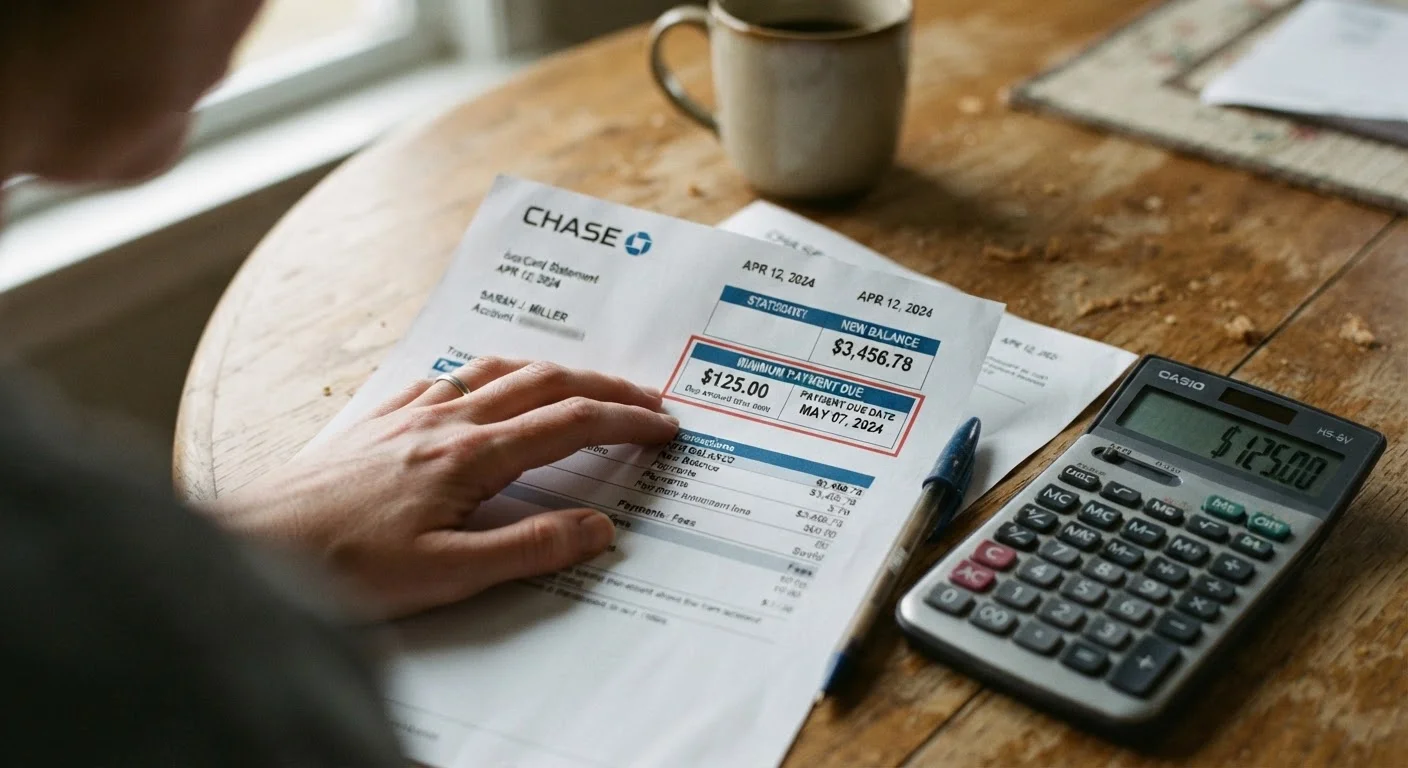
This is not a scare tactic — it's straightforward arithmetic. The Credit CARD Act of 2009 actually requires card issuers to print this repayment estimate right on your monthly statement. Many people have never looked at it. If you have a statement nearby, find the disclosure box — it shows the payoff date at minimum payments alongside a faster three-year payoff estimate.
For a broader look at the habits that quietly extend debt timelines, see common debt repayment pitfalls that many borrowers overlook.
Use the Statement Disclosure to Your Advantage
Every credit card statement is required by law to show how long payoff will take at minimum payments, plus the monthly amount needed to be debt-free in three years. Use that three-year figure as your target payment instead of the minimum. It's a simple, concrete number you can plug directly into your budget.
Breaking the Pattern: What Actually Moves the Needle
The single most effective shift is paying a fixed dollar amount rather than the calculated minimum. When lenders recalculate your minimum based on a shrinking balance, your payoff timeline stretches automatically. Committing to a set number — say, $100 per month regardless of what the statement demands — keeps the principal declining at a steady pace.
Beyond that, even irregular extra payments matter. A tax refund, a side-hustle payment, or a reduced grocery week can all become lump-sum contributions toward principal. Each dollar applied above the minimum shortens the repayment window.
Building this habit fits naturally into the broader discipline of budgeting basics — knowing where each dollar goes before it gets spent. Tracking your spending, even loosely, makes it easier to find room for those extra payments. You might also explore the everyday money moves hub for practical steps on building financial habits that stick.
This article is for general informational and educational purposes only and does not constitute personalized financial advice. Consult a qualified financial professional for guidance specific to your situation.