

Key Takeaways
Why Accessories Carry So Much Weight
There's a reason people reach for a particular necklace on a hard day, or save a specific bag for moments that matter. Accessories are not merely decorative — they function as personal shorthand, broadcasting values, memories, and identity to the world in ways clothing alone often can't. Unlike a full outfit, a single accessory can be swapped in seconds, making it one of the most flexible and personal tools in anyone's style vocabulary.
Research into what's sometimes called "enclothed cognition" — the idea that what we wear influences how we think and feel — suggests that objects worn close to the body take on layers of meaning beyond the purely aesthetic. A bracelet passed down through a family, a pair of earrings bought on a meaningful trip, or a watch earned after years of work: each carries a narrative thread that shapes how the wearer moves through the world.
Accessories also sit at the intersection of self-expression and social communication. They can signal group membership, cultural heritage, personal beliefs, or simply a mood. If you've ever wondered how much your choices communicate, exploring the psychology behind getting dressed offers a fascinating deeper look at this dynamic.
Jewelry as personal narrative
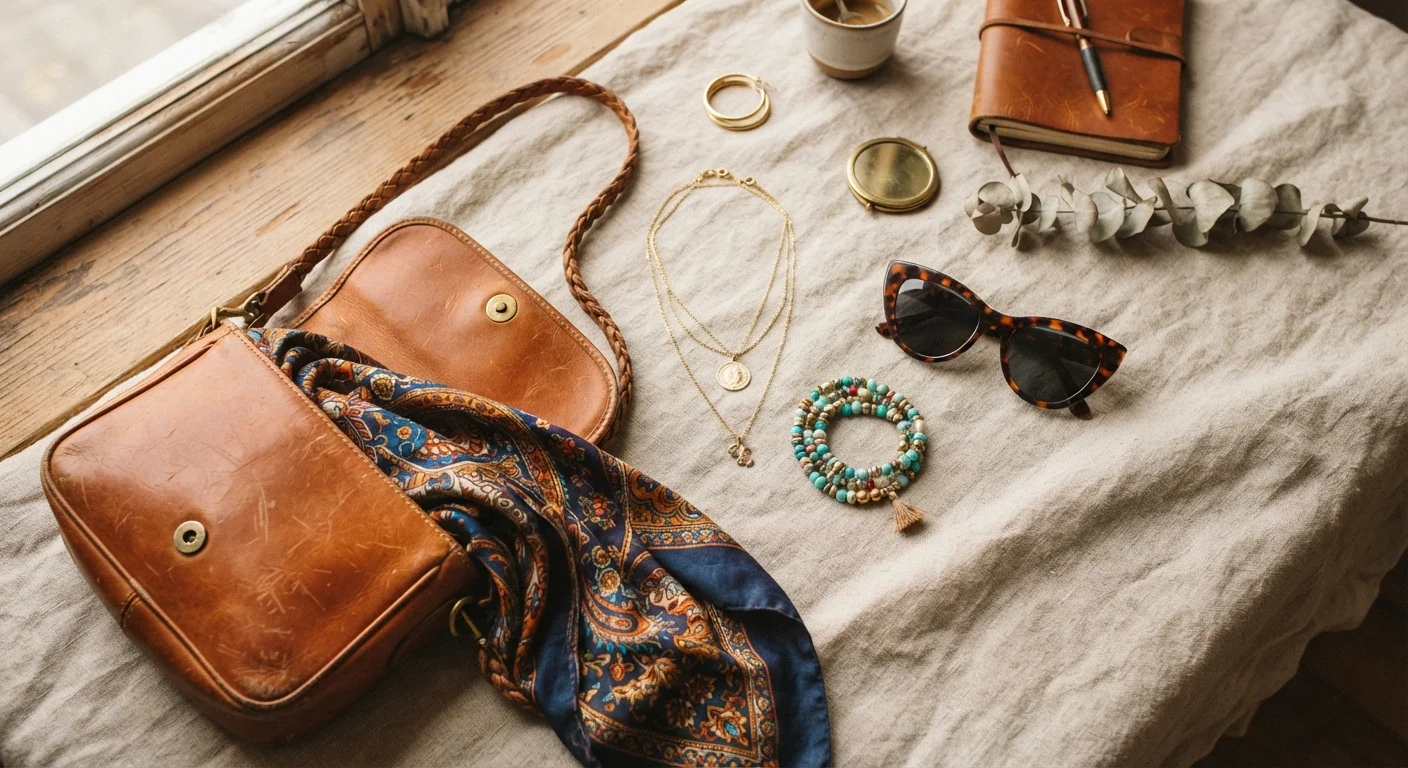
Jewelry may be the most intimate category of accessory. A ring can mark a commitment, a loss, or a personal milestone. Layered necklaces might map a decade of meaningful moments — a pendant from a grandmother, a charm from a city visited alone for the first time, a simple gold chain bought as a reward. Unlike clothing, jewelry is often worn continuously, making it a nearly permanent extension of the self.
The meanings attached to jewelry are also deeply cultural. Many traditions use specific pieces to mark rites of passage, community membership, or spiritual beliefs. Wearing culturally significant jewelry thoughtfully — and with awareness of its origins — adds intentionality to self-expression rather than diminishing it.
Jewelry worn daily becomes an almost permanent extension of personal identity and memory.
Bags as a statement of priorities
What you carry says something about how you move through the world. A structured tote signals organization and practicality; a small crossbody suggests freedom of movement; a worn canvas backpack might communicate a preference for function over formality. Bags are also one of the most visible accessories, carried at arm's length and in full view — making them one of the first things people register.
Beyond aesthetics, bags involve real trade-offs: durability, capacity, environmental footprint, and cost all factor in. Choosing a bag that genuinely serves your daily life while reflecting your values is an exercise in practical self-expression — and one that doesn't require spending a lot.
What you carry reflects how you move through the world, not just what looks good.
Hats, scarves, and the art of head-to-toe intention
Hats and scarves carry a particular kind of boldness. They frame the face, draw attention upward, and often function as the most expressive element of an entire look. A wide-brimmed hat reads as theatrical and confident; a knit beanie as casual and grounded; a silk headscarf as polished or culturally resonant, depending on how it's styled and who's wearing it.
Scarves, in particular, offer remarkable versatility — worn around the neck, tied to a bag handle, wrapped as a hair accessory, or folded into a pocket square. Their relatively low cost makes them accessible entry points for anyone exploring a bolder personal aesthetic without major investment.
Hats and scarves frame the face and often become the bravest statement in any look.
Glasses and sunglasses as face architecture
Few accessories are as transformative as glasses. Frames become part of the face itself — altering perceived proportions, drawing attention to specific features, and becoming so associated with a person that removing them can feel like a costume change. Eyewear is also one of the few accessories that many people wear every single day out of functional necessity, which makes the aesthetic choice feel especially meaningful.
Sunglasses layer on an additional dimension: they project an attitude without revealing expression, which gives them a particular kind of power. Whether minimalist, vintage-inspired, or boldly geometric, frames communicate a point of view about aesthetics and identity. Color choices in accessories — including frame colors — also play a meaningful role in that communication.
Eyewear becomes part of the face itself — few choices are as consistently identity-defining.
Layering and mixing as creative practice
One of the most energizing things about accessories is that they reward experimentation. Layering multiple necklaces of different lengths, mixing metals that "aren't supposed to go together," or pairing a delicate ring with a chunky bracelet are all low-stakes ways to push creative boundaries and discover what genuinely feels like you.
This kind of playful mixing also sidesteps some of the myths that can hold people back from authentic style — the idea that rules must be followed, or that a cohesive look requires expensive pieces. Common self-expression myths worth challenging are a useful read for anyone who has felt constrained by imaginary style laws.
Mixing and layering accessories is one of the lowest-stakes ways to discover your authentic style.
Accessories as markers of milestones and belonging
Some accessories exist primarily as markers — of a milestone crossed, a community joined, or a value held publicly. A class ring, a friendship bracelet, a pin on a lapel, a team scarf worn on game day: these pieces communicate belonging and history simultaneously. They invite recognition from those who share the reference and offer quiet self-affirmation for the wearer.
This dimension of accessories is worth taking seriously. In a world where identity is increasingly complex and multifaceted, wearing a small visible signal of something that matters to you — even if most people won't recognize it — is a form of integrity. Your style, including your accessories, can reflect who you actually are rather than who you feel you're supposed to be.
A single pin or bracelet can quietly signal a community, a milestone, or a deeply held value.
Making Your Accessories Work for You
The most empowering aspect of accessories is that they meet you wherever you are — in budget, in confidence level, and in style journey. You can build a meaningful collection gradually, focusing on pieces that actually resonate rather than chasing trends. And if you're navigating the tension between dressing for yourself and dressing for an audience, this look at self-expression versus social expectation can help you find your own footing.
Accessories also pair naturally with a thoughtful approach to the broader wardrobe. If aligning your style choices with your values matters to you, sustainable self-expression strategies are worth exploring. For the full picture on using fashion as an identity tool, this comprehensive guide to self-expression through style brings everything together.
Start small, but start intentionally
You don't need a full collection to express yourself through accessories. Choose one or two pieces that genuinely resonate — something with a story, a cultural connection, or simply a shape you keep returning to. Build from there rather than acquiring broadly. Fewer, more meaningful pieces tend to feel more authentically expressive than a crowded jewelry box of impulse purchases.