

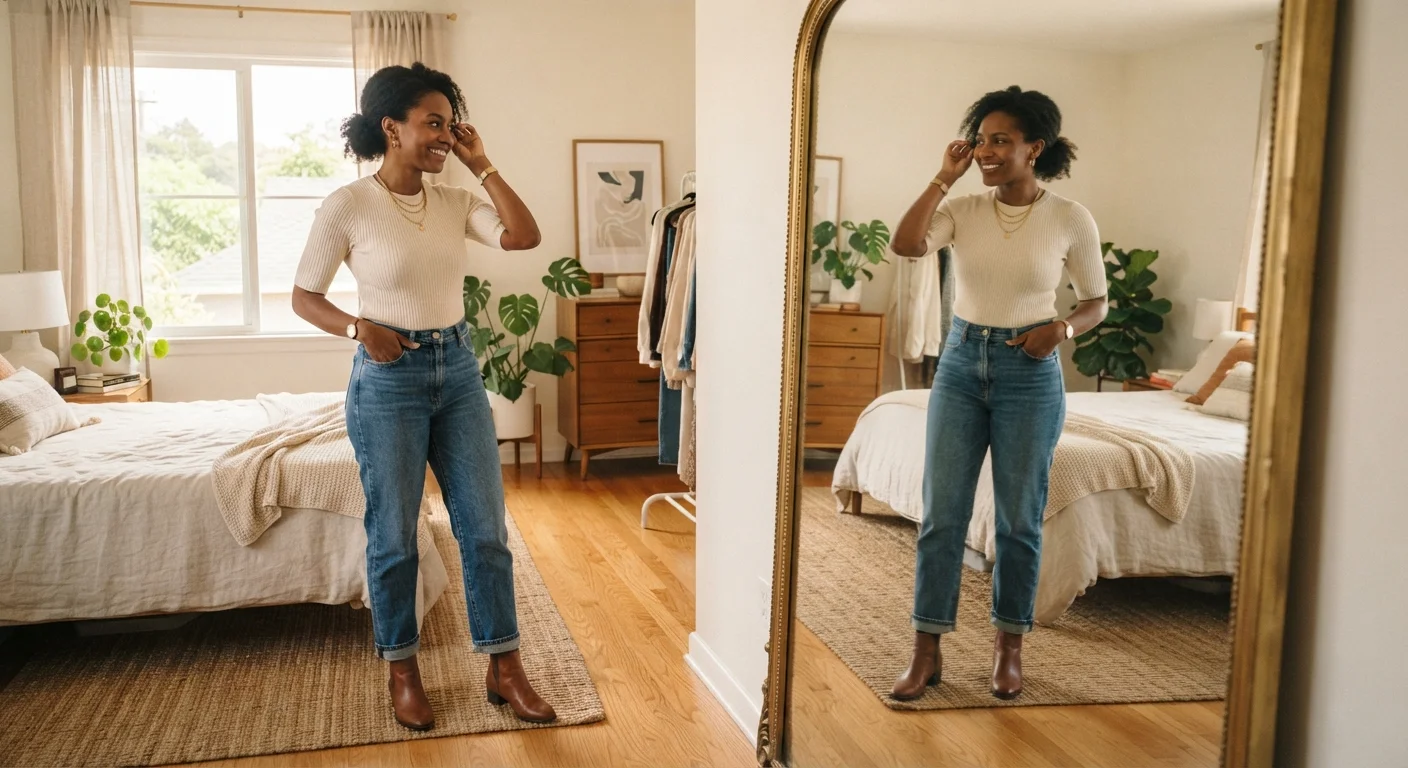
Key Takeaways
Builds a more consistent, authentic sense of identity
When your clothing reflects your inner sense of self, it reinforces rather than obscures your identity over time. This consistency can reduce the mental overhead of second-guessing every outfit.
Can contribute to greater daily confidence
Wearing something that feels genuinely yours — rather than performative — tends to translate into how you carry yourself. The effect is hard to quantify but widely reported.
Reduces reliance on external validation
When your style is rooted in your own preferences, you're less vulnerable to shifting trends or other people's opinions. That independence can be genuinely freeing.
Supports creative self-expression and experimentation
Treating your wardrobe as a creative outlet invites curiosity rather than anxiety. Trying new silhouettes, colors, or combinations becomes exploration rather than risk.
Can create friction in professional or formal settings
Workplaces and formal events often carry explicit or implicit dress expectations. Ignoring these entirely can affect how colleagues, clients, or employers perceive your professionalism — fairly or not.
May draw unwanted attention or commentary
Standing out — especially in more conservative environments — can invite unsolicited opinions. Not everyone has the social bandwidth or safety to navigate that consistently.
Cultural and family contexts add real stakes
In many family or cultural settings, clothing carries significant symbolic weight. Choosing to dress very differently from expectations can sometimes require navigating complex relational dynamics.
Fully ignoring others can become its own pressure
Ironically, the goal of dressing 'purely for yourself' can become another standard to perform — leading to self-consciousness of a different kind if your choices don't feel bold enough.
Our Verdict
Neither approach is universally right. Dressing entirely for yourself is most fulfilling when you have the social safety and freedom to do so. Dressing primarily for others may be practical in certain professional or cultural contexts, but it can become draining if it never leaves room for genuine self-expression. A flexible mindset — one that adapts to context without losing your sense of self — tends to serve most people best.
Anyone who feels pulled between self-expression and external expectations and wants a more intentional, less anxious relationship with getting dressed.
Why This Tension Exists in the First Place
Getting dressed is rarely a neutral act. What we wear communicates something — to ourselves, to the people around us, and to the broader social contexts we move through. That's not a flaw in the system; it's actually part of what makes fashion interesting. But it does create a genuine push-and-pull that many people feel every morning.
On one side is the desire for authentic self-expression — wearing what makes you feel like you. On the other is the awareness that clothing carries social signals, and those signals can have real consequences in workplaces, family settings, or cultural spaces. Neither pull is irrational. Understanding both is the starting point for finding your own balance. If you're not sure where your personal style even begins, our guide to finding your aesthetic is a useful first step.
The Case for Dressing for Yourself
When your outward appearance aligns with how you actually feel inside, the effect can be quietly powerful. Many people report that dressing intentionally — in ways that reflect their values, mood, or identity — contributes positively to their sense of confidence and well-being. This isn't vanity; it's self-authorship.
Builds a more consistent, authentic sense of identity
When your clothing reflects your inner sense of self, it reinforces rather than obscures your identity over time. This consistency can reduce the mental overhead of second-guessing every outfit.
Can contribute to greater daily confidence
Wearing something that feels genuinely yours — rather than performative — tends to translate into how you carry yourself. The effect is hard to quantify but widely reported.
Reduces reliance on external validation
When your style is rooted in your own preferences, you're less vulnerable to shifting trends or other people's opinions. That independence can be genuinely freeing.
Supports creative self-expression and experimentation
Treating your wardrobe as a creative outlet invites curiosity rather than anxiety. Trying new silhouettes, colors, or combinations becomes exploration rather than risk.
Dressing for yourself also creates a consistent visual identity that doesn't depend on trend cycles or other people's approval — a theme explored further in personal style vs. trends. And as body neutrality frameworks remind us, centering how you feel and communicate — rather than how you appear to others — can fundamentally shift the experience of getting dressed into something more grounding than stressful.
The Case for Dressing with Others in Mind
There's nothing inherently inauthentic about dressing with your audience in mind. Humans are social creatures, and clothing has always functioned partly as a shared language. Adapting what you wear to a job interview, a wedding, or a religious ceremony isn't a betrayal of yourself — it's a form of social fluency.
Can create friction in professional or formal settings
Workplaces and formal events often carry explicit or implicit dress expectations. Ignoring these entirely can affect how colleagues, clients, or employers perceive your professionalism — fairly or not.
May draw unwanted attention or commentary
Standing out — especially in more conservative environments — can invite unsolicited opinions. Not everyone has the social bandwidth or safety to navigate that consistently.
Cultural and family contexts add real stakes
In many family or cultural settings, clothing carries significant symbolic weight. Choosing to dress very differently from expectations can sometimes require navigating complex relational dynamics.
Fully ignoring others can become its own pressure
Ironically, the goal of dressing 'purely for yourself' can become another standard to perform — leading to self-consciousness of a different kind if your choices don't feel bold enough.
Understanding how dress codes actually work can ease a lot of this anxiety — when you know the unwritten rules, you can navigate them deliberately rather than reactively. The key distinction is between adapting thoughtfully and suppressing your identity entirely.
Finding a Balance That Actually Works
The most livable approach for most people isn't an either/or — it's a sliding scale that shifts with context. You might express your full personal aesthetic on weekends while keeping a professional-adjacent wardrobe for work. You might use accessories to inject personality into an otherwise conventional outfit. Small, intentional choices can signal authenticity even within constraints.
59%
Adults who say clothing affects their confidence
According to a survey by the American Psychological Association, a majority of adults report that what they wear influences how confident they feel during their day.
2 in 3
Workers who adapt style for workplace expectations
Research on workplace dress consistently finds that most employees consciously modify their personal style to meet perceived professional norms, regardless of formal dress codes.
Accessories in particular are often the place where personal expression survives even the most dress-code-heavy environments. A pin, a scarf, a watch — these small elements can communicate identity more directly than any single garment.
This Isn't a Binary Choice
The framing of 'dressing for yourself vs. dressing for others' can make it sound like you must pick a side. In practice, most people — consciously or not — blend both. The goal isn't to eliminate the tension entirely, but to become more intentional about when you prioritize one over the other. Context-sensitivity and self-awareness can coexist with a genuine personal aesthetic.
It's also worth remembering that your relationship with clothing is allowed to evolve. What felt right at 22 may not fit at 35 — and that's not inconsistency, it's growth. If you want your wardrobe to also reflect broader values, sustainable self-expression explores how to bring those layers into alignment too.