

Key Takeaways
Start here
What Is a Personal Aesthetic, Really?
Next
Start With What Already Draws You In
Then
Translating Inspiration Into an Actual Wardrobe
When you're ready
Your Aesthetic Can Evolve — And That's the Point
What Is a Personal Aesthetic, Really?
The word aesthetic gets thrown around a lot — on social media, in style conversations, in every corner of the internet. But stripped of the buzzword energy, a personal aesthetic is simply a consistent visual language you use to express who you are. It's the recurring colors, silhouettes, textures, and moods that show up across what you wear, how you style yourself, and even the environments you're drawn to.
Crucially, an aesthetic is not a rigid uniform, a personality type, or a trend you have to chase. It doesn't require a label (though labels like "soft minimalist" or "eclectic maximalist" can be useful shorthand). What it requires is a degree of intention — being thoughtful, even loosely, about why certain choices feel right to you.
For most people, the journey toward a defined aesthetic begins with acknowledging that one already exists in embryonic form. Your gut reactions to what you like and dislike are the seed. This guide helps you water them.
Aesthetic
A consistent set of visual qualities — colors, shapes, textures, moods — that characterize your personal style. It's a recurring sensibility, not a rigid category.
Capsule wardrobe
A small, curated collection of versatile clothing items that work well together, reducing decision fatigue and making it easier to dress with intention.
Silhouette
The overall shape or outline a garment creates on the body — for example, fitted, boxy, flowy, or structured. Silhouette is one of the strongest signals of a style's mood.
Mood board
A visual collage of images, colors, textures, or references that represent a desired look or feeling. Used in fashion to clarify and communicate style direction.
Self-expressive dressing
The practice of choosing clothing and accessories intentionally to communicate aspects of your personality, values, or emotional state — rather than dressing purely out of habit or social convention.
Start With What Already Draws You In
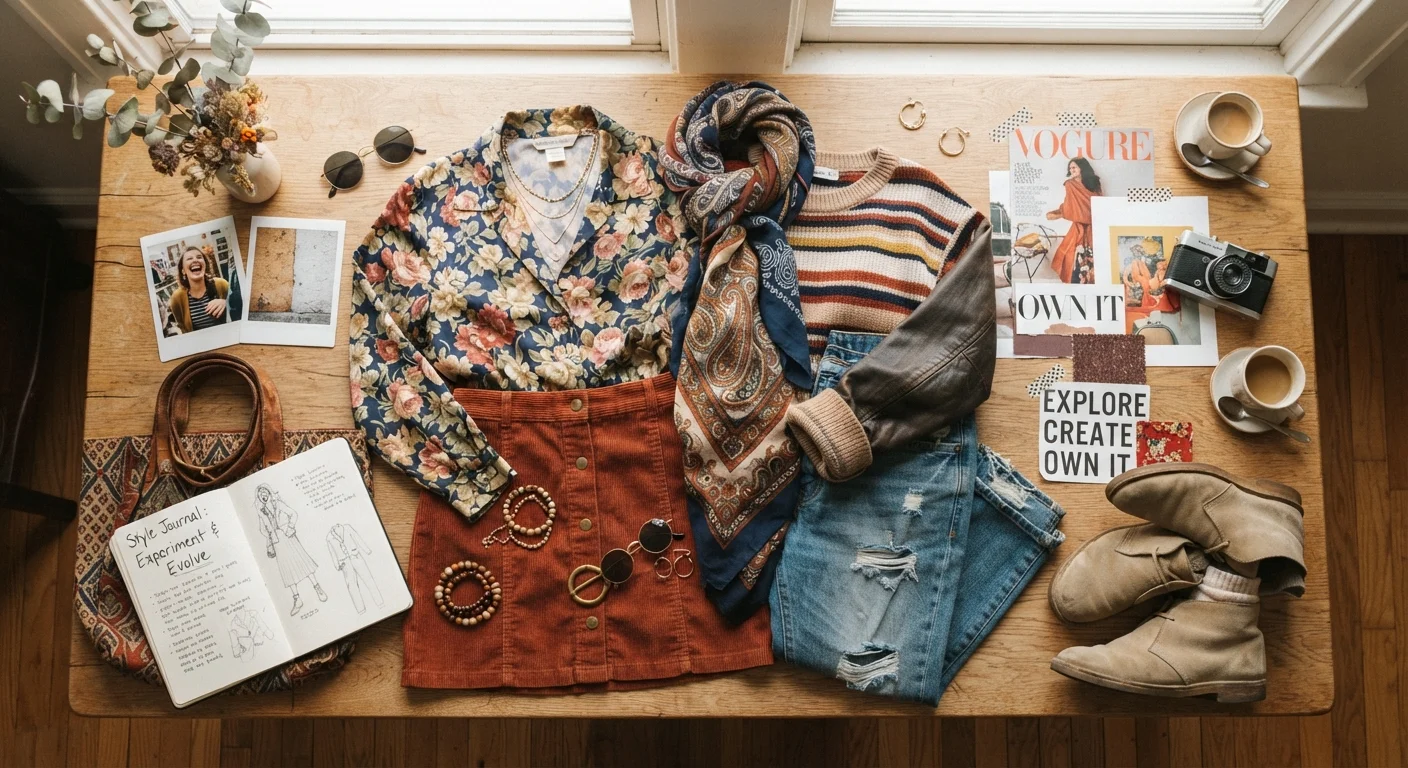
The single most effective starting exercise costs nothing: gather visual references without overthinking them. Scroll through image platforms, flip through magazines you actually enjoy, or simply observe outfits you admire on people around you. Save or clip anything that creates a positive reaction — even if you can't articulate why yet.
After collecting 20 to 30 images over a week or two, look for patterns. Ask yourself:
- Are most images light and airy, or dark and dramatic?
- Do the clothes fit loosely or closely? Are silhouettes structured or relaxed?
- What colors appear repeatedly?
- Is the overall mood polished, casual, playful, romantic, or something else?
Those recurring answers are the building blocks of your aesthetic. This process works because it bypasses self-consciousness — you're responding to images, not constructing an identity from scratch.
Your beauty choices belong in this exploration too. The way you approach hair and makeup is part of your overall visual story. See our guide to beauty as self-expression for a deeper look at how those rituals connect to identity.
Don't edit yourself during the inspiration phase
When gathering visual references, resist the urge to second-guess what you save. If something creates a positive reaction, capture it — even if it seems inconsistent with other images. The editing and pattern-finding comes later. Your unfiltered instincts during this phase are the most useful data you have.
Translating Inspiration Into an Actual Wardrobe
Inspiration boards are clarifying, but at some point the rubber meets the road: what do you actually wear? This is where beginners often feel stuck, especially if their current wardrobe doesn't reflect the aesthetic they've discovered they want.
The good news is that transformation doesn't have to be a full overhaul. A more practical approach:
- Audit what you already own. Pull out pieces that genuinely reflect your discovered aesthetic — you likely own more than you think. These become your foundation.
- Identify the gaps. What silhouette, color, or item type is missing? Prioritize one or two additions rather than wholesale replacement.
- Think in outfits, not individual pieces. A new item only earns its place if it works with at least three things already in your closet.
Budget is a real consideration for most people. Explore the everyday fashion hub for practical tips on dressing confidently without overspending. It's also worth noting that style identity rooted in personal values — including sustainability — tends to produce more durable, satisfying wardrobes. Our piece on aligning your wardrobe with your values explores that connection further.
Your Aesthetic Can Evolve — And That's the Point
One of the most freeing realizations about personal style is that it's allowed to change. The aesthetic that felt exactly right at 22 may not reflect who you are at 32 — and that's not inconsistency, it's growth. Treating your style as a fixed identity can actually create pressure that makes getting dressed feel like a performance rather than an expression.
A healthier framework: think of your aesthetic as a living document. Revisit it deliberately every so often, especially after major life changes, new interests, or simply a shift in what brings you joy. Notice when you stop reaching for pieces that once felt central to your look — that's information.
For readers wondering how to stay grounded in a personal aesthetic while still engaging with what's new in fashion, our article on personal style versus trends offers a nuanced way to think about that balance.
Ultimately, the goal of self-expressive dressing isn't to land on a perfect, permanent answer. It's to develop a clearer, more confident relationship with how you present yourself — one that feels genuinely yours, whatever form that takes.