

Key Takeaways
Option A
Certified Refurbished
The structured, inspection-backed second-life option.
Best for: Shoppers who want significant savings but need documented quality standards and a meaningful warranty.
Option B
New (Factory-Sealed)
The untouched, full-warranty baseline.
Best for: Buyers who prioritize full manufacturer support, the latest production run, and zero prior usage history.
If you need full manufacturer support and the latest firmware or hardware revision
New (Factory-Sealed)
Only new products guarantee you're getting the most current production version with an unbroken manufacturer warranty chain.
If you want meaningful savings with documented quality checks and a real return window
Certified Refurbished
Manufacturer-certified or major retailer-certified programs require functional testing and typically include a 90-day to one-year warranty.
If you're comfortable doing your own due diligence and want the steepest discount
Certified Refurbished
Third-party and seller-refurbished tiers often offer the deepest price cuts, but require careful review of seller ratings and return policies.
If you're buying a gift and want zero ambiguity about condition
New (Factory-Sealed)
A factory-sealed box removes any uncertainty about prior use, cosmetic wear, or missing accessories.
Why Condition Labels Are Inconsistent — and Why It Matters
Walk through any major electronics retailer online and you'll encounter a dizzying mix of labels: new, open-box, certified refurbished, manufacturer refurbished, seller-refurbished, and pre-owned. The problem is that none of these terms are legally standardized. A "refurbished" label from one seller can mean a full factory inspection with a one-year warranty; from another, it might mean the item was wiped and repackaged with no testing at all.
This inconsistency isn't accidental — it's a byproduct of how secondary electronics markets developed. Manufacturers, retailers, and third-party resellers each created their own grading systems to serve their own needs. The result is a landscape where the label is only the starting point, not the answer.
Understanding what each tier actually involves — and what protections come with it — is the most reliable way to avoid paying a premium for something that doesn't deliver. This is especially relevant as the same logic applies in other markets; see how certified pre-owned compares to standard used vehicles for a parallel example of how certification tiers work in practice.
| Criterion | Certified Refurbished | New (Factory-Sealed) |
|---|---|---|
| Prior use | Yes — tested and repaired | None — untouched |
| Inspection standard | Varies by program; documented testing required for manufacturer-certified | Quality-controlled at factory |
| Warranty | 90 days to 1 year (program-dependent) | Full manufacturer warranty |
| Cosmetic condition | May show minor wear; graded by tier | Pristine, no wear |
| Accessories | May be third-party substitutes | All original, factory-included |
| Typical price vs. new | 15%–40% less | Full retail price |
| Return policy | Varies by seller or retailer | Standard manufacturer/retailer policy |
Breaking Down the Key Condition Tiers
New (factory-sealed) means the product has never been opened, used, or returned. It carries a full manufacturer warranty and reflects the current production specifications. This is the baseline against which all other conditions are measured.
Open-box is where ambiguity begins. An open-box item was returned after purchase — but the reason for the return varies enormously. It could be that a customer changed their mind within a return window and never used the product. It could also mean a device was returned because of a defect. Retailers rarely disclose the specific return reason. Open-box items may or may not have been inspected before going back on the shelf, and warranties are often shortened or limited to the retailer's own return policy.
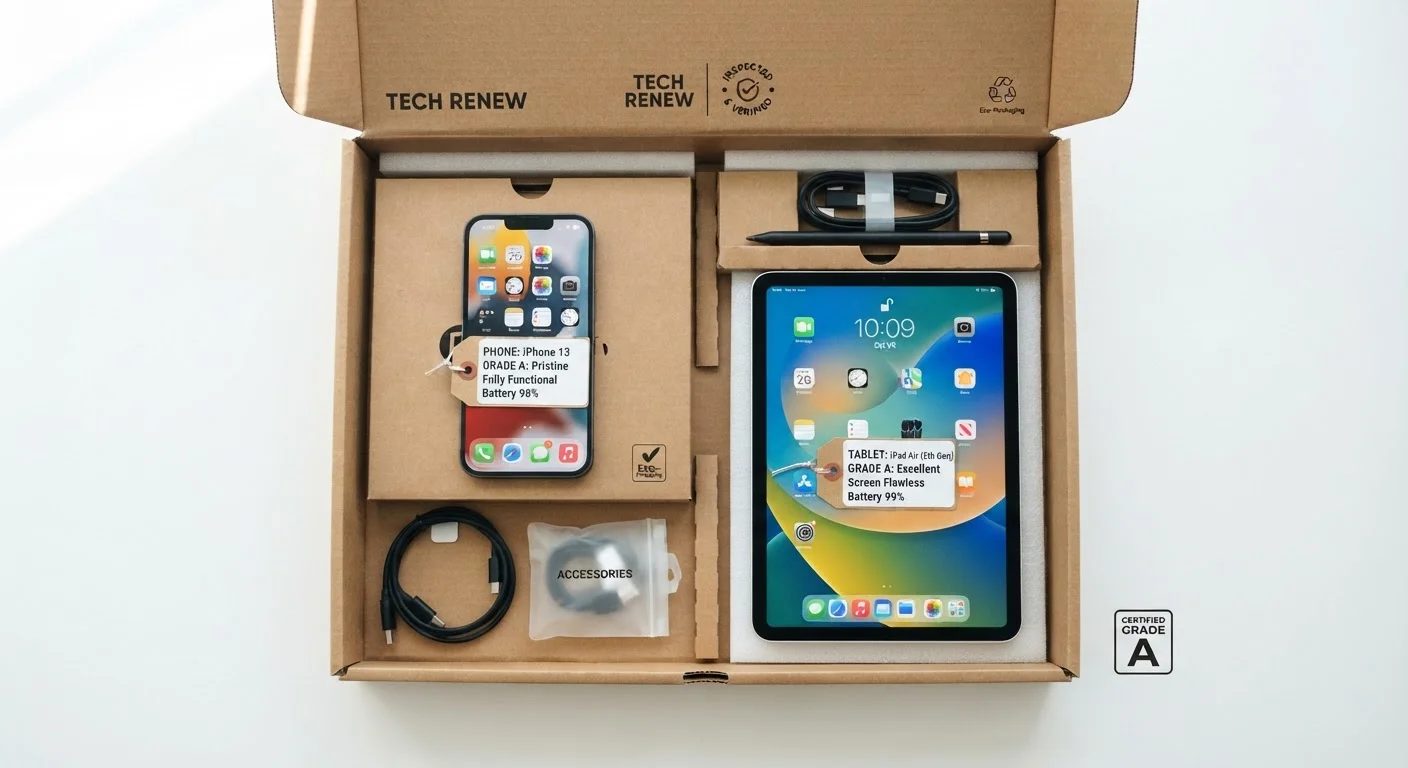
Certified refurbished — particularly when the certification comes from the original manufacturer — is a meaningfully different category. These programs typically require the device to be disassembled, tested against original specs, repaired where necessary, and repackaged. Manufacturer-certified programs usually include a warranty (commonly 90 days to one year) and may replace cosmetically damaged components. Major retailer-certified programs follow similar frameworks, though specifics vary.
Seller-refurbished offers no standardized baseline. It indicates that a third-party seller — not the manufacturer — has done some form of refurbishment, but the scope of testing, parts used, and warranty coverage are entirely at the seller's discretion. Seller feedback ratings and return policies become the primary quality signals here.
~40%
Potential savings on certified refurbished electronics
Consumer electronics research consistently shows certified refurbished devices can sell for 15–40% below new retail, depending on product age and category.
~1 in 4
Online electronics purchases returned by US shoppers
Industry estimates suggest roughly 25% of online electronics purchases are returned, feeding a large and varied secondary market with inconsistent condition standards.
What to Actually Check Before You Buy
The condition label is a starting point, not a finish line. Before committing to any non-new purchase, verify the following:
- Who issued the certification? Manufacturer-certified programs carry more weight than retailer or third-party labels. Look for the specific program name, not just the word "certified."
- What does the warranty cover and for how long? A 30-day seller warranty is categorically different from a 12-month manufacturer warranty. Read the warranty terms, not just the duration.
- Are all original accessories included? Refurbished listings often substitute third-party cables, chargers, or earbuds. This matters both for functionality and resale value.
- What is the return window? Electronics can reveal defects only after real-world use. A 15-day return window gives you much less protection than a 30- or 90-day window.
- What cosmetic grade applies? Some programs use letter or number grades (A, B, C or Grade 1, 2, 3) to indicate scratch and wear levels. If no grade is specified, ask or assume the lower end.
This same principle of reading the fine print applies whenever you're comparing tiered quality options — whether you're looking at generic vs. name-brand products or thrifted vs. new clothing. The label is marketing; the details are what matter.
Open-Box Is Not the Same as Refurbished
Open-box items were simply returned and placed back on sale — they are not necessarily tested or repaired. Some retailers do inspect open-box returns before resale, but many do not. If a listing says "open-box" rather than "certified refurbished," treat it as a returned product of unknown condition unless the retailer explicitly states otherwise. Always verify the specific retailer's open-box policy before purchasing.