

Key Takeaways
Option A
Generic (Store Brand)
The cost-conscious, no-frills alternative.
Best for: Budget-conscious shoppers who prioritize function over brand recognition across everyday staples.
Option B
Name Brand
The established, premium-marketed option.
Best for: Shoppers where formulation, performance consistency, or reliability genuinely justifies a higher price.
If you're buying everyday pantry staples like flour, sugar, or canned goods
Generic (Store Brand)
These products have standardized compositions with little meaningful variation between generic and branded versions. The savings are real and consistent.
If you're purchasing over-the-counter medications with identical active ingredients
Generic (Store Brand)
Generic drugs approved in the U.S. must meet the same FDA standards for active ingredient, dosage, and bioequivalence as their branded counterparts.
If you're buying electronics, power tools, or appliances
Name Brand
Brand-name manufacturers often have more established quality-control histories, longer warranty support, and wider availability of replacement parts.
If you're shopping for cleaning supplies or paper products
Generic (Store Brand)
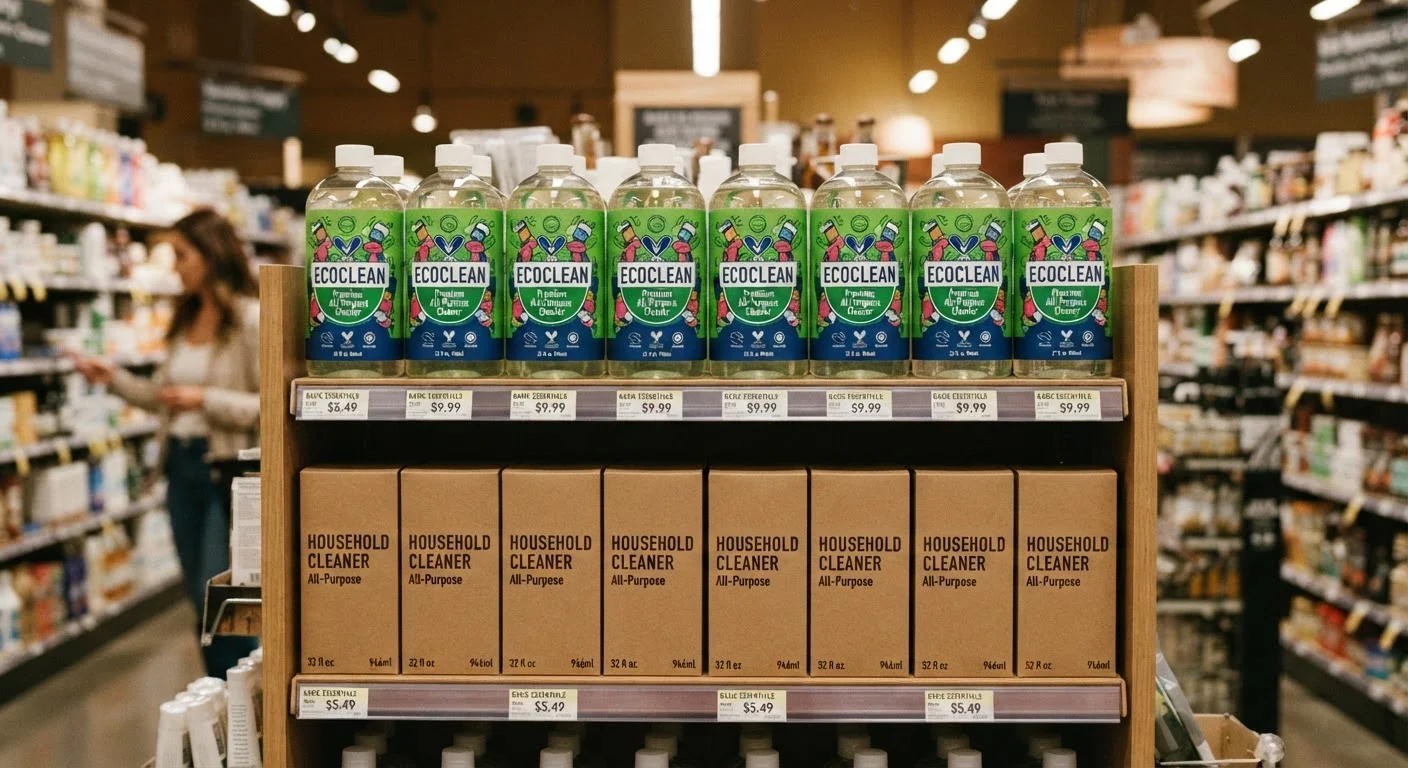
Many store-brand cleaning products are chemically comparable to branded versions. A quick label comparison of active ingredients usually confirms this.
If personal preference, sensory experience, or past results matter significantly
Name Brand
Some categories — skincare formulations, specialty foods, performance gear — involve formulation nuances where brand-specific differences are real and worth investigating individually.
The Core Question: What Are You Actually Paying For?
When a name brand product costs 40–60% more than its store-brand equivalent, that difference rarely reflects a proportional gap in quality. It more often reflects advertising spend, retail positioning, and the cost of brand-building. Understanding what drives a price difference — and whether that difference translates to something meaningful for you — is the foundation of sharper shopping decisions.
Generic and store-brand products have expanded significantly in quality and category coverage over the past two decades. Major retailers invest in their own-label lines precisely because product quality is a competitive differentiator. That said, generics are not uniformly equal to name brands. The gap varies widely by category, and assuming either direction by default is a mistake.
For a broader look at how pricing psychology affects everyday purchasing, see how retailers use pricing tactics to influence spending.
| Criterion | Generic (Store Brand) | Name Brand |
|---|---|---|
| Price | Typically 20–50% lower | Higher; includes marketing costs |
| Ingredient / spec equivalence | Often identical (check label) | May have proprietary formulations |
| OTC medication standards | FDA-equivalent active ingredients | Same active ingredient, higher cost |
| Warranty & support (electronics) | Shorter or limited | More established repair ecosystem |
| Packaging & branding | Minimal; functional | Premium; heavily marketed |
| Manufacturing origin | Often same factory as name brand | Brand-owned or contracted production |
| Category consistency | Strong in staples, weaker in specialty | More consistent across complex categories |
Where Generics Consistently Hold Their Own
Certain product categories follow standardized formulations or regulatory requirements that effectively level the playing field between generic and branded options.
- Over-the-counter medications: In the U.S., generic OTC drugs must contain the same active ingredient at the same dosage as their brand-name counterparts — a requirement enforced by the FDA. When the active ingredient is identical, choosing the lower-cost option is straightforward.
- Pantry and grocery staples: Flour, sugar, canned vegetables, dried pasta, and similar commodities have little room for meaningful quality differentiation. Taste-test research consistently shows consumers struggle to distinguish generic from branded versions in blind conditions for many staples.
- Basic cleaning and household supplies: Bleach, dish soap, and multi-surface cleaners list active ingredients on the label. Comparing those labels — rather than the packaging — tells you whether the formulations are equivalent.
Store Brand ≠ Inferior by Default
Many major retailers require their store-brand suppliers to meet the same manufacturing and quality standards as national brands — and in some cases, the same production facilities produce both. The FDA also requires generic medications to demonstrate bioequivalence to their brand-name counterparts. The assumption that a store label means lower quality is increasingly outdated, though it still holds in certain specialty categories.
If you're building a smarter framework for evaluating everyday purchases, this grounded introduction to smarter shopping covers the fundamentals of pricing literacy and cutting through marketing noise.
Where Name Brand Products May Justify the Premium
Not every product category reduces to a label comparison. Some areas involve formulation complexity, reliability history, or long-term cost considerations where brand reputation carries more weight.
- Electronics and appliances: Component sourcing, firmware support, warranty service, and parts availability all vary. Established brands often have stronger repair ecosystems and longer support timelines — factors that matter especially for major purchases. Researching before major household purchases is worth the effort here.
- Skincare and personal care: Active ingredient percentages, stabilization chemistry, and delivery systems differ meaningfully between formulations. A product claiming a similar active ingredient isn't necessarily equivalent if the concentration or formulation context differs.
- Specialty or performance categories: High-performance athletic gear, professional-grade tools, or precision instruments are areas where brand history and materials sourcing can reflect genuine engineering differences rather than just marketing.
The parallel in the automotive world is instructive: the distinction between OEM, equivalent, and aftermarket parts mirrors the generic vs. name brand decision — see understanding OEM versus aftermarket parts for a related framework.
~20–25%
Average price gap: generics vs. name brands
Consumer research consistently finds store-brand products priced roughly 20–25% below name-brand equivalents across grocery and household categories.
~80%
Americans who buy store brands regularly
Surveys by the Private Label Manufacturers Association have found the large majority of U.S. consumers purchase store-brand products on a regular basis.
Bioequivalent
FDA standard for generic drug approval
The FDA requires generic drugs to be bioequivalent to brand-name versions, meaning the active ingredient works the same way in the body at the same dosage.
A Practical Decision Framework
Rather than applying a blanket rule, use a short checklist before defaulting to either option:
- Compare the ingredient or spec list, not the label. For food, cleaning products, and medications, the active or primary ingredients tell you most of what you need to know.
- Consider the stakes of getting it wrong. Low-stakes purchases (paper towels, pantry staples) warrant less investigation. High-stakes purchases (appliances, medications for complex conditions, baby products) warrant more scrutiny.
- Factor in total cost, not just unit price. A cheaper product that requires replacement or uses more per application may not actually save money. Understanding what sale prices actually mean applies the same logic to markdown pricing.
- Check reviews for pattern evidence. Individual preferences vary, but consistent patterns across many user reviews — especially about durability or performance — carry more signal than marketing claims.
- Use a trial purchase before committing in bulk. For recurring purchases, try the generic version in a single unit before buying in quantity.
Building this kind of evaluative habit connects to broader budgeting fundamentals — knowing where to spend less frees up room to spend where quality genuinely matters to you.