

Key Takeaways
Why Advance Communication Is Everything
Cruising with a dietary restriction — whether it's a celiac diagnosis, a severe nut allergy, a vegan lifestyle, or a religious requirement like kosher or halal — is genuinely manageable on most modern ships. The catch? The system works best when you do the legwork before you ever step onboard.
Most major cruise lines have dedicated special dietary teams, but they rely on advance notice to source ingredients, prep isolated cooking areas, and brief the galley staff. Waiting until you're at the dinner table to announce a gluten intolerance puts the kitchen in a tough spot — and you in an anxious one.
When booking, look for the cruise line's dietary accommodation form or special needs section. Submit your restrictions in writing, being as specific as possible: "gluten-free" is more actionable than "wheat sensitivity." Once your booking is confirmed, follow up again about 30–60 days before sailing to ensure your file is flagged correctly. Ask for written confirmation of what accommodations have been arranged.
Save Everything in Writing
When you receive confirmation of your dietary accommodation from the cruise line, save it — screenshot, email, or printout. Having documentation in hand when you speak with the maître d' or guest services onboard gives your request instant credibility and speeds up resolution if anything has been missed.
If you're new to cruising altogether, the First-Time Cruiser's Complete Handbook covers many of the logistical questions that come up well before dietary planning even begins.
Best Practices for Onboard Dining
Submit dietary restrictions in writing at the time of booking, using precise clinical or culinary language.
Vague descriptions like 'sensitive to dairy' can be interpreted many ways. Specific language — 'lactose intolerance requiring no milk, butter, or cream in any dish' — leaves no room for misinterpretation and travels clearly through the cruise line's systems.
Introduce yourself to the dining room maître d' on the first evening and confirm your restrictions directly.
Even with advance documentation, getting face-to-face with the person who manages your section creates accountability and opens a direct channel of communication for the rest of the voyage. Staff turnover and busy embarkation days mean paperwork doesn't always arrive where it needs to.
Pre-order the following day's meals at the end of each main dining room dinner.
This gives the galley sufficient lead time to source ingredients, use a clean prep area, and prepare a version of the dish that meets your needs — rather than improvising at service time. It also eliminates the stressful moment of scanning a menu for safe options while hungry.
Carry a printed or digital 'allergy card' summarizing your restrictions in plain language — and in relevant languages for ports of call.
Language barriers and loud dining rooms make verbal communication risky. A concise written card that you can hand to waitstaff removes ambiguity and creates a reference point that staff can take to the kitchen.
Ask the buffet manager — not line staff — to retrieve items directly from the kitchen when cross-contamination is a concern.
Buffet servers are trained for speed and volume, not allergen management. The manager has the authority and knowledge to fulfill a kitchen-prepared, isolated request and can communicate your needs to the back-of-house team accurately.
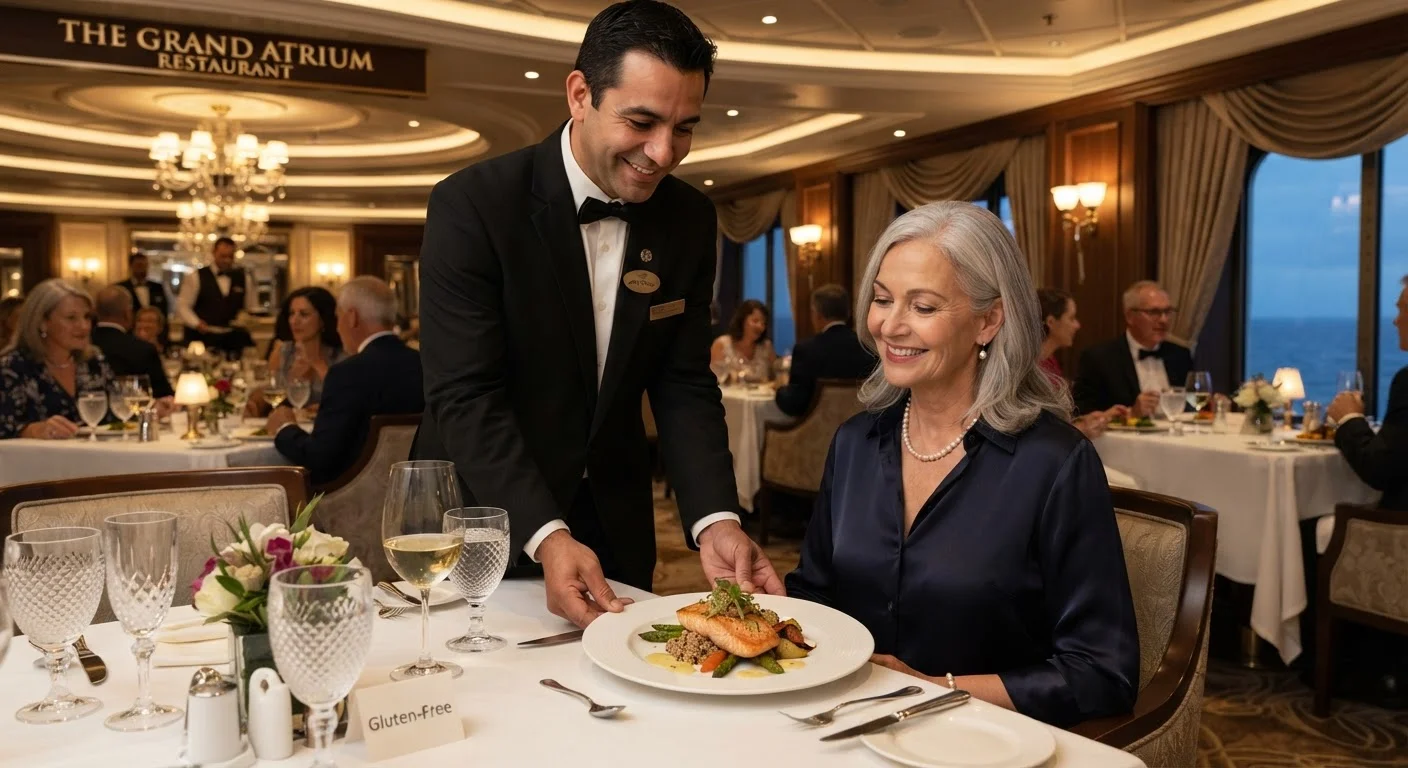
Understanding how different dining venues handle restrictions will save you real stress. The main dining room — typically included in your fare — is staffed by waiters who work the same tables every night and can build a working knowledge of your needs. Many cruise lines allow you to pre-order the following night's meal at the end of dinner, giving the kitchen hours to prepare allergen-free versions properly.
For a broader look at what your dining costs actually cover, see what 'all-inclusive' actually means on a cruise.
Buffets, Specialty Restaurants, and Shore Days
The buffet is the most challenging environment for anyone with a serious restriction. Shared serving utensils, steam trays where foods mingle, and high passenger turnover make cross-contamination a real concern. If your restriction is medically serious, treat the buffet with caution — speak directly with a buffet manager rather than relying on signage, and don't hesitate to ask for items to be brought from the kitchen rather than served from the line.
Specialty restaurants (think steakhouses, sushi bars, or Italian trattorias) often charge a surcharge and may have less flexibility than the main dining room. Call ahead or ask the maître d' before you're seated whether the kitchen can accommodate your restriction — don't assume a specialty kitchen has the same protocols as the main galley.
Shore days add a layer of complexity. If the ship is docked and most passengers are off exploring, onboard dining may be scaled back to the buffet only. Plan ahead: either eat a substantial breakfast before leaving the ship, carry safe snacks, or research dining options at the port in advance. Our guide on ship vs. independent shore excursions can help you structure your day ashore more effectively.
Kosher and Halal Require Earlier Planning
Certified kosher and halal meals are handled differently from other dietary restrictions — they typically require the cruise line to source and seal meals from approved suppliers well in advance. Some cruise lines offer these as standard on certain itineraries and only by special arrangement on others. Confirm the specific process with your cruise line at least 60–90 days before sailing, and ask explicitly whether meals are certified or simply 'prepared without pork,' as the two are very different things.
Quick Wins: Starting Strong on Day One
First-time cruisers are often surprised by how much of their experience is shaped by the knowledge they bring onboard. The things first-time cruisers wish they'd known earlier covers the practical realities of ship life that dietary planning fits neatly alongside.
This article is for general informational purposes only. Travelers with severe food allergies or medical dietary requirements should consult their healthcare provider before travel and verify all accommodation details directly with their cruise line prior to departure.