

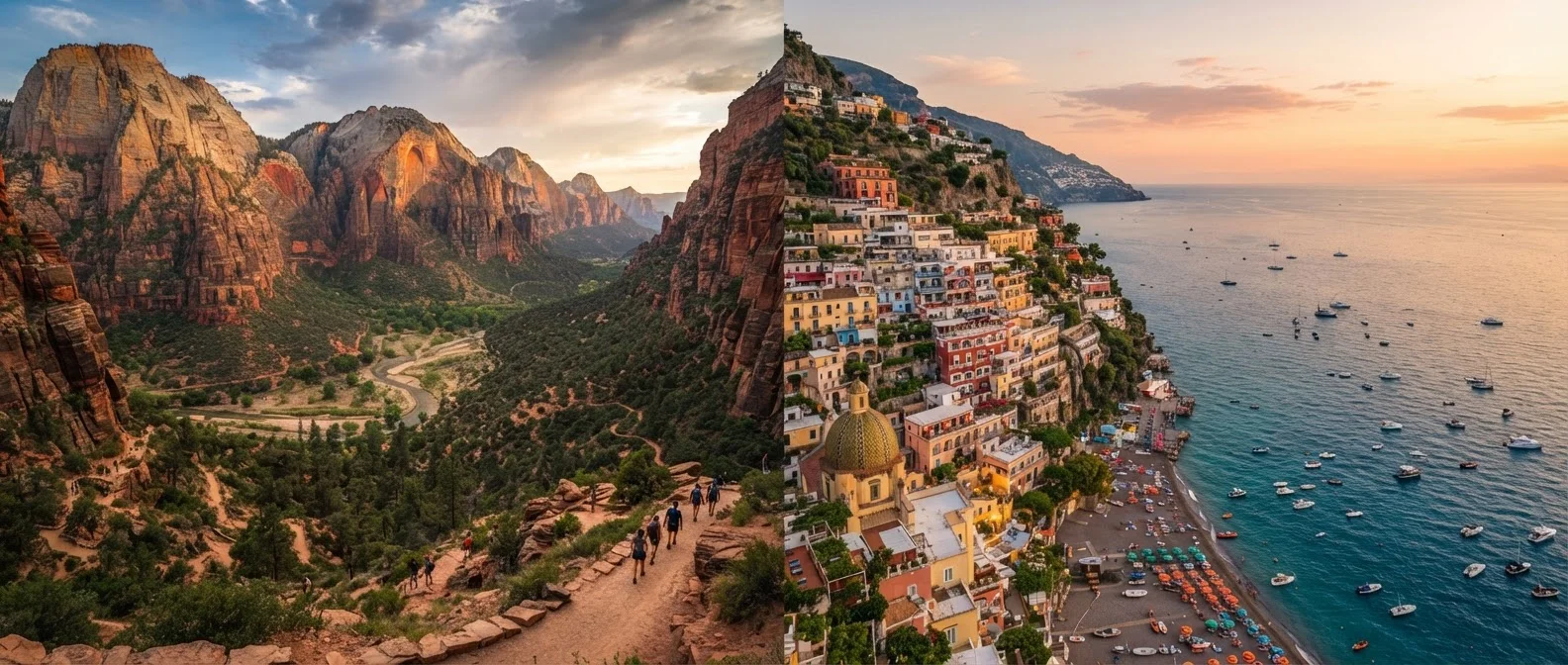
Key Takeaways
Option A
U.S. National Parks
The accessible, awe-inspiring home front option.
Best for: Travelers who want world-class natural scenery, minimal passport logistics, and flexible trip lengths on a controllable budget.
Option B
International Destinations
The culturally rich, horizon-expanding alternative.
Best for: Travelers seeking immersive cultural contrast, unique cuisine, and experiences that simply can't be replicated on domestic soil.
If you want natural grandeur without passport logistics
U.S. National Parks
Parks like the Grand Canyon, Yellowstone, and Glacier deliver jaw-dropping landscapes with straightforward access and no international entry hurdles.
If cultural immersion and culinary discovery are your priorities
International Destinations
Countries in Southeast Asia, Central America, or Southern Europe offer deeply distinct cultural experiences that domestic travel generally cannot replicate.
If you're traveling with a family on a tight budget
U.S. National Parks
The America the Beautiful annual pass covers entrance fees at hundreds of federal sites, making per-day costs extremely manageable for families.
If your dollar needs to stretch across many days of travel
International Destinations
In destinations where the U.S. dollar is strong — parts of Latin America, Southeast Asia, Eastern Europe — daily costs for food, lodging, and transit can be surprisingly low.
If you value easy, spontaneous trip planning
U.S. National Parks
Domestic parks require no visas, currency exchange, or travel advisories, and many are drivable from major U.S. cities, reducing planning complexity significantly.
Breaking Down the Real Costs
Comparing national parks to international travel isn't just about which plane ticket is cheaper — it's about total cost across every category: transportation, lodging, food, activities, and incidentals. Understanding where money actually flows is key to making a fair comparison. Our guide to travel spending categories breaks this framework down further.
For national parks, the biggest upfront variable is how you get there. Driving to parks like Great Smoky Mountains or Shenandoah is inexpensive for East Coast visitors, while flying to reach Glacier or Olympic adds significantly to the bill. Once you arrive, costs drop sharply: entrance fees are modest (or covered by an annual interagency pass), and campsite fees — typically $15–$30 per night — are well below hotel rates. Food costs largely depend on whether you self-cater, a real option when camping or using vacation rentals.
International travel front-loads costs in flights and, depending on destination, visas or travel documentation. But once abroad, daily costs in many popular destinations run lower than equivalent U.S. spending. A full meal in Portugal, Colombia, or Vietnam can cost a fraction of a comparable U.S. restaurant experience. Accommodation options also vary enormously — from hostels to boutique hotels — giving budget-conscious travelers real flexibility.
| Criterion | U.S. National Parks | International Destinations |
|---|---|---|
| Passport / Visa Required | No | Often yes |
| Average Flight Cost | Varies; drivable options exist | Higher; international airfare |
| Daily Food Cost | Moderate; self-catering possible | Low to moderate (destination-dependent) |
| Accommodation Range | Camping to lodge; limited luxury | Hostel to resort; wide range |
| Cultural Immersion | Limited | High |
| Natural Scenery | World-class | Varies by destination |
| Planning Complexity | Low to moderate | Moderate to high |
| Language Barrier | None | Possible; varies by country |
| Annual Pass Value | Strong (America the Beautiful) | Not applicable |
Experience Depth: What Each Type of Trip Actually Delivers
Value isn't only financial. The texture of a trip — what you remember, learn, and carry home — matters just as much as what you spent getting there.
National parks deliver scale and wildness that is genuinely hard to match anywhere on Earth. Watching geysers erupt at Yellowstone, hiking among ancient sequoias, or rafting through the Grand Canyon are experiences rooted in geological time. For outdoor enthusiasts, the variety across 63 national parks is extraordinary: desert, alpine, coastal, volcanic, and boreal ecosystems all exist within U.S. borders. The experience, however, is largely nature-focused. Cultural immersion, language encounters, and culinary discovery are limited by definition.
International destinations offer a different kind of depth. Exploring a centuries-old market in Morocco, learning regional cooking techniques in Oaxaca, or navigating a new transit system in Japan engages travelers in ways that national parks typically don't. Cultural contrast — encountering different rhythms, values, and ways of daily life — is itself a form of education and enrichment. If eco-tourism is your specific interest, destinations like Costa Rica and Ecuador offer nature experiences that rival U.S. parks while layering in cultural context. Our comparison of Costa Rica vs. Ecuador eco-tourism explores that angle in detail.
63
Designated U.S. National Parks
The U.S. National Park Service manages 63 national parks spanning deserts, mountains, coastlines, and forests across the country.
325M+
Annual National Park Visits
According to the National Park Service, U.S. national parks collectively receive over 325 million recreational visits in a typical year.
Top 10
Most-Visited Parks Require Reservations
Many high-demand parks, including Yosemite and Rocky Mountain, now require timed-entry reservations during peak seasons to manage visitor volume.
Lodging choices also shape the experience significantly on both trip types. Vacation rentals versus hotels is a decision that plays out differently in a mountain gateway town than in a European city — worth thinking through before you book.
Planning, Accessibility, and Practical Considerations
Ease of planning is a real differentiator. National parks require no passport, no visa research, no currency exchange, and no review of foreign entry requirements. Language is no barrier. Medical and emergency infrastructure is familiar. For families with young children, first-time solo travelers, or anyone managing health considerations, these factors carry genuine weight.
International travel requires more preparation — but that preparation is manageable with the right approach. Before any international trip, consulting resources that cover entry rules, safety advisories, health requirements, and local customs is essential. A structured pre-trip research checklist can streamline this process considerably. Entry requirements and travel advisories change; always verify current rules with official government sources before departure.
Seasonality affects both options equally. Peak summer crowds at Yellowstone or Yosemite can strain accommodations and diminish the sense of wilderness. Similarly, traveling during monsoon season or local holidays abroad can affect pricing, availability, and logistics. Flexibility in timing often unlocks better value on either path.
For travelers who find international logistics daunting, structured travel planning services can help. Travel planning resources for American travelers covers both domestic and international tools worth knowing about.
This article is for general informational purposes only. Prices, entry requirements, and conditions at specific destinations change frequently. Always verify current travel advisories, visa rules, and park reservation requirements through official government and park authority sources before making travel plans.