

| Number of mainstream body styles | Approximately 12 recognized types (Based on standard industry and regulatory classification systems) |
| What body style describes | Structural form: roofline, doors, and cargo integration |
| What body style does NOT describe | Engine, drivetrain, brand segment, or trim level |
| Most commonly confused pair | Hatchback vs. sedan (cargo access method differs) |
| Marketing vs. regulatory labels | May differ — title documents reflect official classification |
What a Body Style Label Is Actually Describing
When a window sticker, advertisement, or vehicle registration lists a body style, it's describing the physical structure of the vehicle — specifically the number of enclosed rows, the roofline profile, how cargo space is integrated, and how the vehicle opens. It is not a comment on drivetrain, engine size, or brand segment.
Body style labels matter in practical ways: they affect insurance classification, registration fees in many states, how the vehicle is taxed for commercial use, and what you can realistically fit inside. Understanding what each term means is useful whether you're shopping, registering, or simply trying to read a vehicle's spec sheet accurately. For a broader map of how categories like SUVs, trucks, and sedans relate to each other, see the plain-English guide to vehicle categories.
| Number of mainstream body styles | Approximately 12 recognized types (Based on standard industry and regulatory classification systems) |
| What body style describes | Structural form: roofline, doors, and cargo integration |
| What body style does NOT describe | Engine, drivetrain, brand segment, or trim level |
| Most commonly confused pair | Hatchback vs. sedan (cargo access method differs) |
| Marketing vs. regulatory labels | May differ — title documents reflect official classification |
The Core Body Style Terms Defined
Most confusion around body styles comes from a handful of terms that look similar or get used interchangeably in casual conversation. Here is what each one precisely describes:
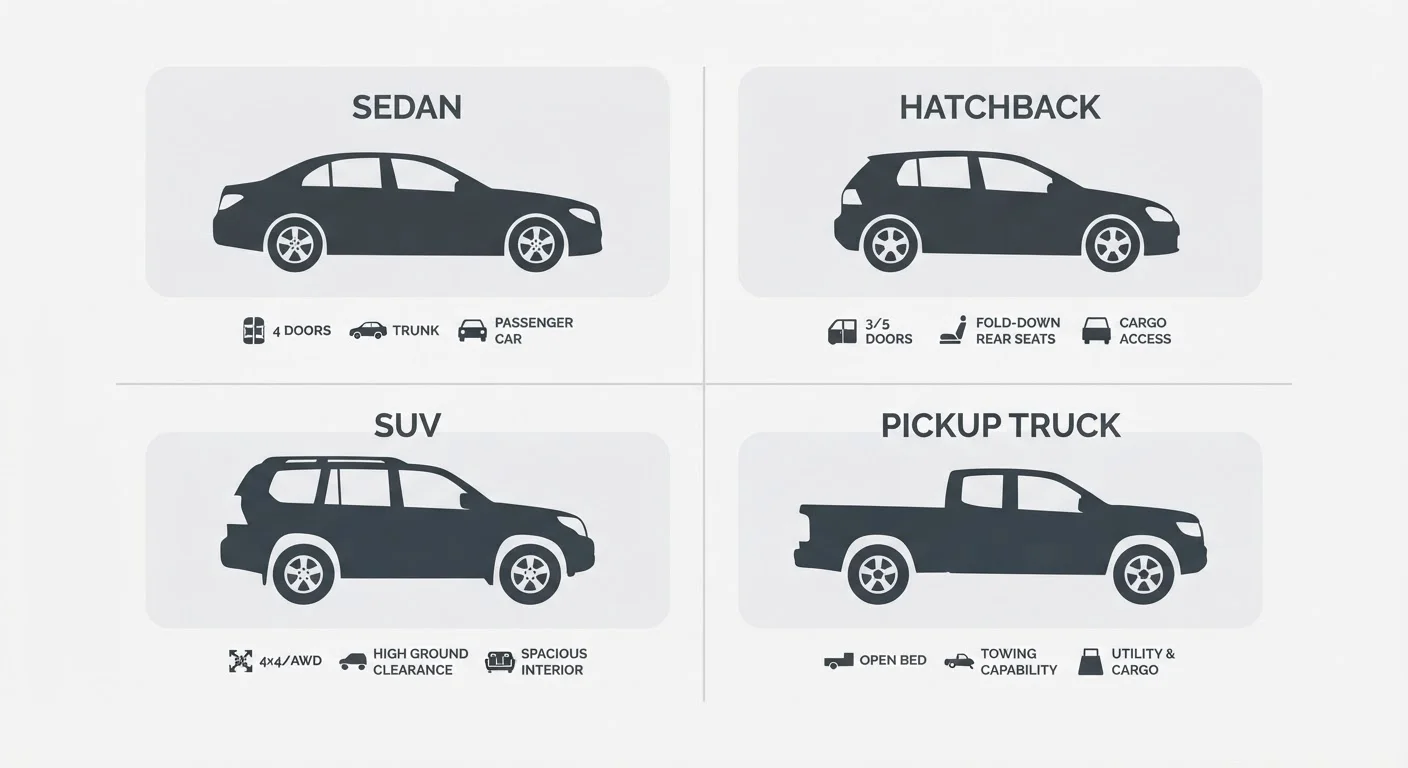
- Sedan: A three-box design — engine compartment, passenger cabin, and trunk as three distinct sections. Typically four doors. The trunk is a separate enclosed space with its own lid.
- Hatchback: A two-box design where the passenger cabin and cargo area share one continuous space under a single rear door that swings upward. See how this distinction affects day-to-day use.
- Coupe: Traditionally a two-door vehicle with a fixed roof and a sloped rear roofline. Some manufacturers now apply the label to four-door vehicles with a similar profile — a contested usage, but increasingly common.
- Fastback: A roofline that slopes continuously and steeply from the roof to the rear bumper in one unbroken line. Can appear on coupes, sedans, or hatchbacks.
- Station wagon: An extended roofline carried all the way to the rear of the vehicle, creating an integrated cargo floor behind the rear seats. Four-door configuration is standard.
- Shooting brake: A two-door wagon — combining a coupe's silhouette with extended cargo space behind the rear seats. Rare in modern production.
- Convertible / Cabriolet: A vehicle with a retractable roof, either soft-top fabric or a folding hard-top. Open-air vehicles include several sub-types beyond the standard convertible.
- Roadster: An open two-seat vehicle without a fixed roof or rear side windows, prioritizing a minimalist, sporty design.
- SUV (Sport Utility Vehicle): A taller-riding vehicle with a wagon-style body built on a truck-influenced or unibody platform. Interior volume is accessed through a rear liftgate.
- Crossover (CUV): Functionally similar to an SUV in shape, but built on a car-derived unibody platform rather than a body-on-frame structure.
- Pickup truck: An open cargo bed separated from the cab. Cab configurations vary — regular, extended, and crew cab describe how many rows of seating are enclosed.
- Minivan: A tall, sliding-rear-door van-bodied vehicle optimized for passenger capacity. The sliding door is the definitive structural identifier.
Three-box design
A vehicle layout where the engine bay, passenger cabin, and cargo trunk are three visually distinct compartments. Classic sedans are the primary example.
Two-box design
A vehicle layout where the engine bay and the combined passenger-plus-cargo cabin form only two compartments. Hatchbacks and SUVs follow this structure.
Unibody platform
A vehicle construction method where the body and frame are one integrated structure. Most modern passenger cars and crossovers use unibody construction, as opposed to the separate body-on-frame approach common in trucks.
Liftgate
A rear door that swings upward to provide access to a vehicle's cargo area. Common on hatchbacks, wagons, SUVs, and crossovers.
Roofline profile
The visual shape formed by the top of a vehicle from front to rear. Roofline profile is one of the primary distinguishing features between body styles such as fastbacks, coupes, and sedans.
Shooting brake
A two-door vehicle that combines a coupe's body shape with extended cargo space behind the rear seats, similar to a compact two-door wagon. The term has historical roots in British coachbuilding.
Where Labels Get Complicated
Automakers sometimes apply body style labels differently from the traditional definitions — often for marketing reasons. A four-door vehicle marketed as a coupe is the clearest modern example. In these cases, the label is technically inaccurate by classic standards but has become widely accepted usage in the industry.
Registration and insurance documents generally rely on standardized categories set by regulatory bodies, not marketing labels. The term on a window sticker and the term on a title may differ. If you're researching how a vehicle is classified for tax, insurance, or registration purposes, the title document or the manufacturer's official spec sheet is the reliable source — not ad copy.
Body style also connects to what appears on a Monroney label (window sticker), where the classification can affect estimated fuel economy comparisons and EPA testing categories. When you're ready to match a body style to how you actually live and drive, a practical framework for choosing a vehicle type can help narrow the field.
Classic Car Body Styles Follow the Same Rules
Vintage and classic vehicles use the same structural terminology, which is part of why terms like 'shooting brake' and 'roadster' survive today — they originated in early coachbuilding language. If you're exploring classic vehicle ownership, the same body style vocabulary applies. The classic vehicles section covers history, care, and culture for vintage models.