

Key Takeaways
Class-leading towing and payload capacity
Half-ton trucks routinely offer towing ratings between 8,000 and 13,000 pounds depending on configuration, enabling them to haul boats, horse trailers, and utility trailers that would exceed the limits of most other consumer vehicles.
Open cargo bed offers unmatched load flexibility
An open truck bed accepts oversized items — lumber, furniture, landscaping materials — that simply cannot fit in an enclosed vehicle, without requiring a trailer.
High seating position improves visibility on highways
The elevated driving position gives truck operators a clear sightline over traffic in highway and rural conditions, which many drivers find more comfortable on long drives.
Resale values tend to hold well in many markets
Full-size trucks have historically maintained stronger resale value than many other vehicle segments, though this varies by model, condition, mileage, and market conditions.
Modern interiors rival passenger car comfort
Crew-cab configurations provide generous rear seating, and higher trim levels include comfort and technology features comparable to mainstream passenger vehicles.
Four-wheel drive provides genuine off-road and weather capability
Available 4WD systems help drivers navigate unimproved roads, deep snow, or muddy job sites that would stop most passenger cars and crossovers.
Fuel economy is significantly lower than alternatives
Most full-size trucks with V8 or turbocharged V6 engines return EPA city estimates in the mid-to-upper teens (mpg), compared to the mid-to-high 20s common in midsize crossovers — a cost difference that adds up quickly over a year of commuting.
Urban and garage parking is a persistent challenge
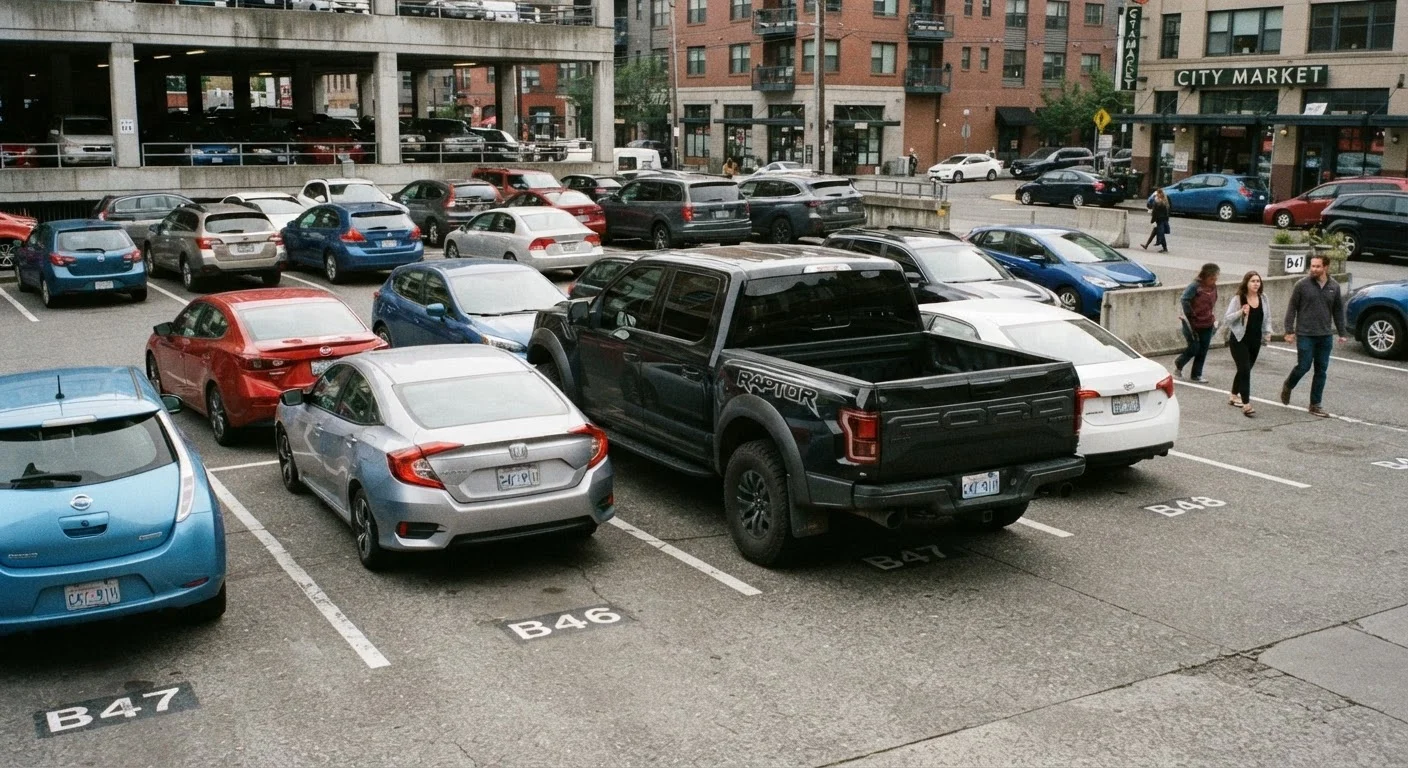
Crew-cab long-bed configurations can exceed 22 feet in overall length, making parallel parking, tight multi-story garages, and urban lots genuinely difficult to navigate.
Higher purchase price and insurance costs
Full-size trucks sit at the upper end of consumer vehicle pricing, and their repair costs and replacement part prices are typically reflected in higher insurance premiums compared to smaller vehicles.
Maneuverability in tight spaces is limited
Wide turning radii and significant vehicle length make U-turns, narrow driveways, and congested urban blocks more demanding than in a sedan or compact SUV.
Ride quality can feel stiff when bed is empty
The rear suspension on full-size trucks is engineered for load-bearing; without weight in the bed, many drivers notice a firm, bouncy ride quality that passenger cars don't exhibit.
Running costs beyond fuel add up over time
Larger tires, heavier braking components, and more complex 4WD systems mean routine maintenance and replacement costs can exceed those of lighter vehicles.
Our Verdict
A full-size truck is a genuinely capable vehicle that earns its keep for owners who regularly tow, haul, or operate in demanding conditions. For drivers whose daily routine involves mostly urban commuting or light passenger use, the fuel costs, parking challenges, and sheer size become real friction points that smaller vehicles avoid. The key is honest self-assessment: how often do you need the truck to be a truck?
Best suited to drivers who regularly tow trailers, haul heavy loads, or navigate job sites — and who are willing to accept the fuel and parking trade-offs that come with the territory.
What Makes a Full-Size Truck Different from Other Vehicles
Full-size trucks — think half-ton pickups like the F-150, Silverado 1500, and Ram 1500 class — are purpose-built around a body-on-frame architecture designed for load-bearing work. That structural approach sets them apart from most crossovers and SUVs, which use unibody construction optimized for ride comfort and fuel efficiency. The result is a vehicle category that excels at towing and hauling but asks something in return from drivers who use it every day.
Before weighing the trade-offs, it helps to understand that "full-size truck" covers a wide range of configurations. Cab size, bed length, drivetrain, and engine choice all affect how the vehicle behaves as a daily driver. See our guide to pickup truck configurations for a deeper look at how those specs affect real-world use.
The Real Advantages of Daily Driving a Full-Size Truck
Owning a full-size truck as your primary vehicle comes with a set of practical benefits that are difficult to replicate in any other vehicle class.
Class-leading towing and payload capacity
Half-ton trucks routinely offer towing ratings between 8,000 and 13,000 pounds depending on configuration, enabling them to haul boats, horse trailers, and utility trailers that would exceed the limits of most other consumer vehicles.
Open cargo bed offers unmatched load flexibility
An open truck bed accepts oversized items — lumber, furniture, landscaping materials — that simply cannot fit in an enclosed vehicle, without requiring a trailer.
High seating position improves visibility on highways
The elevated driving position gives truck operators a clear sightline over traffic in highway and rural conditions, which many drivers find more comfortable on long drives.
Resale values tend to hold well in many markets
Full-size trucks have historically maintained stronger resale value than many other vehicle segments, though this varies by model, condition, mileage, and market conditions.
Modern interiors rival passenger car comfort
Crew-cab configurations provide generous rear seating, and higher trim levels include comfort and technology features comparable to mainstream passenger vehicles.
Four-wheel drive provides genuine off-road and weather capability
Available 4WD systems help drivers navigate unimproved roads, deep snow, or muddy job sites that would stop most passenger cars and crossovers.
Beyond the listed advantages, modern full-size trucks have closed much of the comfort gap that once separated them from mainstream passenger vehicles. Crew-cab models offer rear-seat legroom that rivals midsize sedans, and higher trim levels frequently include features like heated and ventilated seats, advanced driver-assistance systems, and large infotainment screens. Ride quality has improved substantially compared to trucks from two decades ago, making highway commutes considerably more manageable.
The Genuine Disadvantages You'll Notice Every Day
The same characteristics that make full-size trucks capable working vehicles create friction in everyday driving situations. These are not hypothetical inconveniences — they show up regularly.
Fuel economy is significantly lower than alternatives
Most full-size trucks with V8 or turbocharged V6 engines return EPA city estimates in the mid-to-upper teens (mpg), compared to the mid-to-high 20s common in midsize crossovers — a cost difference that adds up quickly over a year of commuting.
Urban and garage parking is a persistent challenge
Crew-cab long-bed configurations can exceed 22 feet in overall length, making parallel parking, tight multi-story garages, and urban lots genuinely difficult to navigate.
Higher purchase price and insurance costs
Full-size trucks sit at the upper end of consumer vehicle pricing, and their repair costs and replacement part prices are typically reflected in higher insurance premiums compared to smaller vehicles.
Maneuverability in tight spaces is limited
Wide turning radii and significant vehicle length make U-turns, narrow driveways, and congested urban blocks more demanding than in a sedan or compact SUV.
Ride quality can feel stiff when bed is empty
The rear suspension on full-size trucks is engineered for load-bearing; without weight in the bed, many drivers notice a firm, bouncy ride quality that passenger cars don't exhibit.
Running costs beyond fuel add up over time
Larger tires, heavier braking components, and more complex 4WD systems mean routine maintenance and replacement costs can exceed those of lighter vehicles.
It's also worth noting that visibility around the hood and at low speeds in parking structures can be more demanding than in a sedan or crossover. Backup cameras and parking sensors help, but they don't entirely close that gap. If you're also evaluating vehicles with similar utility footprints, our overview of van configurations offers a useful point of comparison.
~16 mpg
Typical city fuel economy for V8 half-ton trucks
EPA estimates for common V8-equipped full-size trucks in city driving conditions generally fall in the 15–17 mpg range, compared to 25–28 mpg for many midsize crossovers.
8,000–13,000 lbs
Typical half-ton truck towing capacity range
Maximum tow ratings for properly configured half-ton trucks vary widely by cab, bed, engine, and axle ratio — always verify the specific vehicle's tow guide before hitching a trailer.
~22 ft
Overall length of a crew-cab long-bed truck
Many standard parking spaces in the United States are 18–20 feet long, meaning a crew-cab long-bed truck may overhang or simply not fit in standard urban parking stalls.
Matching the Truck to Your Actual Driving Life
The central question for any prospective full-size truck owner is straightforward: how often will you actually use the truck's defining capabilities? Someone who tows a boat on weekends, hauls lumber for home projects, or works a job that requires carrying equipment has a clear use case. Someone whose week is mostly highway commuting and grocery runs is largely paying the truck tax — higher fuel costs, harder parking — for utility they rarely deploy.
A practical framework is to track your driving over a typical month and note how often you genuinely needed towing, payload capacity, or off-road clearance. If the answer is rarely, a smaller truck, a capable crossover, or an alternative vehicle type may serve your daily life better without the trade-offs. Our article on matching a vehicle type to how you actually use it offers a structured way to think through that decision.
Configuration Affects Daily Livability Significantly
Not all full-size trucks impose the same daily trade-offs equally. A regular-cab short-bed is considerably easier to park and maneuver than a crew-cab long-bed, even within the same model line. If you're drawn to the truck format but concerned about urban driving demands, cab and bed configuration choices can meaningfully change the day-to-day experience. Evaluating the specific configuration — not just the model — matters before committing.
For drivers who need to understand where full-size trucks sit relative to heavier-duty options, the distinction between light-duty and heavy-duty classifications matters for towing ratings, payload limits, and even registration requirements. Our explainer on truck duty classifications covers those differences in detail.