

Key Takeaways
Vehicle Brake System
A vehicle's brake system is a network of mechanical and hydraulic components that work together to slow or stop the vehicle when the driver presses the brake pedal. The system converts the force of your foot into hydraulic pressure, which squeezes friction material against a rotating surface to reduce wheel speed. Most modern passenger vehicles use disc brakes at the front and either disc or drum brakes at the rear.
Hydraulic brake systems operate on Pascal's principle: pressure applied to a confined fluid transmits equally in all directions, allowing a relatively small pedal force to generate large clamping forces at each wheel.
How Braking Begins: The Master Cylinder and Hydraulic Circuit
When you press the brake pedal, you're not mechanically pulling on a cable attached to each wheel. Instead, your foot compresses a master cylinder—a piston-and-reservoir assembly mounted in the engine bay—that pressurizes brake fluid throughout a sealed hydraulic circuit. That pressurized fluid travels through steel lines and flexible rubber hoses to each wheel, where it activates the components that physically stop the vehicle.
Modern vehicles typically use a tandem master cylinder with two separate hydraulic circuits, often split diagonally or front-to-rear. This redundancy means that if one circuit develops a leak, the other can still provide some braking force—a critical safety design. Brake fluid condition plays a significant supporting role here; degraded or moisture-contaminated fluid can reduce performance and promote internal corrosion. For a closer look at fluid maintenance, see our guide to vehicle fluid checks.
Brake Pads: The Friction Interface
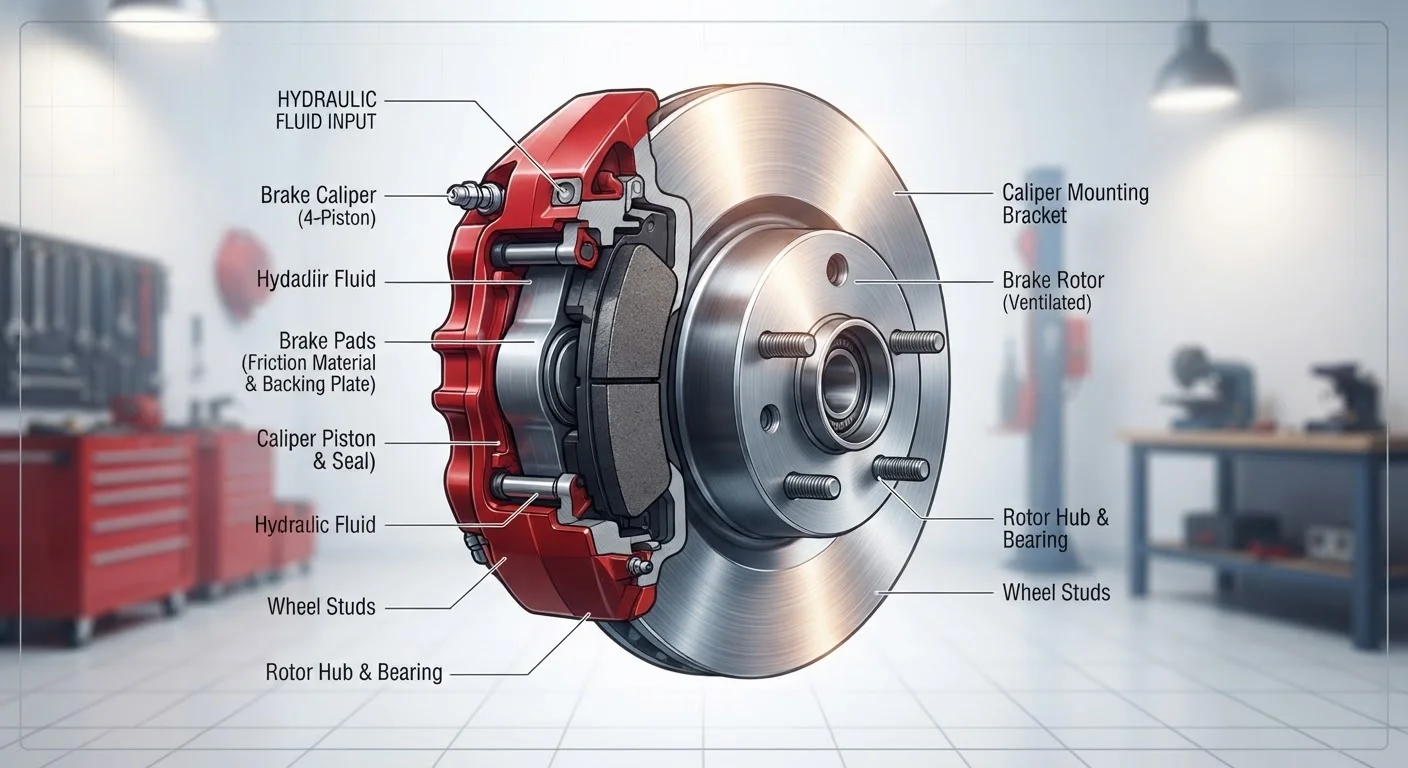
Brake pads are the consumable workhorses of the system. Each pad consists of a steel backing plate bonded to a layer of friction material—a compound formulated to grip the rotor surface without generating excessive heat or noise. Common friction materials include non-asbestos organic (NAO), semi-metallic, and ceramic formulations, each with different trade-offs in heat tolerance, dust output, and longevity.
Pads wear down gradually with every stop. Most include a thin metal wear indicator tab that contacts the rotor and produces a squealing noise when friction material reaches a minimum safe thickness—typically around 2–3 mm. Ignoring this warning accelerates rotor damage: a steel backing plate grinding against a rotor surface can score the rotor deeply, often making replacement necessary rather than a simple resurface.
Check Both Sides of Each Axle
When a mechanic recommends pad replacement, both pads on the same axle should be replaced together—never just one side. Mismatched friction material on the left and right wheels creates uneven braking force and can cause the vehicle to pull under stops. The same principle applies to rotors: if one is damaged, inspecting its pair is always worthwhile.
Pad replacement intervals vary widely based on driving style and environment. City driving with frequent stops wears pads faster than highway commuting. Checking brake condition is a routine part of scheduled maintenance—see our scheduled maintenance overview for context on when inspections typically occur.
Rotors and Calipers: How Stopping Force Is Generated
The rotor (also called a disc) is a flat, circular plate bolted to the wheel hub that spins with the wheel. When the hydraulic circuit is pressurized, the caliper clamps the brake pads against both faces of the rotor, generating friction that converts the vehicle's kinetic energy into heat. Rotors are designed to dissipate this heat quickly; vented rotors—which have internal cooling fins between the two friction faces—are standard on front axles where heat loads are highest.
The caliper is the hydraulic actuator that does the clamping. A floating caliper (the most common design) has one or two pistons on one side; hydraulic pressure pushes the inner pad against the rotor, and the caliper slides on guide pins to pull the outer pad in simultaneously. A fixed caliper has pistons on both sides and is often found on performance vehicles for more even pad contact and higher clamping force.
~70%
Of braking force handled by front brakes
Weight transfers forward under braking, so front brakes carry the majority of stopping load in most passenger vehicles—explaining why front pads typically wear faster than rear pads.
2–3 mm
Typical minimum brake pad thickness
Most manufacturers and technicians cite approximately 2–3 mm of remaining friction material as the threshold for pad replacement, though exact specs vary by vehicle and pad type.
Every 2–3 years
Recommended brake fluid change interval
Many manufacturers recommend flushing brake fluid on this schedule because the fluid is hygroscopic—absorbing atmospheric moisture that lowers its boiling point and introduces corrosion risk.
Rotor condition is measured by thickness and runout. A rotor worn below its minimum thickness specification loses the mass needed to absorb heat safely, increasing fade risk. A technician uses a micrometer to measure thickness at multiple points around the rotor to check for both overall wear and thickness variation—the latter being a common cause of pedal pulsation.
Understanding these components helps when reviewing a repair estimate. For guidance on interpreting what a shop quotes you, see reading a repair estimate.
Warning Signs and When to Seek Professional Service
Brake systems rarely fail without warning. Common symptoms that indicate a need for professional inspection include:
- Squealing or squeaking during normal stops—often the wear indicator signaling low pad material.
- Grinding or metal-on-metal noise—indicates pads are fully depleted and the backing plate is contacting the rotor.
- Pedal pulsation or steering wheel vibration when braking—typically caused by rotor thickness variation or warping.
- Soft or spongy pedal—may indicate air in the hydraulic lines or a failing master cylinder.
- Vehicle pulling to one side under braking—can point to a seized caliper or uneven pad wear.
Any of these symptoms should prompt a professional inspection rather than a wait-and-see approach. Brake work involves safety-critical components, and repairs should be performed by a qualified mechanic. If you're evaluating a used vehicle and want to assess its maintenance history, our vehicle shopping guide covers what to look for during a pre-purchase inspection.
This article is for general informational purposes only. Brake system inspection and repair should always be performed by a licensed, qualified mechanic. Do not attempt brake repairs without proper training, tools, and safety precautions.