

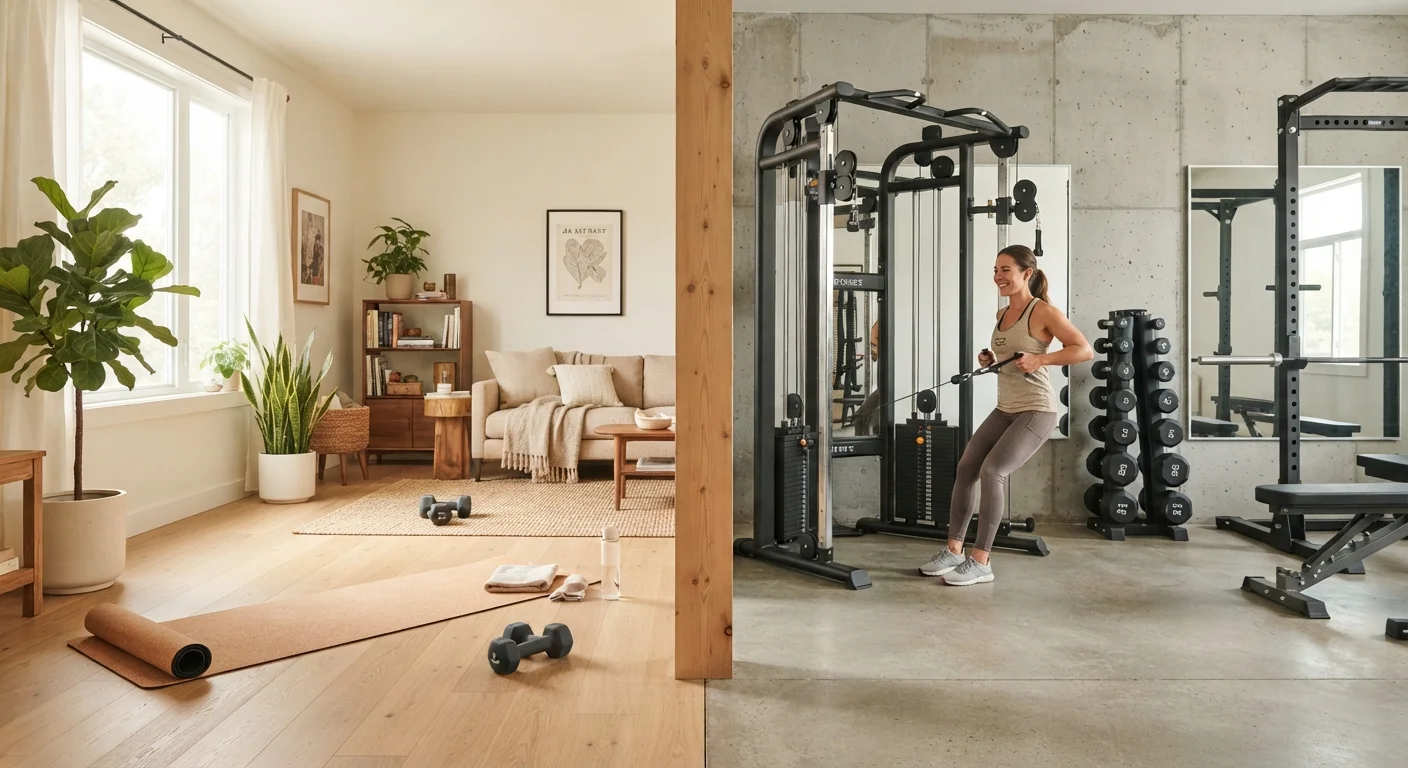
Key Takeaways
Option A
Home Workouts
The flexible, barrier-free option.
Best for: People who value convenience, privacy, or have unpredictable schedules that make commuting to a gym impractical.
Option B
Gym Workouts
The structured, fully equipped environment.
Best for: People who benefit from variety of equipment, social motivation, or the mental separation between home and exercise space.
If your schedule is unpredictable or commuting is a real barrier
Home Workouts
Removing the commute eliminates one of the most common reasons people skip sessions. A consistent home routine often beats an inconsistent gym membership.
If your goals include heavy strength training or specific machine-based exercises
Gym Workouts
Barbells, cable systems, and progressive weight stacks are difficult to replicate at home without significant investment. Gyms provide immediate access to these tools.
If you're just starting out and want to build the habit first
Home Workouts
Lower stakes and zero travel make it easier to build early consistency, which matters more than setting at the beginning of a fitness journey.
If social atmosphere and variety keep you motivated
Gym Workouts
Group classes, a structured environment, and the energy of other exercisers can meaningfully support adherence for those who find solo home sessions uninspiring.
If cost is a significant consideration
Home Workouts
Bodyweight routines require no equipment at all, and a modest investment in resistance bands or adjustable dumbbells can cover most training needs affordably over time.
What the Setting Actually Changes
Where you exercise influences access to equipment, the social environment, cost, and convenience — but it does not change what makes exercise effective. Whether you're doing a push-up in your living room or on a gym floor, the muscle recruitment, cardiovascular demand, and recovery requirements are identical. The setting is a delivery mechanism, not the active ingredient.
That said, the delivery mechanism matters practically. Home workouts eliminate the commute and offer complete scheduling flexibility, which research consistently identifies as one of the strongest predictors of long-term exercise adherence. Gyms, on the other hand, provide infrastructure that's genuinely hard to replicate at home without significant expense — particularly for resistance training that relies on heavy barbells, cable machines, or specialized cardio equipment.
For those building movement habits from the ground up, starting with home-based sessions often reduces friction enough to make consistency achievable before environment becomes a meaningful variable.
| Criterion | Home Workouts | Gym Workouts |
|---|---|---|
| Cost | Low to none (bodyweight) or one-time equipment cost | Ongoing membership fees required |
| Convenience | No commute; available any time | Subject to hours, location, and commute |
| Equipment variety | Limited without significant investment | Broad range typically available |
| Progressive overload potential | Moderate; limited by available resistance | High; wide load range and machine variety |
| Social motivation | Absent unless using virtual classes | Available; classes, trainers, gym atmosphere |
| Privacy | Complete | Shared public environment |
| Space required | Minimal for bodyweight; more for equipment | Provided by facility |
Where Home Workouts Fall Short
The most significant limitation of working out at home is progressive overload — the principle of gradually increasing demand on the body to drive continued adaptation. Bodyweight movements have a ceiling. Once push-ups or lunges become easy, advancing without additional resistance requires creativity: slower tempos, more complex variations, or added volume. These strategies work, but they eventually reach practical limits for individuals with strength-specific goals.
Equipment investment is the other honest constraint. Resistance bands, adjustable dumbbells, and pull-up bars can cover considerable ground affordably, but replicating a fully stocked gym requires space and money that many households don't have. Motivation can also be harder to sustain in isolation — the absence of a structured environment means the workout competes with household distractions and the pull of the couch.
~49%
Adults who cite time as a top exercise barrier
According to CDC physical activity data and public health surveys, time constraints consistently rank among the most commonly reported barriers to regular exercise for U.S. adults.
~67%
Gym members who rarely use their membership
Industry analyses of gym membership behavior suggest a substantial portion of members attend infrequently, highlighting the gap between enrollment and sustained participation.
Where Gyms Fall Short
A gym membership that doesn't get used is one of the most common money-spending patterns in fitness. Membership costs, commute time, operating hours, and crowding during peak periods all create friction that erodes attendance over time. For people with irregular work schedules, caregiving responsibilities, or social anxiety around public exercise spaces, these barriers can be genuinely prohibitive rather than merely inconvenient.
Gyms also impose a degree of external structure that some exercisers find motivating and others find off-putting. The environment is rarely designed for modification — you work around others' schedules and the facility's equipment availability. For low-impact movement forms like yoga or gentle stretching, a quiet home space is often preferable to a busy gym floor.
What Never Changes Regardless of Setting
Certain principles of exercise science are setting-agnostic. Progressive overload, adequate rest, sleep quality, nutrition, and consistency all determine results far more than whether you trained at home or in a commercial facility. Consistency reliably outperforms intensity over the long term — a moderate workout done four days a week beats an intense one done sporadically.
The balance between different types of training — strength, cardiovascular, mobility — also remains relevant regardless of location. If you're unsure how to think about structuring that balance, comparing strength training and cardio is a useful starting point for understanding what each contributes. And for readers new to exercise terminology encountered in app-based home workouts or gym programs alike, a plain-language fitness glossary can reduce confusion early on.
Many people find a hybrid model works well in practice: home sessions for shorter, bodyweight-focused workouts on busy days, and gym sessions when access to heavier equipment or group classes is the priority. The goal is sustainable movement, and the environment is simply a tool toward that end.
A Note on Hybrid Approaches
Many exercisers find that rigid either/or thinking about home versus gym workouts adds unnecessary pressure. A flexible approach — using home sessions for convenience on busy days and gym sessions when equipment or classes are the priority — can sustain higher overall consistency than committing exclusively to one setting. Adherence, not environment, is the variable most worth optimizing.
This article is for general informational purposes only and does not constitute medical or personal fitness advice. Consult a qualified healthcare or fitness professional before beginning or significantly changing an exercise routine, particularly if you have existing health conditions.