

Key Takeaways
Start here
Why a Budget Matters Before You Think You Need One
Next
Step 1: Add Up Your Take-Home Income
Then
Step 2: List Your Fixed and Variable Expenses
Core skill
Step 3: Give Every Dollar a Job
Keep it going
Step 4: Track, Review, and Adjust
Pitfalls to avoid
Common First-Budget Mistakes to Avoid
Why a Budget Matters Before You Think You Need One
A budget isn't a punishment — it's a map. Without one, most people genuinely don't know where their money goes until it's gone. A survey from the National Endowment for Financial Education has consistently found that people without a spending plan are more likely to carry high-interest debt and less likely to have an emergency fund.
You don't need a high income or a financial background to build one. You need about an hour, honest numbers, and a place to write things down. If you've ever wondered why your paycheck disappears faster than expected, a simple monthly budget answers that question — and puts you back in control. If you're also wrestling with common hesitations about starting, budgeting myths worth examining can help clear those up first.
Net income
The amount of money you actually receive after taxes and other deductions are taken out of your paycheck — the real number to build your budget around.
Fixed expense
A regular cost that stays the same every month, such as rent, a car payment, or a set insurance premium.
Variable expense
A spending category where the amount changes month to month — like groceries, gas, or dining out.
Zero-based budgeting
A method where you assign every dollar of income a specific purpose — savings, bills, spending — so that income minus all allocations equals zero.
Emergency fund
A dedicated pool of savings set aside to cover unexpected costs — like a car repair or medical bill — without going into debt.
Step 1: Add Up Your Take-Home Income
Start with what actually lands in your bank account — your net income (also called take-home pay) after taxes, Social Security, and any other deductions. Using your gross salary will overstate what you have to work with.
- Salaried workers: Use your typical net paycheck multiplied by the number of times you're paid per month (twice for biweekly, twice a month for semi-monthly).
- Hourly workers: Use your average hours over the last two or three months, then multiply by your net hourly rate.
- Side income: Include freelance, gig, or part-time income, but be conservative — use your lowest recent month if it varies.
Write this single number at the top of your page or spreadsheet. Everything else in your budget works within this ceiling. If your income shifts significantly month to month, budgeting on an irregular income covers approaches built for that reality.
Step 2: List Your Fixed and Variable Expenses
Now list everything you spend money on — not what you think you spend, but what you actually do. Pull up two or three recent bank and credit card statements.
Fixed Expenses
Fixed expenses are costs that stay the same every month: rent or mortgage, car payment, insurance premiums, loan minimums, and subscription services at a set rate. List each one with its exact dollar amount.
Variable Expenses
Variable expenses change month to month: groceries, gas, dining out, clothing, entertainment, and personal care. Estimate a realistic monthly average for each — not a wishful number, an honest one based on your statements.
Irregular Expenses
Don't forget costs that hit a few times per year — car registration, holiday gifts, annual subscriptions, or medical co-pays. Divide each by 12 and include that monthly fraction. Many first-time budgeters forget this step and then feel blindsided when these bills arrive.
Use Real Numbers, Not Ideal Ones
When estimating variable expenses, look at your last two or three months of actual bank or card statements rather than guessing. Most people underestimate what they spend on food, gas, and personal care by 20–30%. Accurate numbers make for a budget that actually works.
Step 3: Give Every Dollar a Job
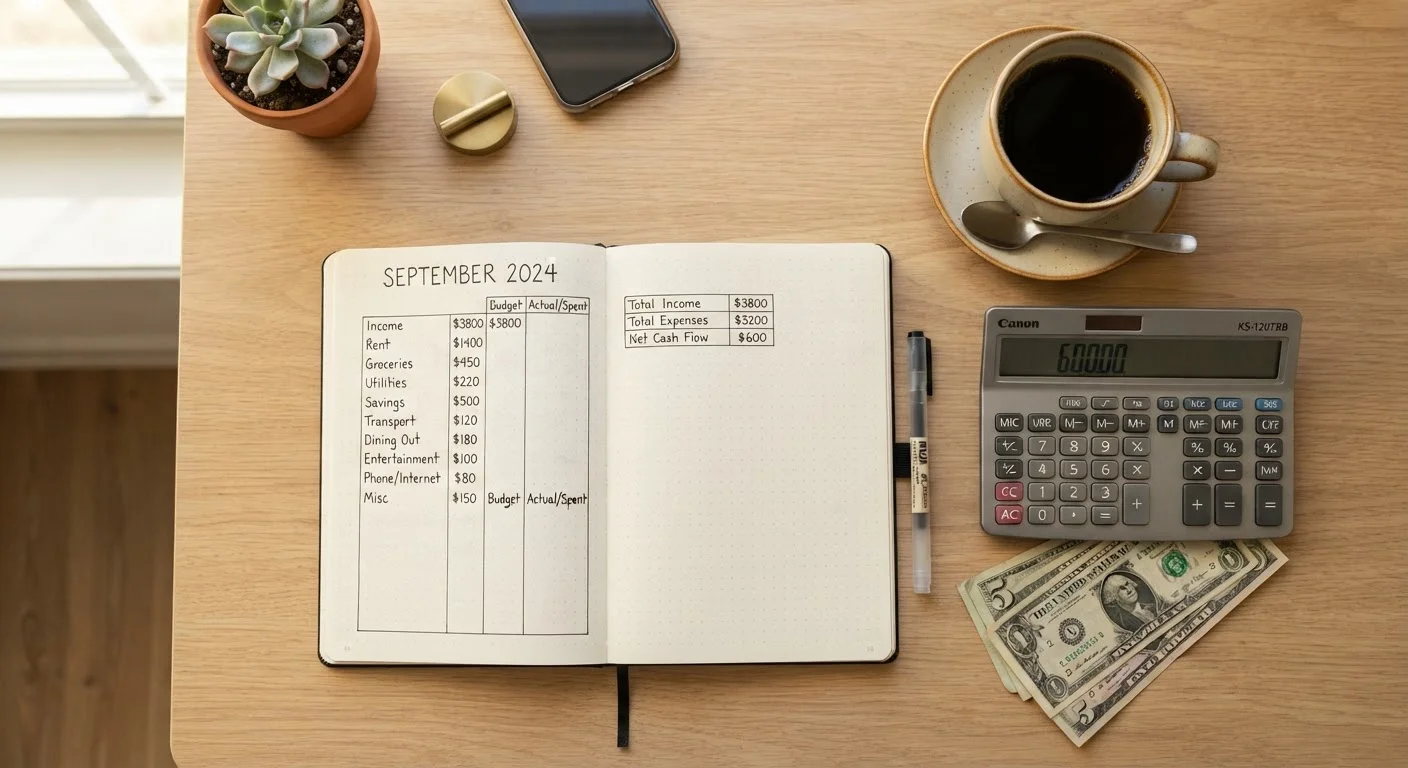
Subtract your total expenses from your take-home income. Ideally you have money left over. Now decide — deliberately — what that remainder does. This is the core principle behind zero-based budgeting: every dollar is assigned a purpose until the balance reaches zero. Leftover money doesn't disappear; it gets allocated to savings, an emergency fund, or extra debt payments.
A widely referenced guideline is the 50/30/20 rule: roughly 50% of take-home pay toward needs (housing, food, utilities, transportation), 30% toward wants (dining, entertainment, hobbies), and 20% toward savings and debt reduction beyond minimums. These aren't rigid mandates — high-cost-of-living areas or heavy debt loads may shift these ratios considerably. Use them as a diagnostic, not a prescription.
Even a small savings allocation matters. Building a savings habit on a tight budget shows how consistent small contributions create meaningful momentum over time.
Don't Skip the Savings Line
Many first-time budgeters treat savings as whatever's left over at the end of the month — which often means nothing gets saved. Instead, list savings as a fixed line item and allocate it before discretionary spending. Even a modest, consistent amount builds a meaningful habit and a financial cushion over time.
Step 4: Track, Review, and Adjust
A budget written once and never looked at again doesn't work. Set a short weekly check-in — even five minutes — to compare what you planned against what you actually spent. At the end of the month, do a fuller review: Did any category run over? Did income change? Did an irregular expense surface that you hadn't planned for?
Adjust your next month's budget accordingly. This monthly reset is a normal part of the process, not a sign something went wrong. The monthly budget reset checklist walks through exactly what to review when closing out one month and opening the next.
Over time, tracking reveals patterns — the subscriptions you forgot, the category that always runs over, the months that cost more. That information makes each subsequent budget more accurate and less stressful.
Common First-Budget Mistakes to Avoid
Most first budgets have predictable weak spots. Knowing them in advance shortens the learning curve.
- Being too optimistic about variable spending. Use your actual statements, not what you hope to spend on groceries or dining.
- Forgetting irregular expenses. Not accounting for annual or quarterly costs is one of the most common reasons budgets feel broken when they're actually just incomplete.
- Leaving no room for fun. A budget with zero discretionary spending is almost impossible to sustain. A realistic budget includes some amount for enjoyment — it just makes that spending intentional.
- Giving up after one imperfect month. Every budget needs adjustment. A bad month is data, not defeat.
For a broader look at how a budget connects to longer-term financial decisions — including debt and savings goals — the complete personal budgeting framework provides a useful next step.
This article is for general informational and educational purposes only and does not constitute personalized financial, tax, or legal advice. Please consult a qualified financial professional for guidance specific to your situation.