

Key Takeaways
Why Budgeting Works—and Why Most People Quit
Most Americans have tried budgeting at least once. Far fewer have stuck with it. The gap between starting and sustaining usually comes down to one problem: the budget was built as a restriction rather than a plan. Effective budgeting isn't about saying no to everything—it's about directing money intentionally so your spending reflects your actual priorities.
Research from the Consumer Financial Protection Bureau consistently finds that households with a written spending plan feel more financially confident and are better prepared for unexpected expenses. The mechanics are simple; the discipline is the hard part. This guide walks through every stage—setup, tracking, adjusting, and sustaining—so you have a complete framework to return to whenever your financial situation changes.
Start Simple, Refine Later
Don't wait until you have a perfect system to begin. Start with three broad categories—needs, wants, savings—and add granularity only once the habit of reviewing is established. Complexity added too early is the fastest route to abandonment.
This article is for general financial education purposes only and is not personalized financial advice. For guidance specific to your situation, consider consulting a licensed financial professional.
Step One: Know Your Real Income
Your budget's foundation is take-home pay—the amount deposited into your account after taxes, health insurance premiums, and any retirement contributions are already deducted. Using gross (pre-tax) income is one of the most common budgeting mistakes because it overstates what you actually have to work with.
If your income varies month to month—freelance work, tips, commissions, or gig earnings—use a conservative baseline: either your lowest recent month or an average of the past three to six months. Budget to that floor, and treat anything above it as an intentional surplus to allocate, not a windfall to spend freely.
~40%
Americans who follow a formal budget
Surveys by Gallup and similar polling organizations have consistently found fewer than half of U.S. adults maintain a written household budget.
3–6 months
Recommended emergency fund coverage
Financial planning guidelines widely recommend covering three to six months of essential expenses in an accessible savings account.
20–30%
How much people underestimate variable spending
Behavioral finance research suggests consumers routinely underestimate discretionary spending before they begin formal tracking.
If you're new to this process, our plain-language guide to building your first monthly budget walks through each income calculation step in detail.
Step Two: Map Every Dollar to a Category
Before you can allocate money, you need to see where it currently goes. Pull three months of bank and credit card statements and group every transaction into one of two broad buckets:
- Fixed expenses: Amounts that are the same each month—rent or mortgage, car payment, insurance premiums, subscriptions.
- Variable expenses: Amounts that change—groceries, dining out, gas, clothing, entertainment, household supplies.
Most people underestimate variable spending by 20–30% before they've actually tracked it. That gap is where budgets break down. Once you see real numbers, you can make informed trade-offs rather than guesses.
When categorizing expenses, create a separate 'irregular but predictable' bucket for things like car registration, annual subscriptions, and holiday gifts—then divide the total by 12 and set aside that amount monthly.
These expenses derail budgets precisely because they feel surprising, even though they happen every year. Pre-funding them as sinking funds eliminates the disruption.
If you use a credit card for daily spending, reconcile it weekly rather than waiting for the monthly statement—pattern recognition is far sharper when the transactions are recent.
Memory decay means month-old charges feel abstract. Weekly check-ins keep spending behavior visible and easier to course-correct.
Not sure what a term means? Our budget glossary covers 30 common terms—from discretionary income to sinking funds—in plain language.
Step Three: Choose a Method That Fits Your Life
Once you know your income and your spending categories, you're ready to pick a structure. No single method is universally correct—the best framework is the one you'll actually maintain.
- 50/30/20
- Allocate 50% of take-home pay to needs, 30% to wants, and 20% to savings and debt repayment. Good for beginners because the math is simple and the categories are broad.
- Zero-based budgeting
- Assign every dollar a job until income minus expenses equals zero. More time-intensive but highly effective for people who want granular control.
- Pay-yourself-first
- Move your savings contribution automatically on payday before you spend anything else. Spending decisions happen with whatever remains.
- Envelope method
- Withdraw cash (or use digital equivalents) for each spending category. When the envelope is empty, spending in that category stops for the month.
Explore additional budgeting frameworks, including reverse budgeting and hybrid approaches, to find the fit that matches your habits and goals.
“A budget is telling your money where to go instead of wondering where it went.”
— John C. Maxwell, Author and leadership speaker, widely cited in personal finance contexts
Step Four: Track, Review, and Adjust Monthly
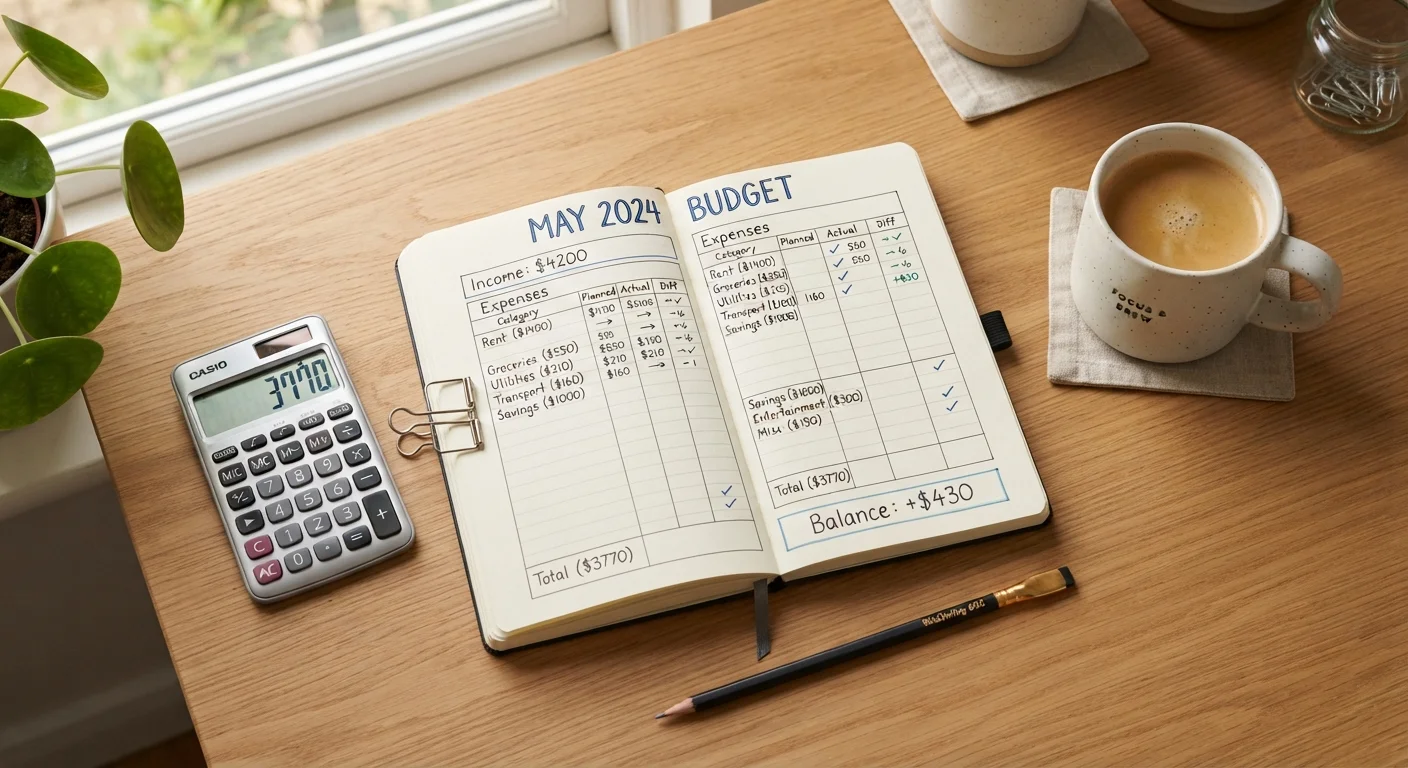
A budget written once and never revisited is just a wish list. The review habit is what turns a plan into a system. At the end of each month, compare what you planned to spend against what you actually spent in each category.
Look for three things: categories where you consistently overspend (signal to reallocate or reduce), categories where money sits unspent (potential to redirect toward goals), and one-time expenses you forgot to plan for (candidates for a sinking fund next month).
Your Budget Should Change as Life Changes
A budget built when you were single may not serve you after a marriage, a child, or a job change. Review your entire framework—not just monthly numbers—at major life transitions. Clinging to outdated allocations is a common reason budgets stop working even when the habit remains intact.
Adjusting your budget isn't failure—it's the process working as intended. Financial situations change: income fluctuates, expenses appear, and goals shift. Use a monthly reset checklist to close out each month cleanly and start the next one with updated numbers.
Connecting Your Budget to Long-Term Goals
Day-to-day budgeting only pays off when it's connected to something meaningful: an emergency fund, debt elimination, a down payment, or retirement savings. The link between monthly tracking and long-term progress is a dedicated savings line item—treated as a fixed expense, not a leftover.
A common target for emergency savings is three to six months of essential living expenses, though the right amount depends on your income stability, household size, and risk tolerance. Debt repayment strategy is similarly personal—some people prioritize highest-interest balances first (sometimes called the avalanche method); others start with the smallest balance for motivational momentum (the snowball method). Neither is inherently superior; consistency matters more than the order.
For deeper guidance on building savings and managing debt, explore our Saving & Debt hub.
Don't Let 'Budget' Mean 'Deprivation'
Budgets that leave zero room for enjoyment tend to collapse quickly. Including a realistic discretionary line—however modest—makes the plan sustainable. Treating every indulgence as a budget failure creates shame cycles that often lead to abandoning the process entirely.
Sustaining Good Habits Over Time
The difference between people who maintain a budget for years and those who abandon it after two months usually comes down to how automatic and low-friction they've made the process. A few structural habits that support long-term success:
- Automate savings transfers on payday so the decision is made once, not every month.
- Schedule a 15-minute monthly review—treat it like a recurring appointment, not optional homework.
- Build in a small discretionary buffer so the budget doesn't feel punishing. Rigid budgets invite rebellion.
- Revisit the entire framework when a major life change occurs: a new job, a move, a baby, or a shift in debt load.
Budgeting is also just one dimension of smart daily financial decision-making. Our Everyday Money Moves hub covers practical habits for common spending situations. And if a purchase decision is on the table, a grounded introduction to smarter shopping can help you cut through marketing noise before money leaves your account.
Progress over perfection is the operating principle. A budget that's 80% followed consistently delivers far more value than a perfect plan executed for three weeks.