

Key Takeaways
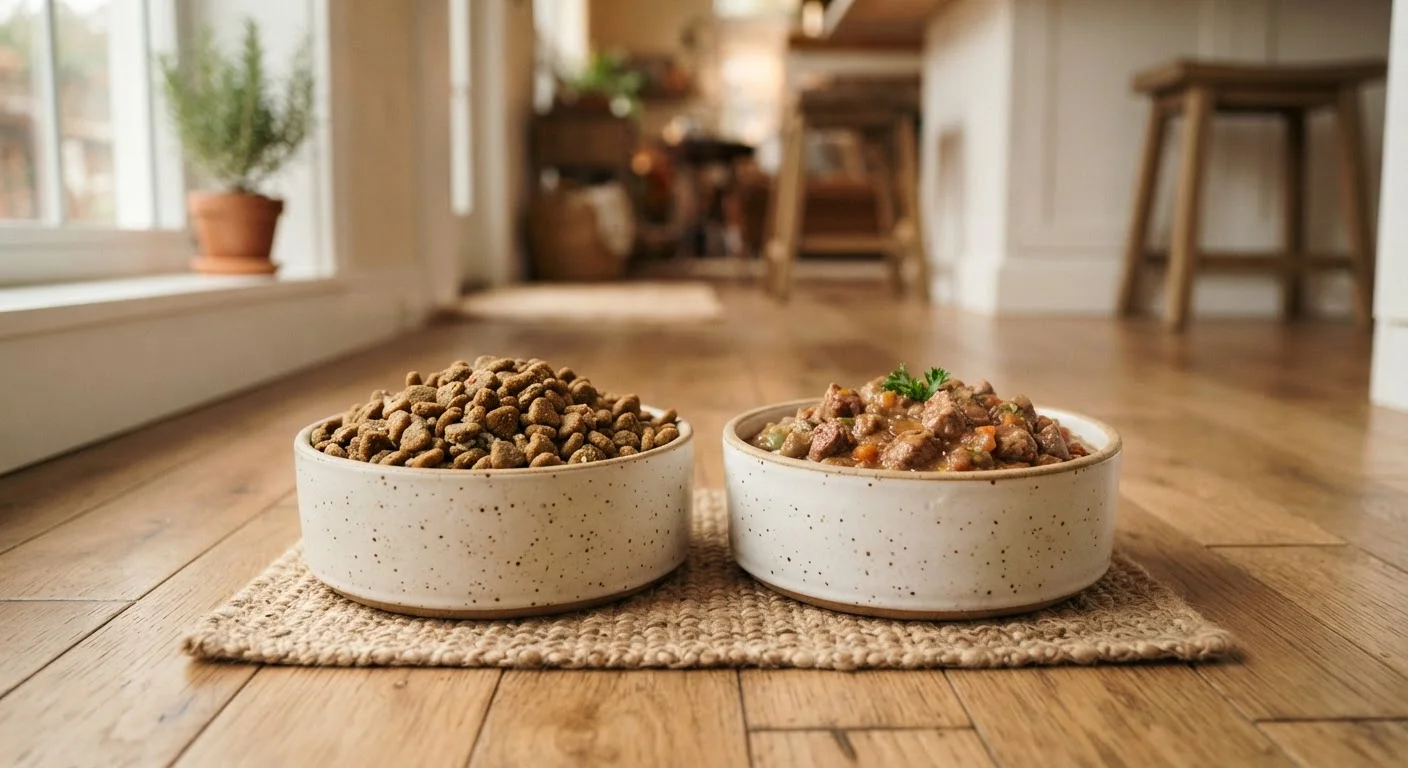
Option A
Dry Kibble
The convenient, shelf-stable everyday staple.
Best for: Pet owners seeking easy storage, portion control, and budget-friendly feeding across most life stages.
Option B
Wet Food
The moisture-rich, highly palatable alternative.
Best for: Pets with hydration needs, picky appetites, dental sensitivities, or those requiring calorie-dense meals in smaller volumes.
If your cat has a history of urinary tract issues
Wet Food
Higher moisture content supports urinary tract health by increasing overall fluid intake — an important factor for cats prone to urinary problems.
If you need a practical, cost-effective option for a healthy adult dog
Dry Kibble
Kibble is easy to measure, store, and feed consistently, making it a practical foundation for most healthy dogs when a quality formula is chosen.
If your pet is a picky eater or has a reduced appetite
Wet Food
Wet food's stronger aroma and softer texture tend to be more appealing to reluctant eaters, which can help maintain adequate nutrition.
If you're managing your pet's weight carefully
Wet Food
Wet food's higher water content means fewer calories per serving volume, which can help pets feel satisfied while consuming fewer total calories.
If convenience and long shelf life are priorities for your household
Dry Kibble
Kibble can be stored at room temperature for months and measured quickly, making it the more practical choice for busy pet owners.
What Actually Differs Between the Two Formats
The most fundamental difference between dry kibble and wet food isn't flavor or price — it's water content. Dry kibble typically contains around 10% moisture, while wet food usually ranges from 70% to 80% moisture. That gap shapes nearly everything else: calorie density, texture, shelf life, and how your pet's body processes each meal.
Kibble is made by cooking ingredients under high heat and pressure through a process called extrusion, which produces the familiar crunchy pellets. Wet food is generally made from fresh or frozen ingredients mixed into a loaf, pâté, or gravy-based format, then sealed in cans or pouches. Both formats can meet a pet's complete nutritional needs when the product carries an AAFCO (Association of American Feed Control Officials) statement of nutritional adequacy. If you're not sure how to find and read that statement, our guide on reading pet food labels walks through every section of the packaging in plain language.
| Criterion | Dry Kibble | Wet Food |
|---|---|---|
| Moisture content | ~10% | 70–80% |
| Calorie density | High (per ounce) | Lower (per ounce) |
| Shelf life (opened) | Weeks to months | 1–2 days refrigerated |
| Cost per calorie | Generally lower | Generally higher |
| Palatability for picky eaters | Moderate | Often higher |
| Dental cleaning benefit | Minimal for most kibbles | Minimal |
| Hydration support | Low | High |
| Ease of portion control | Easy with a measuring cup | Easy with cans/pouches |
Hydration, Nutrition, and Caloric Density
Hydration is where wet food has the clearest advantage, particularly for cats. Cats evolved as desert animals and have a naturally low thirst drive, meaning many don't compensate adequately when fed an exclusively dry diet. Veterinary nutritionists often note that increasing dietary moisture can help support kidney and urinary tract health in cats — though individual health needs vary and your vet is the right person to guide decisions about your specific cat. This connects directly to why cats and dogs need fundamentally different diets.
For caloric management, kibble's higher calorie density means portions must be measured carefully. It's easy to overfill a bowl of kibble without realizing how much energy your pet is actually consuming. Signs your pet may be overweight often trace back to unmeasured free-feeding of kibble — a habit worth reconsidering. Wet food tends to be less calorie-dense by volume, which can feel more satisfying in smaller amounts. That said, some wet formulas are calorie-rich, so checking the guaranteed analysis panel on any label remains important.
~70–80%
Moisture content in wet pet food
Compared to roughly 10% in dry kibble — a difference that significantly affects a pet's total daily fluid intake.
~60%
Of cats' daily water intake from food
Veterinary nutrition research suggests cats on wet diets consume substantially more total water than those on dry diets alone.
3–4x
Higher cost per calorie for wet vs. dry
Cost comparisons vary by brand and region, but wet food generally costs significantly more per calorie than equivalent dry formulas.
Dental Health: Separating Fact from Assumption
A persistent belief holds that dry kibble cleans teeth by scraping away plaque as pets chew. The reality is more nuanced. Most pets crunch through kibble without significant mechanical cleaning action. The Veterinary Oral Health Council (VOHC) maintains a list of products — both foods and treats — that have met specific standards for plaque and tartar reduction. Most standard kibbles do not appear on that list.
Wet food, on the other hand, is sometimes blamed for accelerating tartar buildup, though evidence distinguishing the two formats on dental outcomes is limited. Regular brushing, dental chews evaluated by a veterinarian, and routine professional cleanings have far more evidence behind them than relying on food texture alone. Neither format is a reliable substitute for active dental care.
What the VOHC Seal Actually Means
The Veterinary Oral Health Council (VOHC) awards its seal to pet dental products — including some foods and treats — that have met pre-set standards for reducing plaque or tartar in controlled trials. It's a useful benchmark when evaluating dental health claims. However, the seal covers specific products only; a food being labeled as good for teeth doesn't automatically meet this standard. Ask your veterinarian which dental care approaches are appropriate for your pet's mouth.
Practical Factors: Cost, Storage, and Feeding Logistics
Day-to-day practicality matters as much as nutrition when choosing how to feed your pet. Dry kibble wins on convenience: it stores at room temperature, stays fresh for weeks to months after opening (in an airtight container), and is easy to measure. For multi-pet households or owners with busy schedules, these qualities are genuinely significant.
Wet food requires refrigeration after opening, typically needs to be used within a day or two, and costs more per calorie than kibble. For large dogs eating large volumes, the cost difference can add up noticeably over a month. For small cats eating modest portions, wet food's higher per-unit cost may be more manageable.
Many veterinarians and pet owners settle on a combination approach — wet food at one meal for palatability and hydration benefits, kibble at another for convenience. This isn't a compromise so much as a practical reflection of both formats' strengths. Whichever approach you choose, consistency and avoiding common feeding mistakes matters more than the format itself. Nutritional needs also shift with age, so reviewing your approach over time is worthwhile — especially with the guidance in our life-stage feeding framework.
This article is for general informational purposes and is not a substitute for professional veterinary advice. Always consult your veterinarian about the best diet for your specific pet's health needs.