

Key Takeaways
Pet Food Label
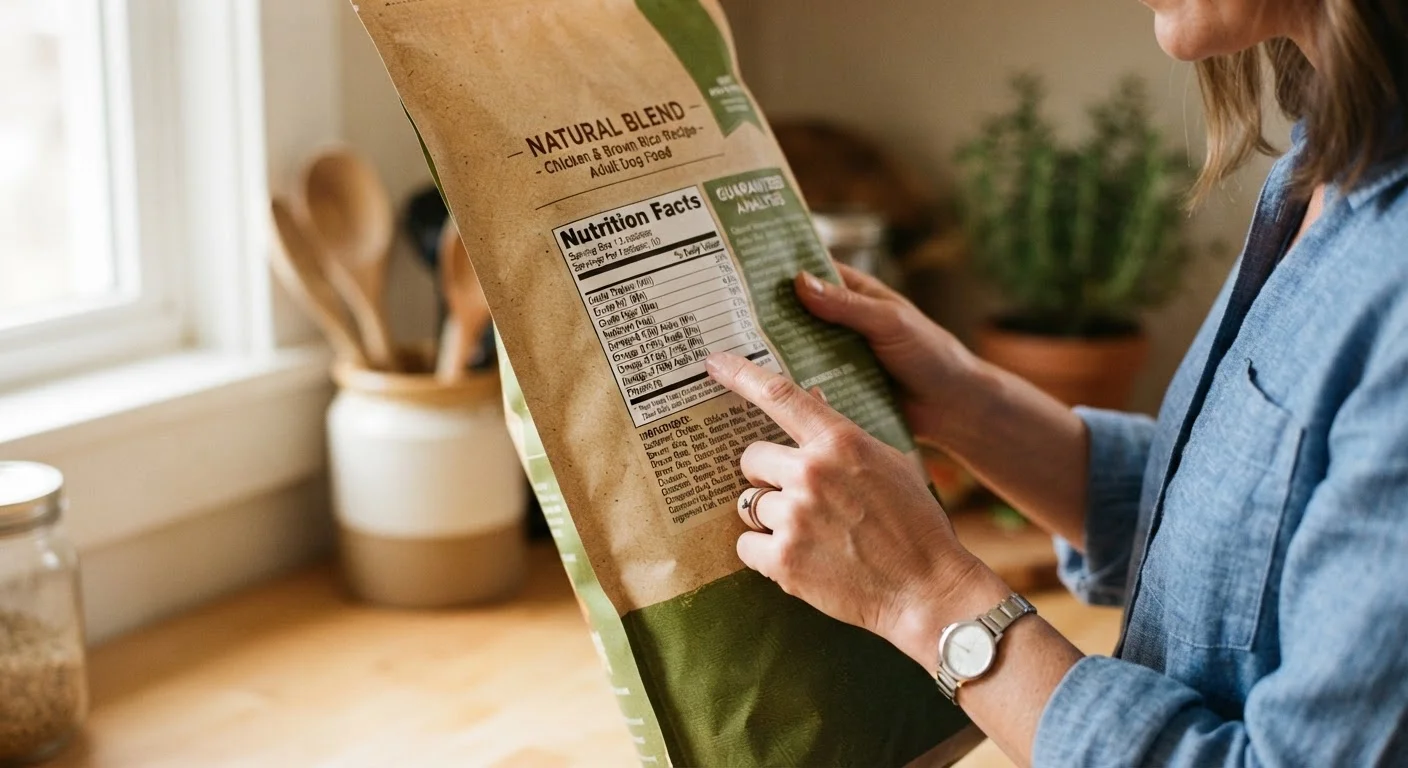
A pet food label is the regulated set of information printed on a pet food package, including the ingredient list, guaranteed analysis, feeding guidelines, and a nutritional adequacy statement. In the United States, these labels are governed by the Association of American Feed Control Officials (AAFCO) and individual state feed laws. Reading them correctly helps you understand what your pet is actually eating — not just what the front-of-bag marketing claims suggest.
AAFCO sets model regulations for pet food labeling, but enforcement is carried out at the state level, so label requirements can vary slightly by state.
Why Pet Food Labels Feel So Confusing
The front of most pet food bags is designed to sell — vivid imagery of fresh chicken, fields of vegetables, and bold phrases like 'grain-free' or 'ancestral diet.' The back of the bag, where the actual regulated information lives, is a different experience entirely. Tiny text, unfamiliar terms, and dense number columns can make even a motivated pet owner's eyes glaze over.
But the back label is where the substance is. Once you know which sections to focus on — and what they're actually measuring — reading a pet food label becomes far less intimidating. Think of it like reading a nutrition facts panel for your own food: once you know what 'percent daily value' means, the whole thing clicks into place. If you're curious how that comparison works, our article on what the nutrition facts label is actually telling you covers human food labels in similar depth.
AAFCO Does Not Approve Individual Products
A common misconception is that AAFCO 'certifies' or 'approves' specific pet foods. In reality, AAFCO sets model regulations and nutrient standards, but it does not test, inspect, or approve individual products. Manufacturers are responsible for ensuring their products comply, and enforcement is handled at the state level.
The Ingredient List: Order, Language, and What It Reveals
Pet food ingredients are listed in descending order by pre-cooking weight. That means fresh chicken — which is roughly 70% water — may weigh more than a concentrated grain or meal ingredient before processing, even if the grain ends up contributing more calories in the finished product.
This is why a single ingredient at the top doesn't tell the whole story. Scan the first five to seven ingredients together. If several protein sources or whole foods appear early, that's generally a more informative sign than any single item alone.
You'll also encounter terms like chicken by-product meal, brewers rice, or dried beet pulp. These aren't automatically low-quality — by-products can include organ meats that are nutritionally dense, and beet pulp is a common fiber source. What matters is how the overall formulation adds up, not whether individual ingredient names sound appealing or alarming.
For a deeper dive into how ingredient list language works across packaged foods, see our guide on reading an ingredient list.
Try the Dry Matter Basis Calculation
To compare protein levels between a wet and dry food, subtract the moisture percentage from 100 to get the dry matter percentage, then divide the crude protein percentage by that number and multiply by 100. For example, a wet food with 78% moisture and 10% protein works out to about 45% protein on a dry matter basis — often higher than it first appears.
The Guaranteed Analysis: What the Numbers Actually Mean
The guaranteed analysis panel lists minimum percentages of crude protein and crude fat, and maximum percentages of crude fiber and moisture. A few important points:
- These are thresholds, not exact values. A food labeled 'minimum 26% crude protein' could contain significantly more. You're seeing a floor, not a precise measurement.
- Moisture content skews comparisons. Wet food may show 10% protein, while dry food shows 28% — but once you account for water content, the actual protein levels may be closer than they appear. Comparing foods on a dry matter basis (a simple calculation that removes moisture from the equation) gives a more accurate picture.
- 'Crude' doesn't mean low quality. It's a lab measurement method, not a comment on the ingredient's worth.
If you're deciding between food formats, our article on dry kibble vs. wet food explains how moisture and nutrient density differ across formats.
95%
Minimum meat content for a named-protein product
Under AAFCO naming conventions, a food called 'Chicken Dog Food' must contain at least 95% chicken (excluding water added for processing).
3%
Minimum meat content for 'with' descriptor
A label reading 'Dog Food with Chicken' only requires 3% chicken content under AAFCO rules — a significant difference from a named-protein product.
2
AAFCO methods for substantiating nutritional claims
Pet food makers can meet AAFCO nutritional adequacy standards either by formulating against published nutrient profiles or by conducting actual animal feeding trials — the latter being a more rigorous standard.
The AAFCO Statement: The Most Important Line on the Label
Near the bottom of most labels, you'll find a small block of text that reads something like: ' is formulated to meet the nutritional levels established by the AAFCO Dog Food Nutrient Profiles for adult maintenance.' This is the nutritional adequacy statement, and it's arguably the single most important line on the package.
It tells you two things: whether the food is complete and balanced (able to serve as a sole diet), and for which life stage it's appropriate. Foods that have only been 'formulated to meet' AAFCO profiles were developed by comparing a recipe against a nutrient chart. Foods that passed an 'AAFCO feeding trial' were tested on actual animals — a higher bar, though not universally required.
If a label says the product is intended as a 'treat,' 'supplement,' or 'intermittent feeding only,' it is not formulated to be a complete diet on its own.
“The nutritional adequacy statement is the most meaningful regulatory information on a pet food label. It tells you whether the product was designed to sustain an animal through a complete life stage — everything else on the label needs to be understood in that context.”
— Dr. Cailin Heinze, Board-certified veterinary nutritionist and former faculty at Tufts University Cummings School of Veterinary Medicine
Front-of-Bag Claims and What They're Worth
Words like 'natural,' 'premium,' 'artisanal,' and 'holistic' appear on many bags, but they carry little to no regulatory weight. AAFCO does define 'natural' — it means ingredients were derived from plant, animal, or mined sources without chemical alteration — but 'premium,' 'holistic,' and similar terms have no official definition and don't correspond to any nutritional standard.
Percentage rules do apply in specific cases. If a food is called 'Chicken Dog Food,' chicken must make up at least 95% of the total ingredients (excluding water). If it says 'with Chicken,' chicken only needs to be 3%. These naming conventions are regulated and worth knowing when you're comparing products.
Avoiding common feeding mistakes often starts with learning to look past front-of-bag language and focus on what the regulated sections of the label actually say.
Putting It All Together
Reading a pet food label well comes down to a simple habit: flip the bag over. Start with the AAFCO statement to confirm the food is complete and balanced for your pet's life stage. Scan the first several ingredients to understand the protein sources and overall composition. Check the guaranteed analysis, keeping moisture content in mind if you're comparing formats. Then set the front-of-bag claims aside entirely.
No label-reading skill replaces a conversation with your veterinarian, especially if your pet has specific health conditions, weight concerns, or is at a life stage transition. Labels provide the foundation — your vet provides the context. If you're also thinking about portion management, our article on signs your pet may be overweight is a practical companion read.
This article is for general informational purposes only and is not veterinary advice. Always consult a licensed veterinarian for guidance specific to your pet's health and nutritional needs.