

Key Takeaways
Color as Self-Expression
Using color in clothing and beauty choices as a deliberate or intuitive way to communicate identity, mood, and values to the world. Just as language conveys meaning through words, color conveys meaning through visual signals — shaping how others perceive you and how you feel about yourself. It's one of the most immediate, nonverbal tools of personal style.
Color psychology is a studied field examining how hues influence emotion and perception; while cultural associations vary significantly across populations, certain physiological responses to color have been observed in research settings.
The Language Your Wardrobe Already Speaks
Before anyone hears your name or reads your resume, they see your colors. Color is one of the fastest signals the human brain processes — which means that the hues you choose to wear are doing communicative work constantly, whether or not you've ever thought about it consciously.
This isn't about color determining who you are. It's about recognizing that color is a tool — one you already use — and understanding it a little better so you can use it more intentionally. Your palette isn't random. It's built from years of personal associations, cultural context, emotional responses, and aesthetic instinct. Making sense of it can unlock a more confident, coherent approach to getting dressed.
For a broader look at how all the elements of personal style work together, the complete guide to self-expression through style is a great companion read.
90%
Of snap judgments about products tied to color
A widely cited finding in color psychology research suggests roughly 90% of initial product assessments are based on color alone, underscoring how powerfully hue shapes first impressions.
62–90 sec
Time for color to shape a first impression
Research published in color and consumer behavior studies suggests people form color-based impressions of a person or object in under 90 seconds of initial viewing.
39%
Of consumers who factor color into brand recognition
Studies on visual identity show a significant share of consumers name color as a primary reason they recognize or remember a brand, a dynamic that parallels how individuals build personal style identity.
What Different Color Families Tend to Communicate
Color associations are cultural and contextual — not fixed laws. That said, certain tendencies show up across research and observation often enough to be worth knowing.
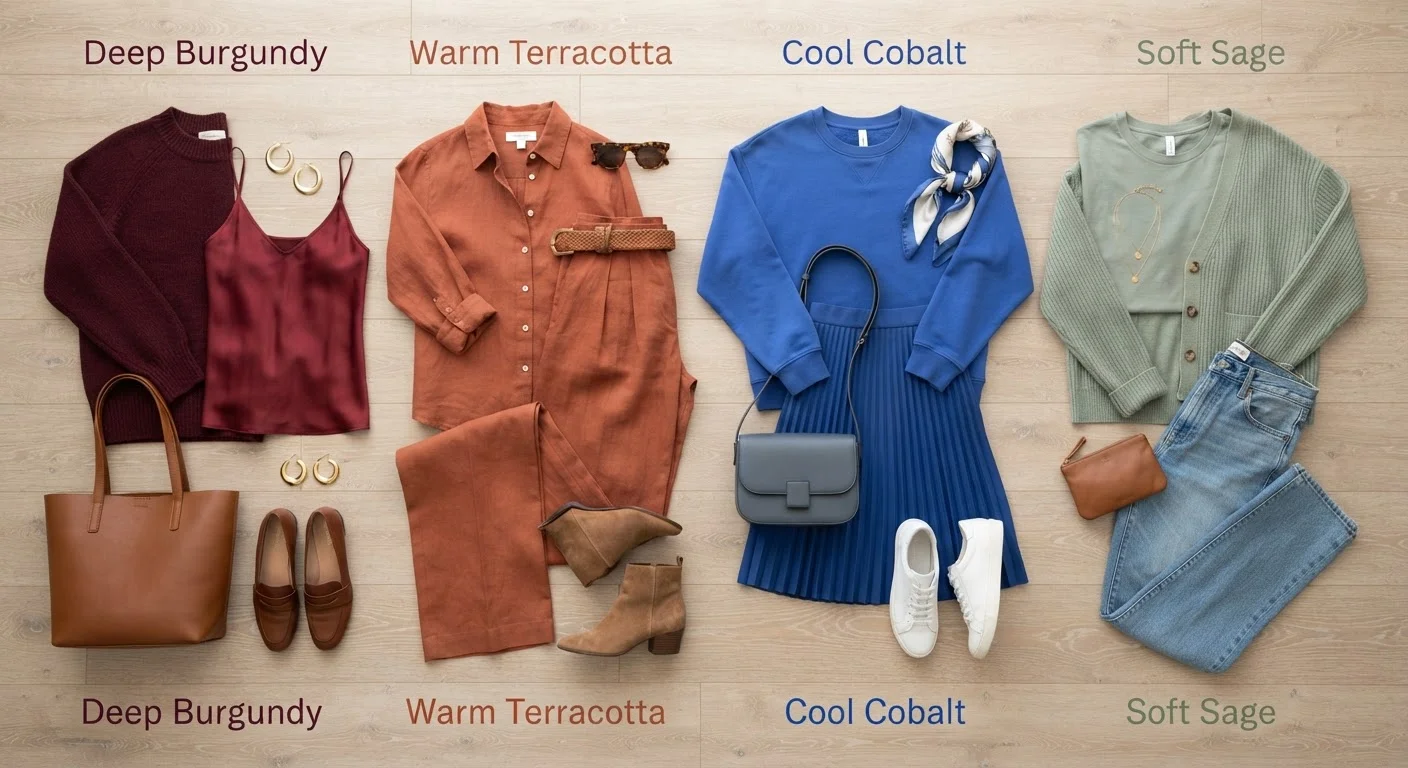
- Bold primaries and saturated brights — reds, electric blues, sunshine yellows — often project energy, confidence, and a willingness to be noticed. People drawn to these shades frequently describe wanting their presence to be felt.
- Earthy tones — terracotta, olive, rust, warm browns — tend to communicate groundedness, warmth, and an affinity for the natural world. These palettes have grown in cultural visibility as conversations around sustainability and authenticity have expanded.
- Cool and muted tones — slate blue, dusty rose, sage, lavender — often read as calm, thoughtful, or quietly creative. Many people who favor these shades describe prioritizing emotional comfort over visual impact.
- Deep, rich shades — burgundy, forest green, navy, charcoal — can signal sophistication, depth, and seriousness without the severity of stark black.
- Neutrals and achromatics — black, white, gray, beige — communicate versatility and intentionality. A monochromatic neutral look can be just as expressive as a maximalist one; it often signals that the wearer is letting other elements — silhouette, texture, accessories — carry the message.
Try a Color Audit of Your Closet
Pull everything out and arrange it by hue. The distribution you see — which shades dominate, which are absent, which you've never actually worn — tells you more about your real color instincts than any quiz. Notice what surprises you; that's often where the most useful self-knowledge lives.
Personal History Shapes Your Palette
Your color instincts aren't purely aesthetic — they're biographical. Think about the colors you associate with safety, with joy, with people you loved or places that mattered to you. Many adults find their deeply preferred shades map back to formative memories: a grandparent's kitchen, a beloved childhood bedroom, a landscape they grew up near.
Cultural background also plays a real role. Meanings attached to color vary meaningfully across traditions and regions — what reads as celebratory in one context can carry an entirely different weight in another. Leaning into the colors meaningful within your own heritage can be a powerful act of self-expression and cultural pride.
If you're exploring how accessories amplify your color story, expressing identity through accessories is worth exploring alongside this.
Using Color With More Intention
The goal isn't to decode a universal color chart and dress accordingly — that would replace one form of external pressure with another. Instead, it's about developing enough awareness to choose colors that feel genuinely like you, whatever that means at any given season of your life.
A few questions worth sitting with: Which colors do you avoid, and why? Are you dressing for how you want to feel, or how you think you're supposed to look? Are there shades you're curious about but haven't tried because they feel like someone else's territory?
Color is one of the most accessible entry points into self-expressive dressing — it costs nothing to experiment, and the feedback is immediate. If a shade makes you feel more like yourself when you put it on, that's not a small thing. That's the whole point. And if you're still figuring out where to begin, finding your aesthetic offers a grounded starting point.
“Color is a power which directly influences the soul. Color is the keyboard, the eyes are the hammers, and the soul is the piano with many strings.”
— Wassily Kandinsky, Influential abstract artist and color theorist, author of 'Concerning the Spiritual in Art'