

Key Takeaways
Gender-Inclusive Fashion
Gender-inclusive fashion refers to clothing and style choices that are not restricted by traditional expectations tied to a person's gender. It recognizes that garments, colors, silhouettes, and accessories don't inherently belong to one gender. This approach allows individuals to dress in ways that reflect who they are rather than conforming to socially assigned categories.
Researchers distinguish between 'gender expression' (how a person presents themselves outwardly) and 'gender identity' (an internal sense of self) — fashion primarily relates to expression, though the two often intersect in meaningful ways.
A Brief History of Gendered Clothing
The idea that certain clothes 'belong' to a specific gender is more recent and more culturally specific than most people realize. For much of Western history, distinctions we now take for granted — like trousers being exclusively male — were far more fluid. Children of all genders wore dresses well into the early 20th century. The color-coding of pink for girls and blue for boys became prominent in American culture only in the mid-20th century, not before.
Women adopting trousers moved from radical to mainstream over the span of decades, driven by practical necessity during wartime, by athletic demands, and eventually by designers who saw utility and elegance as compatible. Men's fashion, by contrast, has faced slower institutional change — the suit's dominance as professional attire has been remarkably persistent — though subcultures and streetwear have consistently pushed back against those limits.
Understanding this history matters because it reframes the conversation: evolving fashion norms aren't a rupture with tradition so much as a continuation of fashion's long habit of reinventing itself. See our exploration of what personal style really means for more context on how style goes far deeper than any single trend or era.
56%
Gen Z adults who know someone using gender-neutral pronouns
According to Pew Research Center survey data, younger Americans are significantly more likely than older generations to have personal familiarity with nonbinary or gender-expansive peers.
~1910s
Decade pink-blue gender color coding began solidifying in the US
Fashion historians note that the strong association of pink with girls and blue with boys became widely marketed in American retail only in the early-to-mid 20th century.
What's Driving the Shift Today
Several forces are converging to reshape how Americans think about clothing and gender. Social media has amplified the visibility of gender-expansive dressing in ways that weren't possible even fifteen years ago, allowing people to see style choices that fall outside mainstream retail categories and recognize that those choices are real, wearable, and worn by real people.
Generational attitudes also play a significant role. Survey research consistently finds that younger Americans hold broader views on gender identity and expression than older generations, and those values are reflected in what they choose to wear and what they expect to find in stores. Retailers have responded — gradually and unevenly — with more gender-neutral sections, size-inclusive options, and marketing that features a wider range of gender presentations.
Cultural moments — from runway collections to celebrity appearances — have made androgynous and gender-blending aesthetics more visible in mainstream media. While runway fashion often operates in a different world from everyday wardrobes, it does shift what feels possible and permissible in public life over time.
“Clothes have no gender. What we've assigned to them is a story — a social agreement that changes over time, like any other agreement we make.”
— Valerie Steele, Director and Chief Curator, Museum at the Fashion Institute of Technology
What Gender-Expansive Dressing Looks Like in Practice
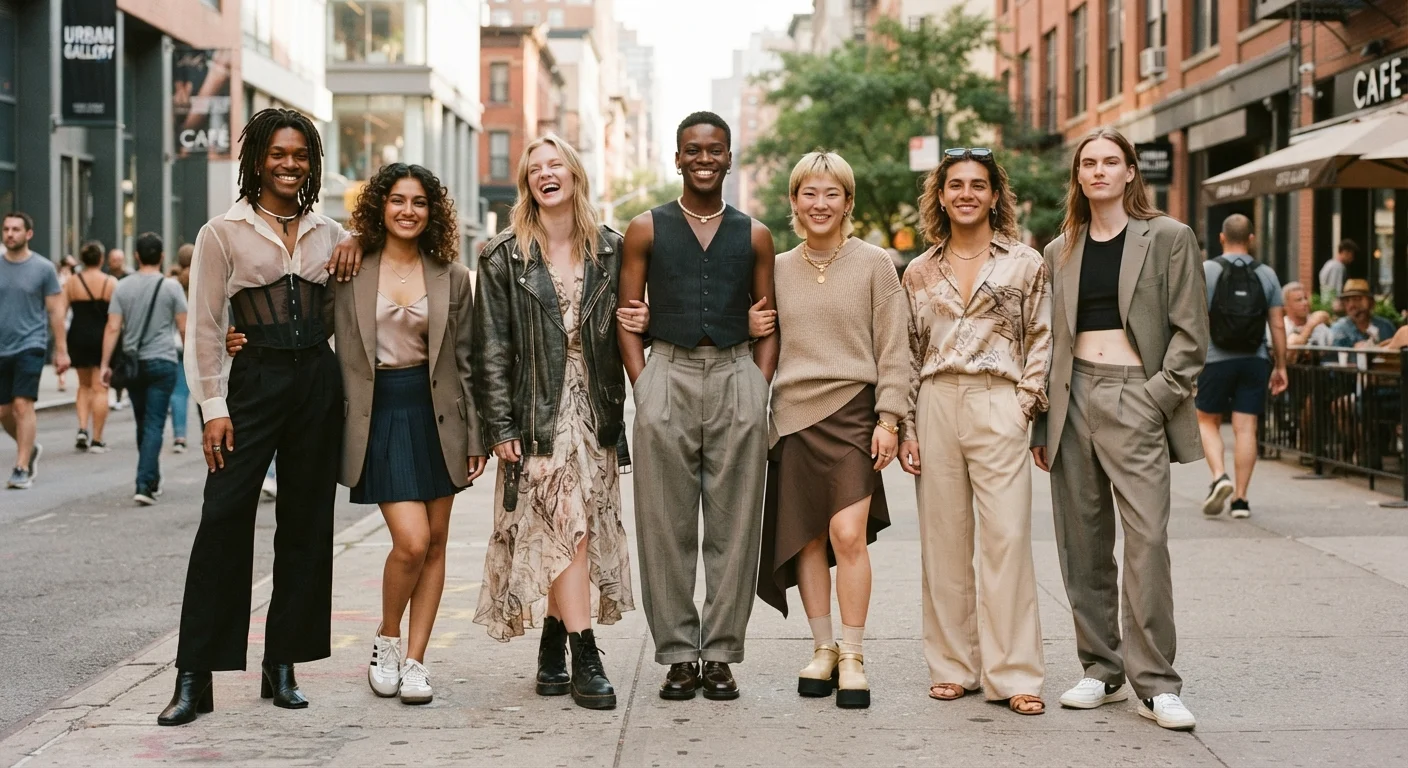
For most people, exploring gender-expansive style doesn't look like a dramatic reinvention. It might be as simple as a woman reaching for a structured, boxy blazer historically associated with menswear, or a man choosing a floral print, a softer fabric, or a longer silhouette. It can mean shopping without filtering by gender category, or just following what genuinely appeals to you rather than what's been assigned to your section of the store.
The everyday fashion conversation has increasingly made room for these choices without requiring a label or a manifesto. That's arguably the most meaningful shift: dressing outside traditional norms no longer demands a public statement. It can simply be a personal one.
If you've ever felt like your style has plateaued or stopped feeling authentic, that's worth paying attention to. Our piece on why your style might feel stale explores what gets in the way of genuine expression — and it's often not about gender at all.
Start Small, Stay Curious
You don't need a whole new wardrobe to explore gender-expansive dressing. Try one item that genuinely interests you — a fabric, a cut, an accessory — without framing it as a statement. Wear it somewhere low-stakes first, and pay attention to how you feel rather than how you think you look. Authentic style usually builds from that honest feedback loop.
Navigating Social Contexts and Practical Realities
Wanting to dress in gender-expansive ways and feeling safe or comfortable doing so in every context are two different things. Workplaces, family environments, geographic regions, and social communities all carry their own expectations and pressures. Acknowledging that reality isn't a reason to abandon authentic expression — it's a reason to be thoughtful about when, where, and how you explore it.
There are also practical limits worth naming honestly: not all bodies are well-served by existing gender-neutral or cross-category options. Sizing gaps between traditionally men's and women's garments remain a genuine barrier for many shoppers. Tailoring can help, but it adds cost. These aren't small obstacles, and glossing over them doesn't serve anyone. The myths that hold people back from authentic dressing include the idea that style exploration is friction-free — it rarely is, and that's okay.
For those who find that getting dressed is entangled with feelings about their body rather than just their gender presentation, the lens of body neutrality and getting dressed can offer a useful reframe — one that centers how you feel and communicate rather than how you appear to others.