

Key Takeaways
Unit Price
A unit price is the cost of a product broken down to a standard measurement — such as per ounce, per count, per liter, or per square foot. It lets you compare the true cost of products sold in different package sizes, regardless of what the sticker price says. Retailers are required to display unit prices on shelf tags in many U.S. states, typically as a small number separate from the total price.
Unit pricing regulations vary by state. Some states mandate unit price disclosure only for food and grocery items, while others extend the requirement to household products and personal care goods.
What Unit Pricing Actually Shows You
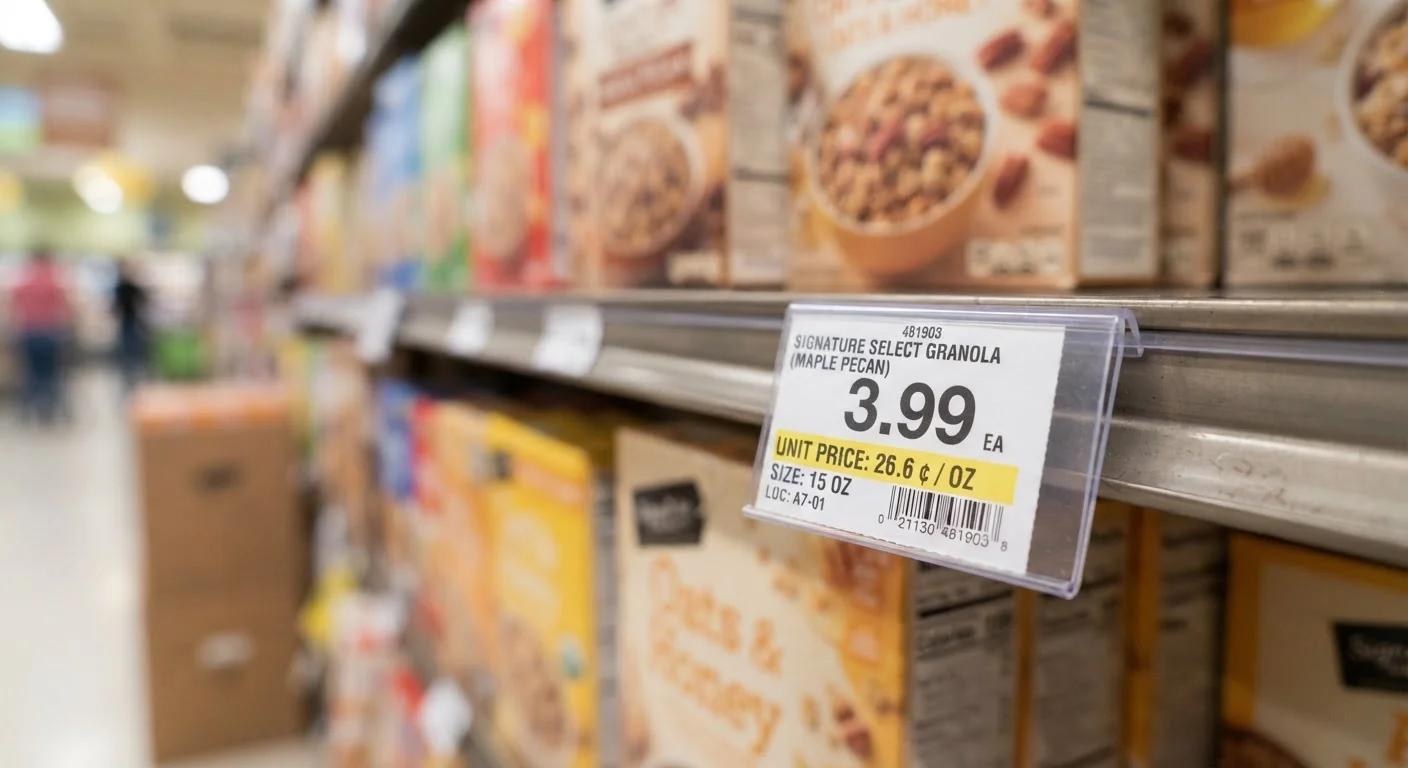
Every grocery shelf tag contains two numbers. The large one tells you what you'll hand over at the register. The small one — often tucked in a corner in a modest font — tells you what you're actually paying for the product itself. That second number is the unit price, and for most purchase decisions, it's the more useful figure.
Unit prices standardize cost to a common measure: dollars and cents per ounce, per count, per liter, or per square foot, depending on the product type. This normalization is what makes comparisons meaningful. A 14-oz can of beans and a 28-oz can of the same beans might sit side by side at different price points, but only the unit price tells you instantly which one costs less per serving.
Unit pricing doesn't account for quality differences, ingredient variations, or personal preference — it's a purely economic comparison tool. Used alongside other information (like an ingredient list), it gives a fuller picture of value. See how to read an ingredient list for context on what else to check beyond the price tag.
~30+
U.S. states with some form of unit pricing law
According to the National Conference of State Legislatures, the majority of U.S. states have enacted unit pricing requirements for at least some categories of retail goods, primarily food products.
Up to 30%
Potential per-unit cost difference between package sizes
Consumer research has documented cases where purchasing a smaller or mid-size package of the same product can cost 20–30% more per unit than its larger counterpart — though the reverse is also sometimes true.
The 'Bigger Is Cheaper' Assumption Doesn't Always Hold
Many shoppers default to the largest available package on the assumption that bulk automatically means savings. This is often — but not always — true. Retailers occasionally price mid-size or smaller packages at a more competitive unit rate, particularly when they're on promotion or being cleared out. The only reliable way to verify is to check the unit price directly rather than assume.
Sale tags introduce another layer of complexity. A "buy two, get one" promotion or a percentage-off sticker can make a name-brand item look attractive while a generic sitting next to it quietly offers a lower unit price without any promotional fanfare. Understanding what a sale price actually means helps you cut through that noise before you reach the cart.
Quickly Verify Before You Assume
Before placing a bulk item in your cart based on price alone, take five seconds to locate the unit price on the shelf tag. Compare it directly to the nearest alternative size or brand. If the shelf tag doesn't show a unit price, you can calculate it yourself: divide the total price by the number of ounces, count, or liters listed on the package.
How to Read a Shelf Tag Quickly
Most U.S. grocery shelf tags follow a similar format: the retail price is displayed prominently, with unit price information printed smaller, often alongside the product's item number and the unit of measure. The unit measure matters — comparing a product priced per ounce against one priced per count requires you to convert, which defeats the purpose.
When unit measures match, the comparison is immediate. When they don't — say, one product lists price per ounce and another per pound — a quick mental conversion (16 ounces per pound) resolves it. Most stores try to display consistent units within a product category, but it's worth double-checking.
Units Must Match for a Fair Comparison
Unit price comparisons are only valid when both products use the same base measure. If one item shows cost per ounce and another shows cost per pound, convert before comparing (there are 16 ounces in a pound). Retailers generally standardize units within a category, but it's worth verifying — especially for items like paper products, which may mix square footage and sheet count.
Retailers use a range of pricing structures and display formats that can make straightforward comparisons harder than they should be. Retail pricing tactics like anchor pricing and charm pricing often work alongside confusing package sizes to steer shoppers away from the best per-unit value.
Putting Unit Pricing to Work at the Store
Unit pricing works best as a quick filter, not an obsessive exercise. In practice, glancing at the unit price takes a few seconds per item and can meaningfully shift which product ends up in your cart — especially for staples you buy regularly. Over dozens of shopping trips, those small differences compound.
It's particularly useful when evaluating store brands against name brands. The price gap is visible in the sticker price, but the unit price confirms whether the gap is proportional to the size difference or whether one option genuinely offers more product per dollar. For a more structured approach to that decision, see generic vs. name brand comparisons.
The habit of checking unit prices doesn't require a calculator or a shopping app — just a few extra seconds at the shelf before the item goes in the cart.