

Key Takeaways
HVAC Preventive Maintenance
HVAC preventive maintenance refers to routine upkeep tasks — such as replacing filters, cleaning coils, and clearing vents — performed on a schedule to keep heating and cooling equipment operating efficiently and reliably. The goal is to catch small problems before they become costly failures. Most maintenance tasks fall into two categories: owner-performed tasks done monthly or seasonally, and professional tune-ups typically done once or twice a year.
HVAC stands for Heating, Ventilation, and Air Conditioning. The system integrates an air handler, heat exchanger or refrigerant coils, a blower motor, ductwork, and controls — each component requiring periodic attention.
Why Filters Are the Starting Point
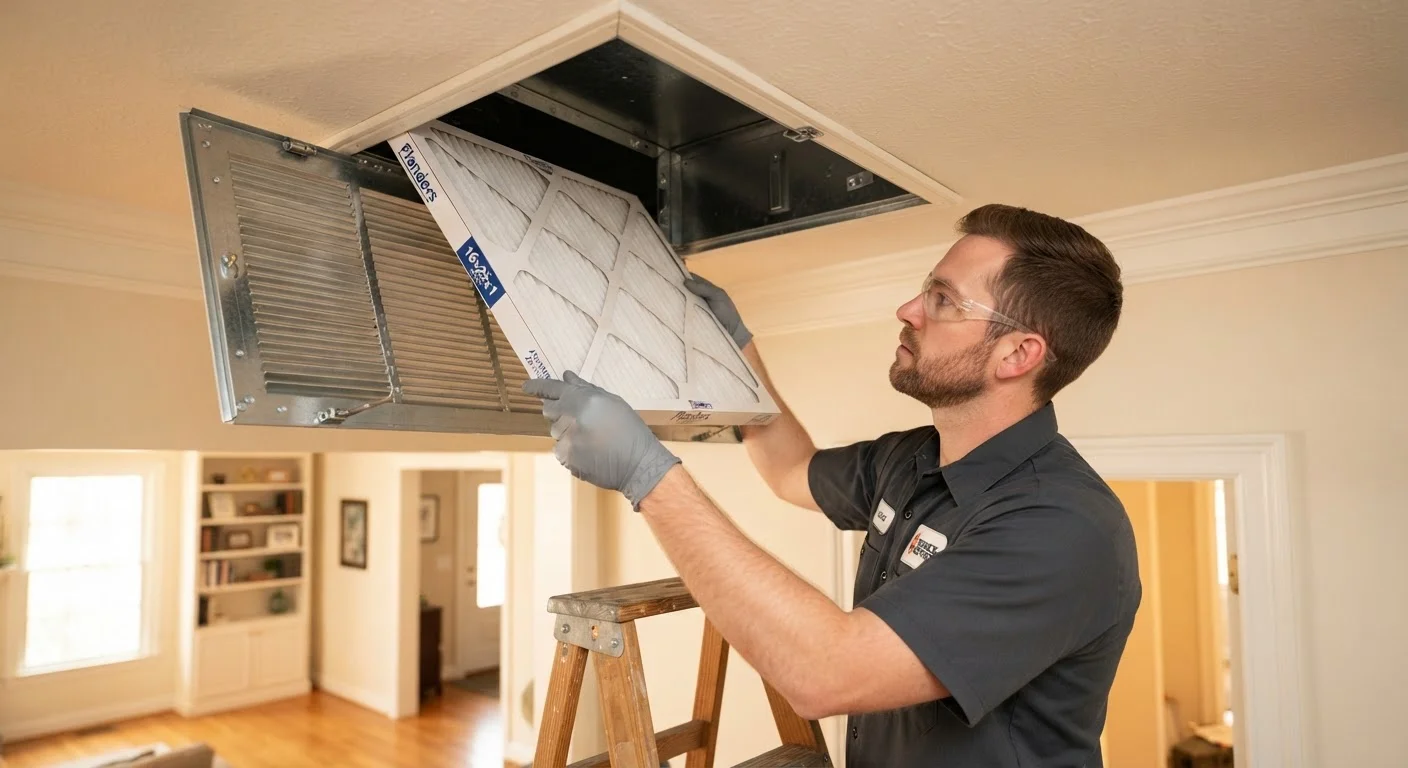
The air filter is the HVAC system's first line of defense — and the component most homeowners can manage themselves. Its job is to trap dust, pollen, pet dander, and other airborne particles before they pass through the blower and coat internal components.
When a filter becomes clogged, airflow is restricted. The system works harder to pull air through, which strains the blower motor, reduces efficiency, and can cause the evaporator coil to freeze up. Replacing the filter on schedule is one of the lowest-cost, highest-impact maintenance tasks available to any homeowner.
Filter selection matters too. Filters carry a MERV rating (Minimum Efficiency Reporting Value) — a scale from 1 to 16 measuring how effectively the filter catches particles. Ratings between 8 and 11 are appropriate for most residential systems. Very high-MERV filters trap more contaminants but restrict airflow more significantly; always verify compatibility with your equipment before switching.
Build a Simple Filter-Change Reminder
Set a recurring phone reminder on the first of each month to check your filter. Hold it up to a light source — if you can't see light through it clearly, it's time to replace it. Buying filters in bulk (same size, same rating) keeps the habit low-friction and low-cost.
For a broader picture of what seasonal upkeep involves, see the seasonal home maintenance checklist that covers HVAC alongside other home systems.
Coils: What They Do and Why They Need Cleaning
Your HVAC system contains two sets of coils, each serving a distinct function:
- Evaporator coils (inside the air handler) absorb heat from indoor air, cooling it before circulation.
- Condenser coils (in the outdoor unit) release that heat to the outside air.
Both accumulate dirt over time. On evaporator coils, grime creates an insulating layer that prevents effective heat absorption, reducing cooling capacity and forcing the system to run longer cycles. On condenser coils, outdoor debris — dust, grass clippings, cottonwood seeds — clogs the fins and restricts heat release.
Condenser coils can often be rinsed gently with a garden hose from the inside out (after shutting off power) to clear surface debris. Evaporator coil cleaning is more involved and is generally best left to a licensed technician, who can also check the condensate drain line — the small pipe that channels moisture away from the coil — for blockages that can cause water damage.
5–15%
Potential energy savings from regular filter changes
The U.S. Department of Energy notes that replacing a clogged filter can lower an air conditioner's energy consumption by roughly 5–15%.
1–3 months
Typical filter replacement interval for standard 1-inch filters
Most HVAC manufacturers and industry guidance recommend checking standard filters monthly and replacing them every one to three months depending on household conditions.
15–20 years
Average lifespan of well-maintained HVAC equipment
Industry sources generally cite 15–20 years as the expected lifespan of central air conditioning equipment that receives consistent preventive maintenance.
Vents, Registers, and Ductwork: The Airflow Side
Filters and coils handle air quality and heat transfer, but vents and ductwork handle distribution. Supply registers deliver conditioned air to rooms; return vents pull air back to be re-conditioned. Both need to remain clear.
Common airflow problems homeowners can address directly include:
- Blocked supply registers — furniture, rugs, or drapes covering vents redirect airflow and create pressure imbalances in the system.
- Closed return vents — closing returns in unused rooms doesn't save energy; it typically increases static pressure and can strain the blower.
- Dusty register covers — grilles and register covers accumulate dust. Removing and rinsing them periodically takes only minutes.
Ductwork itself — the network of metal or flexible channels running through walls, ceilings, and crawl spaces — can develop leaks at joints over time. Leaky ducts lose conditioned air into unconditioned spaces, reducing efficiency noticeably. This is an area for a professional to assess and seal. See how attic ventilation interacts with your HVAC system for more on how connected systems affect each other.
What a Professional Tune-Up Covers
DIY tasks — filter swaps, rinsing the condenser, clearing vents — cover the accessible parts of the system. An annual or biannual professional inspection goes deeper. A qualified HVAC technician typically checks:
- Refrigerant charge and leak detection (refrigerant levels affect cooling capacity and are regulated; only licensed technicians may handle refrigerants legally)
- Electrical connections and capacitors
- Blower motor condition and lubrication
- Thermostat calibration
- Condensate drain function
- Heat exchanger integrity (for furnace systems) — a cracked heat exchanger can allow combustion gases to enter living spaces and is a safety concern requiring immediate professional attention
“The most common cause of HVAC system failure is lack of maintenance. Dirty filters and coils account for a disproportionate share of preventable breakdowns.”
— Air Conditioning Contractors of America (ACCA), National trade association for HVAC professionals
Keeping a record of every service visit, filter change, and repair makes it easier to spot patterns and prove maintenance history if you sell the home. The home maintenance log guide explains what information is worth tracking and why.
Skipping professional inspections rarely saves money in the long run. The cost of deferred maintenance tends to compound — a small refrigerant leak left undetected stresses the compressor, and compressor replacement is one of the most expensive HVAC repairs possible.
This article is for general informational purposes only. HVAC work involving refrigerants, gas lines, or electrical components should be performed by a licensed professional. Always verify local permit and code requirements before undertaking any system modifications.