

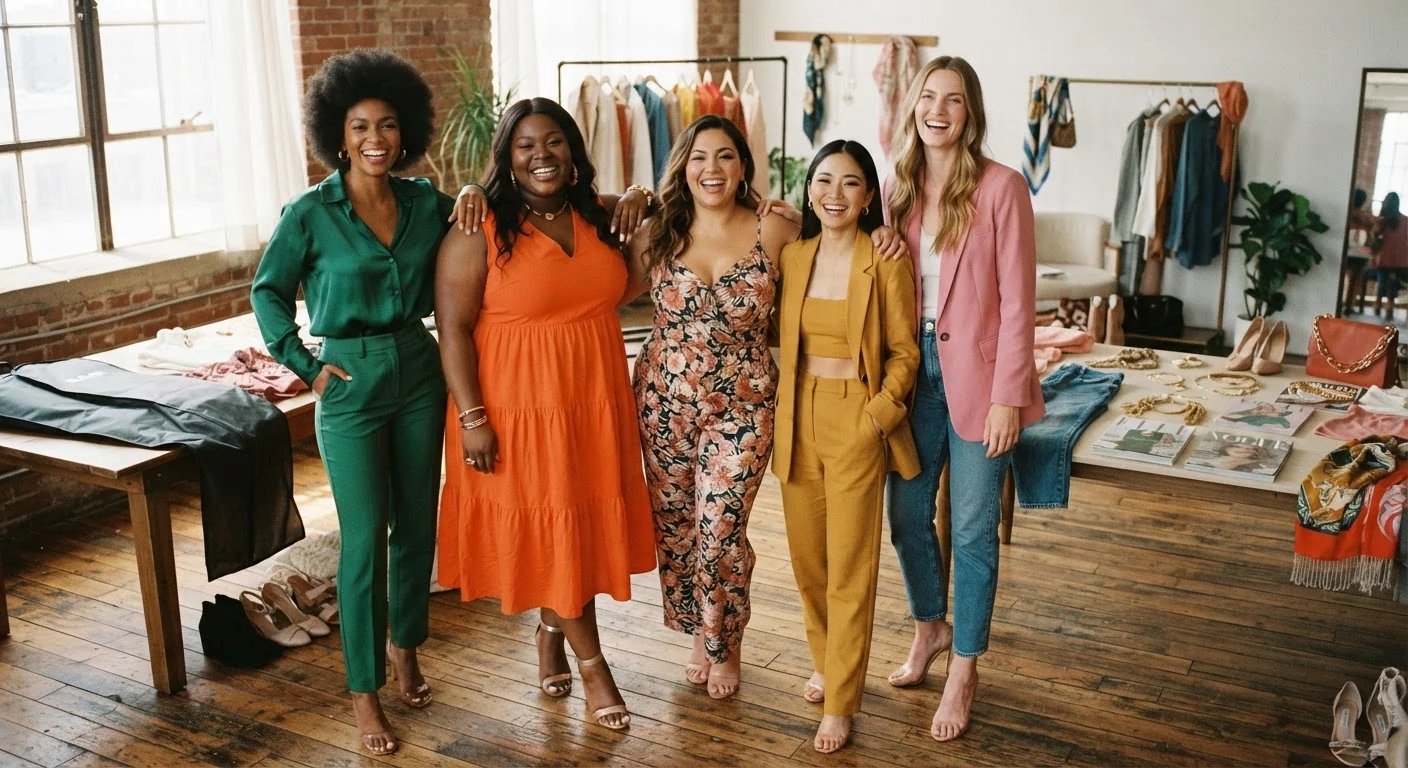
Key Takeaways
Where Body-Shape Advice Comes From — and Why It Deserves Scrutiny
Body-shape dressing systems — hourglass, pear, apple, rectangle, inverted triangle — became mainstream fashion shorthand in the mid-20th century, popularized through women's magazines and style guides. The core premise was simple: identify your shape, then follow a specific set of rules to look 'balanced.' The problem is that 'balanced' almost always meant one thing — closer to a narrow, culturally specific ideal.
That history matters because it helps explain why so many of these rules feel restrictive or even unkind. They weren't developed to help people dress for themselves; they were developed to make a wide range of bodies appear as similar as possible to a single silhouette. Understanding this context makes it easier to separate the genuinely useful structural advice from the stuff that's simply outdated.
If you're still figuring out what style actually means to you, finding your personal aesthetic is a worthwhile first step before getting into the details of proportion and fit.
Myth
You must dress to create an hourglass silhouette regardless of your natural shape.
Fact
Creating an hourglass silhouette is one option, not a universal style requirement. Your goal gets to be whatever you decide it is.
The hourglass ideal reflects a particular cultural moment and a narrow set of beauty standards. Plenty of people dress in ways that emphasize width, volume, or linearity — and look entirely intentional doing it. Choosing not to chase one specific silhouette isn't a style mistake; it's a preference. The clothes you feel most like yourself in are doing their job regardless of whether they conform to a historical prescription.
Myth
Horizontal stripes make you look wider, so people with larger bodies should avoid them.
Fact
Research on the 'Helmholtz illusion' — the idea that vertical lines slim and horizontal lines widen — is more nuanced than fashion rules suggest, and visual perception varies significantly by context.
Some perceptual studies have actually found that vertical stripes can appear to widen a shape under certain conditions, complicating the classic advice. More importantly, whether you 'look wider' in horizontal stripes isn't itself a problem unless you've decided it is. Plenty of people wear horizontal stripes with great effect — the key is usually scale and contrast, not avoidance based on body type.
Myth
Certain colors should only be worn in specific places on the body to minimize or emphasize.
Fact
Color placement can create visual emphasis, but the rule that larger bodies should wear dark colors everywhere to appear smaller reflects bias, not universal style wisdom.
Dark colors don't 'shrink' bodies; they reduce contrast in certain lighting conditions. Meanwhile, the instruction to minimize the appearance of any body part presumes that smaller always equals better — an assumption worth questioning directly. Wear color where you enjoy it. If a bold red draws the eye to your hips or midsection and you like that, it's working exactly as intended.
Myth
Petite people should always avoid oversized clothing.
Fact
Proportion matters, but oversized silhouettes can absolutely work on shorter or smaller frames — it's about intentionality, not prohibition.
Oversized clothing has been a deliberate, celebrated silhouette in fashion for decades, worn by people across every height and frame. On a petite frame, the key considerations are usually fabric weight (lighter fabrics drape rather than overwhelm) and one deliberate point of definition — a tucked hem, a cinched waist, or a visible shoe. These aren't rules; they're tools to use if and when they help you achieve what you're going for.
Myth
Body-shape dressing rules are neutral, objective style guidance.
Fact
Body-shape systems were developed within specific cultural contexts and often encode assumptions about which bodies are ideal. They are not objective or universal.
Most classic body-shape dressing systems were developed and disseminated by predominantly Western, predominantly white fashion media in the mid-to-late 20th century. They reflect that context — including assumptions about what bodies should look like. Treating these systems as neutral or scientific ignores their origins and limits their usefulness. Taking what's genuinely helpful while discarding what isn't is a more thoughtful approach than following the system wholesale.
What Actually Holds Up: Fit, Proportion, and Practical Dressing
Once you strip away the shame-adjacent language, a few genuinely useful ideas remain. Proportion — the visual relationship between different parts of an outfit — is real and worth understanding on your own terms. A voluminous top paired with a fitted bottom creates a different effect than the reverse, and knowing that gives you agency, not obligation.
Fit is probably the single most impactful factor in how clothes look and feel. Garments that pull, gap, or bunch at the shoulders, chest, or hips rarely look polished regardless of body type — and minor alterations can transform off-the-rack pieces dramatically. Understanding when tailoring is worth it can genuinely extend the usefulness of your wardrobe without requiring a complete overhaul.
Fabric weight and drape also matter. Stiff fabrics add structure and volume; lightweight, fluid fabrics follow the body's contours. Neither is inherently better — they just create different silhouettes, and both can work beautifully depending on what you're going for.
Don't Mistake Discomfort for 'Right'
Some dressing rules recommend garments — shapewear, structured waistbands, or certain silhouettes — that cause genuine physical discomfort in order to achieve a particular look. Physical discomfort is worth taking seriously. A garment that restricts breathing, circulation, or movement is not serving you well regardless of the silhouette it creates. Fit that works for your body should feel comfortable throughout the day, not just in a fitting-room moment.
Finally, color, pattern, and print do create visual emphasis — that's simply how human perception works. But 'avoid drawing attention' is not a style goal everyone shares or should feel pressured to adopt. Some people actively want bold prints exactly where traditional advice says to avoid them, and that's a completely legitimate choice. Dressing for yourself versus others is a tension worth exploring on your own terms, not resolved by a magazine rule.
Building a Wardrobe That Works Without the Rulebook
A practical wardrobe isn't built by following body-shape prescriptions — it's built by paying attention to what you reach for, what sits unworn, and what makes you feel ready to take on your day. That process is iterative and personal.
Start with fit as your baseline: if something is genuinely uncomfortable or restricts movement, that's worth addressing regardless of what the garment 'should' do for your shape. From there, experiment with proportion and silhouette freely. Getting more outfits from fewer pieces is a smarter strategy than buying according to a prescribed shape category.
It's also worth checking in on why you're drawn to certain rules. If a guideline genuinely helps you feel more confident, use it. If it mostly makes you feel like your body is a problem to be solved, it may be worth setting it aside. Body neutrality and getting dressed offers a genuinely different framework if the appearance-first approach isn't serving you.
66%
Americans who wear clothing primarily for comfort
A Cotton Incorporated Lifestyle Monitor survey found that comfort consistently ranks as the top driver of clothing choices for the majority of American consumers.
5+
Major body-shape classification systems in use
Researchers and fashion educators have identified at least five widely used and often conflicting body-shape categorization frameworks, each with different definitions and rules.
Trends are part of this too — some will align with your preferences and proportions naturally; others won't, and that's fine. Finding your balance with trends doesn't have to mean following body-shape rules to decide what's 'for you.'