

Key Takeaways
Our Verdict
Motorhomes suit travelers who prioritize road-trip convenience, frequent use, and an all-in-one setup - at the cost of higher purchase prices and more complex maintenance. Towable RVs offer more flexibility in vehicle choice and campsite access, often with a lower entry price, but require a capable tow vehicle and more setup time. Matching the ownership model to your actual travel habits is more important than any single feature.
| Best for | Recommended |
|---|---|
| Frequent travelers and full-timers who value convenience | Motorhome |
| Budget-conscious buyers or those who already own a capable tow vehicle | Towable RV |
| Those who want to explore remote or off-grid campsites | Towable RV |
| Travelers who want a standalone living space without managing a separate vehicle | Motorhome |
The Core Difference: Self-Propelled vs. Towed
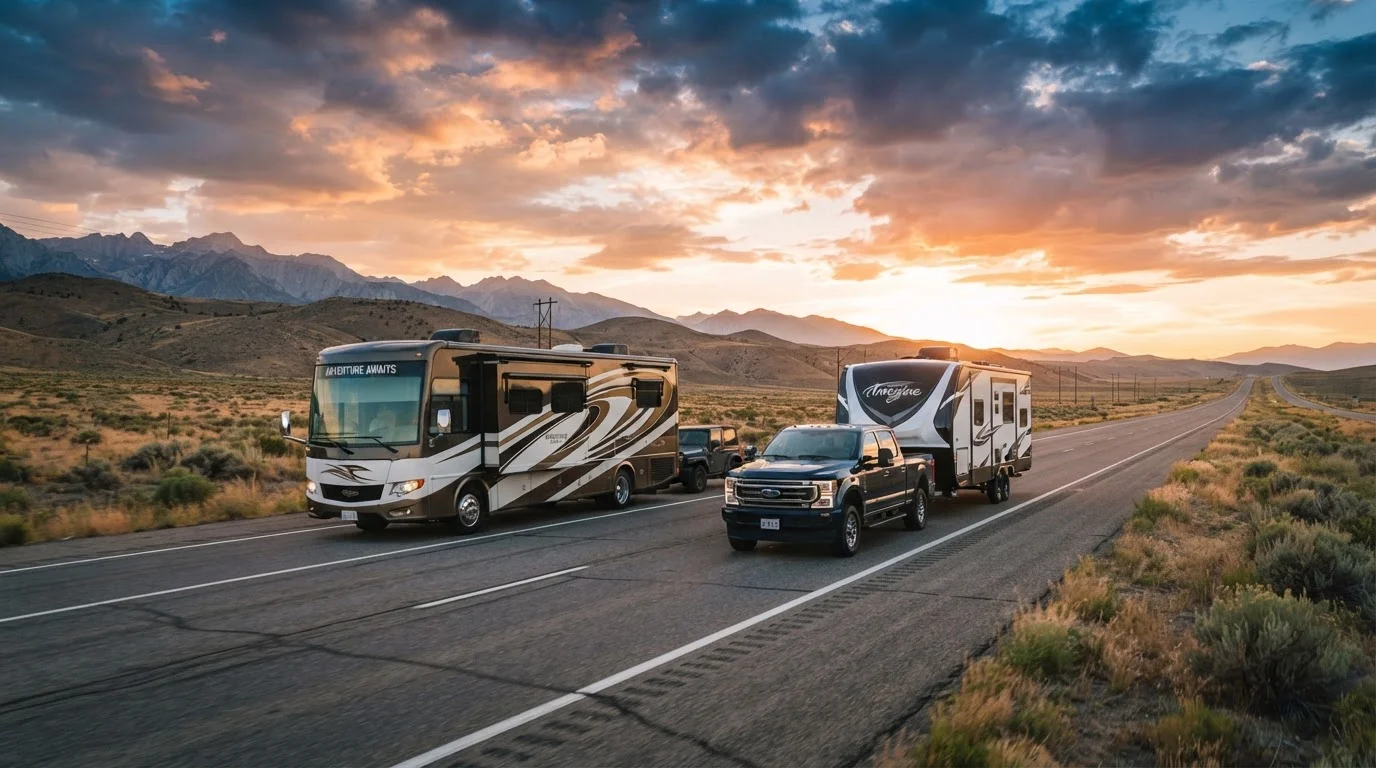
The fundamental split in the RV world is simple: a motorhome is a vehicle with the living quarters built in, driven by its own engine. A towable RV - whether a travel trailer, fifth wheel, or toy hauler - is a standalone unit pulled behind a separate vehicle you already own or purchase specifically for that purpose.
That structural difference cascades into nearly every practical aspect of ownership: how you drive, where you can park, what you spend, and what breaks down. Understanding how motorhome classes differ is a useful first step before comparing them against towable options, since a Class B camper van sits at a very different price and convenience point than a Class A diesel pusher.
For towable buyers, the comparison within that category matters too - travel trailers and fifth wheels have meaningfully different hitch systems, stability profiles, and interior configurations worth understanding separately.
Cost Structure: Purchase Price, Depreciation, and Operating Expenses
On the purchase side, towable RVs tend to carry lower sticker prices at equivalent living space. A well-appointed travel trailer can cost significantly less than a Class A motorhome with similar square footage. However, if you don't already own a truck or SUV with adequate tow capacity, factoring in that vehicle purchase narrows or eliminates the price gap.
7-10 mpg
Typical Class A diesel fuel economy
Industry estimates consistently place large diesel motorhome fuel economy in this range under normal highway driving conditions.
~20-30%
Towing fuel economy reduction
Pickup trucks towing a loaded travel trailer commonly see fuel economy drop 20-30% compared to unladen highway driving, per general engineering estimates.
Depreciation is a real factor in both categories. Motorhomes depreciate as a combined vehicle-and-home asset. If the chassis engine requires a major repair, you're also dealing with a non-drivable living space during downtime. Towable RVs depreciate independently of your tow vehicle, which can offer some flexibility - you could sell or upgrade each separately.
Operating costs diverge significantly on fuel. A Class A diesel motorhome may average 7-10 miles per gallon. Towing a trailer with a pickup reduces fuel economy noticeably from its solo baseline, but the underlying tow vehicle often returns far better mileage when used independently. Insurance, storage fees, and campsite costs are broadly similar across both categories, though some motorhome policies bundle comprehensive coverage that towable policies handle differently.
Tow Capacity Is Non-Negotiable
Exceeding a vehicle's rated tow capacity is dangerous and can cause brake failure, trailer sway, and structural damage to the tow vehicle. Always verify the Gross Combined Vehicle Weight Rating (GCVWR) against both the loaded trailer weight and the tow vehicle's published limits. Never rely on a salesperson's estimate - consult the manufacturer's towing guide for your specific vehicle configuration.
Driving Experience and Campsite Logistics
Driving a motorhome means managing a large, heavy vehicle through traffic, low-clearance roads, and tight campgrounds - all while your passengers can move freely through the living space. There's genuine convenience in pulling into a site, leveling, and being done. Setup typically takes 15-30 minutes rather than an hour or more.
Towable RVs require hitching and unhitching, but once parked, your tow vehicle is free. That independence matters significantly in mountainous or remote areas where you'd otherwise need a toad (a vehicle towed behind a motorhome) to run errands or explore. Many motorhome owners do tow a small car for exactly this reason - which adds towing complexity and cost right back into the equation.
Campsite access is another practical divider. Longer Class A motorhomes - some exceeding 40 feet - are restricted from many state and national park campgrounds with length limits. Shorter towable rigs or a pop-up camper, like those discussed in our pop-up camper overview, can access more sites. That said, fifth wheels and large travel trailers can also exceed typical length limits, so this isn't exclusively a motorhome problem.
Maintenance, Repairs, and Long-Term Ownership Reality
Motorhomes carry two independent systems that both require upkeep: the chassis and drivetrain (maintained like any large vehicle) and the coach systems - plumbing, HVAC, electrical, appliances. When one fails, they can affect each other in ways that complicate scheduling and repair estimates. Chassis service must be performed at facilities equipped for the engine type, which for diesel pushers may mean specialty shops.
Towable RVs eliminate the engine and drivetrain maintenance on the RV unit itself. Bearings, brakes, tires, and frame are simpler systems than a motorhome chassis. However, the tow vehicle absorbs additional wear - more frequent transmission service, brake replacement, and tire wear are common results of regular towing.
Budget Beyond the Sticker Price
Whether you choose a motorhome or a towable, factor in annual maintenance reserves, storage fees (typically $50-$300/month depending on region and type), campground costs, and insurance. First-time buyers frequently underestimate these ongoing expenses, which can average several thousand dollars per year on top of any loan payment.
Both formats benefit from pre-purchase inspections by a qualified RV technician. The misconceptions many first-time buyers carry into the purchase process - including underestimating maintenance budgets - apply equally to motorhomes and towables. And if you're undecided, renting before buying can expose real-world friction points before you commit financially.
For a fuller picture of what day-to-day RV life actually involves, an honest look at the RV lifestyle covers both the rewards and the genuine challenges that ownership brings.
Comparing the Two Models Side by Side
The table below summarizes the key dimensions where motorhomes and towable RVs diverge. No single row tells the whole story - it's the combination of factors that should drive your decision.
| Motorhome | Towable RV | |
|---|---|---|
| Upfront cost (RV unit alone) | Generally higher | Generally lower |
| Additional vehicle required | No (is the vehicle) | Yes (tow vehicle needed) |
| Campsite setup time | Faster (15-30 min typical) | Longer (hitch, level, connect) |
| Independent local vehicle | Requires towing a 'toad' | Tow vehicle is available |
| Maintenance complexity | Higher (two full systems) | Moderate (simpler RV unit) |
| Fuel economy | Lower (self-powered, heavy) | Tow vehicle varies by load |
| Campsite length restrictions | More limiting for large units | Varies widely by rig size |
| Depreciation structure | Combined asset | Separate from tow vehicle |