

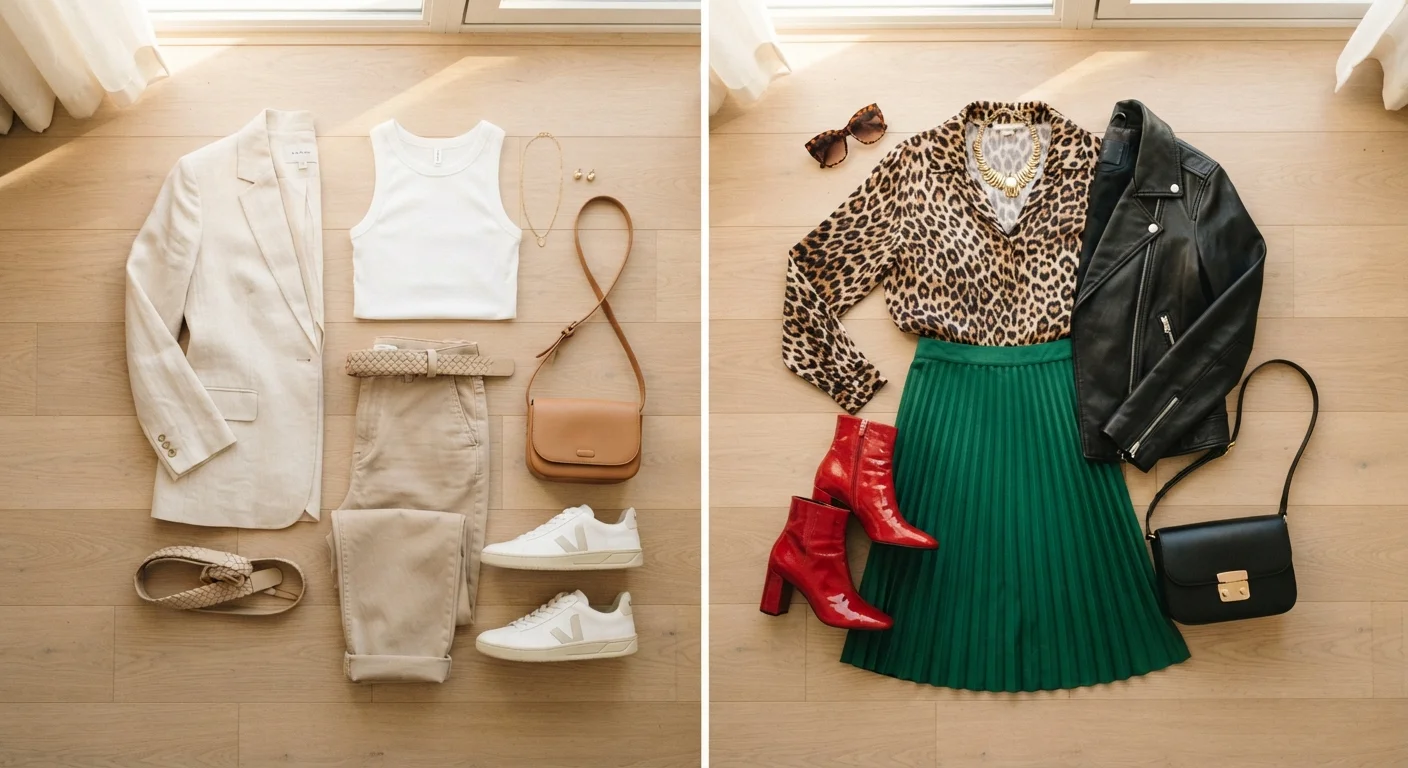
Key Takeaways
Option A
Signature Style
The identity-first approach to getting dressed.
Best for: People who want their wardrobe to feel like a consistent personal statement — instantly recognizable and deeply tied to who they are.
Option B
Capsule Wardrobe
The function-first approach to a streamlined closet.
Best for: People who want a practical, low-decision wardrobe built around a small set of versatile pieces that work together effortlessly.
If you want your wardrobe to feel like an extension of your personality
Signature Style
Signature style is built around self-expression first, making it the right fit for anyone who sees clothing as a form of identity rather than just utility.
If decision fatigue and closet clutter are your biggest frustrations
Capsule Wardrobe
A capsule wardrobe dramatically reduces the number of choices you face each morning by keeping only highly versatile, coordinating pieces.
If you want to shop more sustainably and waste less
Capsule Wardrobe
The capsule model naturally limits acquisition and encourages investing in quality over quantity, which aligns well with mindful consumption goals.
If you're drawn to bold, eclectic, or maximalist aesthetics
Signature Style
Signature style has no size limit — it can absolutely include a large, expressive wardrobe, as long as everything feels coherent to your identity.
If you want a flexible starting point that can grow into either approach
Capsule Wardrobe
A capsule gives you a functional foundation you can build from once you develop a clearer sense of your personal aesthetic over time.
What Each Approach Actually Means
These two concepts get lumped together often — and it's easy to see why. Both push back against mindless consumption, both ask you to be deliberate about what hangs in your closet, and both tend to result in wardrobes that feel more cohesive. But they start from very different places.
Signature style is a philosophy rooted in self-expression. It's the idea that your clothing communicates something consistent about who you are — a recognizable aesthetic thread that runs through your wardrobe regardless of season or occasion. A signature style might be structured and minimalist, or it might be bold and eclectic. The defining feature isn't the number of pieces or a particular color palette — it's coherence of identity. Think of it as answering the question: What do I want my clothes to say about me?
A capsule wardrobe, by contrast, is a structural framework. The concept — popularized in the 1970s by fashion consultant Susie Faux and later expanded by designer Donna Karan's "Seven Easy Pieces" — refers to a curated set of timeless, interchangeable pieces that form the backbone of your wardrobe. The emphasis is on versatility, coordination, and reducing volume. A capsule wardrobe answers a different question: How can I get dressed efficiently with less?
Understanding that distinction — identity versus structure — is the key to figuring out which one (or which combination) serves you best. For a deeper look at how personal aesthetic identities are categorized, explore our guide to style archetypes.
| Criterion | Signature Style | Capsule Wardrobe |
|---|---|---|
| Primary goal | Self-expression and identity | Efficiency and versatility |
| Size of wardrobe | No fixed limit | Intentionally small |
| Color palette | Defined by your aesthetic | Usually neutral and cohesive |
| Trend engagement | Filtered through personal aesthetic | Typically minimized |
| Works for maximalists? | Yes | Generally no |
| Reduces decision fatigue? | Only if well-curated | Yes, by design |
| Starting point | Identity and values | Function and coordination |
Where They Overlap — and Where They Diverge
Both approaches will likely push you toward shopping with more intention and keeping fewer items that don't earn their place. That overlap is meaningful — it's why so many people assume they're the same thing.
The divergence shows up most clearly in how flexible each approach is. A capsule wardrobe has built-in constraints by design: a limited number of items, a neutral or cohesive color story, and an emphasis on pieces that mix and match. Those constraints are a feature, not a bug — they create ease. But they can feel restricting if your personal style skews dramatic, print-heavy, or highly trend-responsive.
Signature style, on the other hand, has no inherent size limit. You can have 15 pieces or 150 — what matters is that they all feel unmistakably you. Someone with a maximalist signature style might own dozens of statement pieces, all of which express a clear, consistent sensibility. That's very different from a capsule approach.
These Approaches Can Work Together
Many people find the most satisfying wardrobe at the intersection of both ideas — capsule thinking provides the editing framework, while a clear signature style provides the aesthetic direction. You don't have to choose one and reject the other entirely. Think of them as complementary lenses rather than competing ideologies.
The sweet spot for many people is using capsule principles — intentionality, versatility, quality over quantity — as a filter, while letting their signature style define the aesthetic. You can build a capsule wardrobe that looks like your signature, rather than a generic neutral one. For practical next steps, our article on curating a wardrobe that actually reflects you walks through the process.
Choosing What Works for Your Life
Neither approach is universally superior — both are tools, and the right tool depends on what problem you're trying to solve.
If you regularly feel like you have nothing to wear despite a full closet, a capsule structure might be the answer. If you feel like your wardrobe doesn't represent who you are, developing a clearer signature style is the better starting point. And if both of those feel true, you may need to work on them in sequence — clarify your aesthetic identity first, then use capsule thinking to edit your wardrobe down to the most expressive, versatile version of that identity.
It's also worth considering how you relate to trends. A rigid capsule wardrobe can sometimes make trend engagement feel wasteful or inconsistent. A signature style gives you a filter — you can adopt trends that align with your aesthetic and skip the rest. For more on navigating that balance, see our piece on personal style vs. trends.
If sustainability is a priority, both approaches can support more mindful consumption — though they do so differently. Our article on sustainable self-expression explores how values-driven dressing intersects with both frameworks. For a thorough breakdown of the capsule concept itself, The Capsule Wardrobe: What It Actually Is and Whether It Works is worth a read before committing to the method.
~30%
Clothing never or rarely worn
Research consistently suggests that a significant portion of the average American's wardrobe goes unworn — estimates commonly cited in sustainability and fashion studies hover around 30% or more.
33
Items in a classic capsule wardrobe
The Project 333 minimalist fashion challenge, developed by Courtney Carver, popularized the idea of living with 33 items or fewer for a three-month period.