

Key Takeaways
Cruise Ship Categories
Cruise ships are grouped into categories based on their size, passenger capacity, onboard amenities, and the type of voyages they're designed to undertake. These categories range from enormous mega-ships carrying thousands of guests to compact expedition vessels built for remote, off-the-beaten-path destinations. Understanding these categories helps travelers match a ship type to their expectations before booking.
The cruise industry uses several overlapping classification systems — including gross tonnage (GT), passenger capacity, and market segment (contemporary, premium, luxury, expedition) — so categories are not always standardized across cruise lines.
Mega-Ships: Floating Cities at Sea
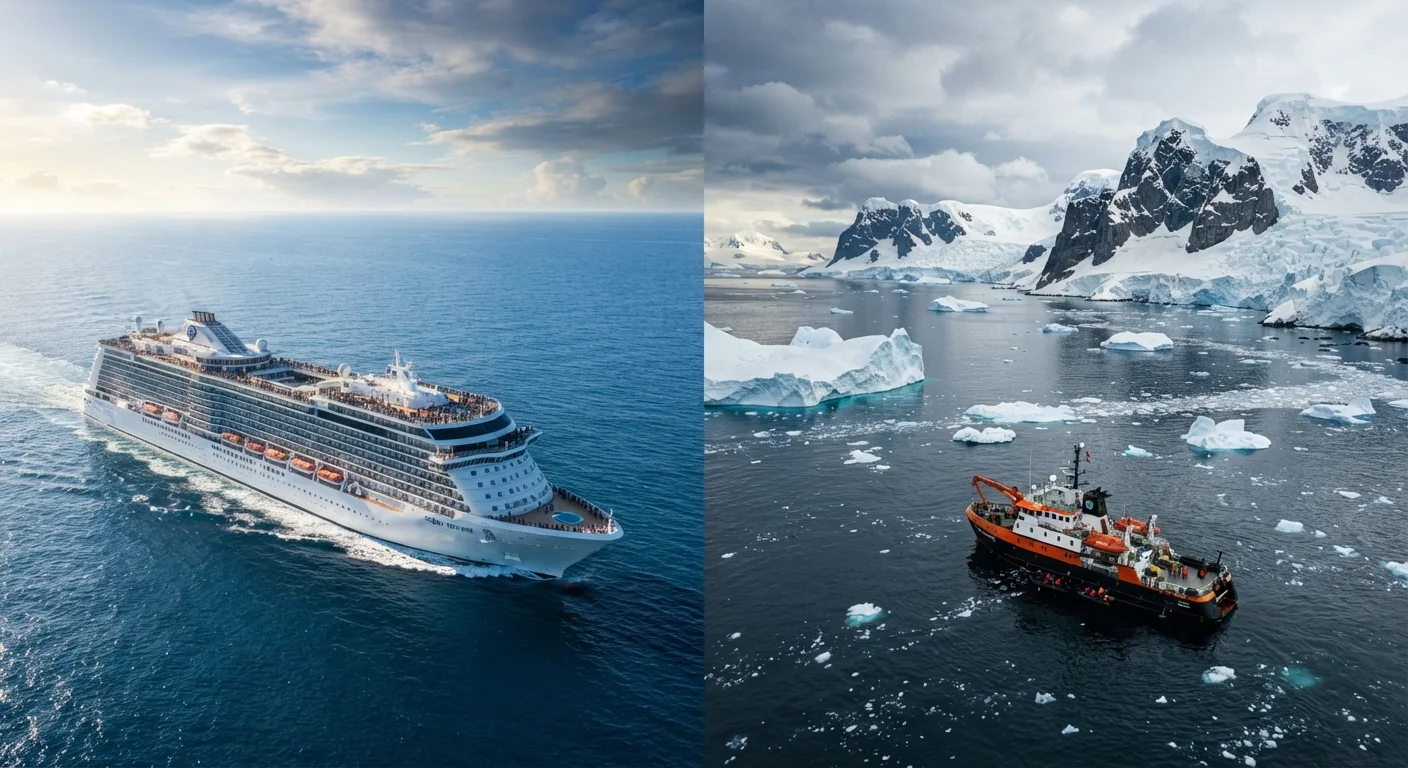
Mega-ships are the most recognizable icons of modern cruising. These vessels — typically carrying 4,000 or more passengers — function less like traditional ships and more like self-contained resort complexes. Think multiple specialty restaurants, Broadway-style theaters, water parks, ice rinks, and even go-kart tracks on the top deck.
Their sheer scale means they call at large, well-equipped port cities. If your priority is onboard entertainment and a broad range of dining and activity options, mega-ships deliver in abundance. The trade-off is that ports of call tend to be high-volume destinations, and the embarkation and disembarkation process can be time-consuming with such large passenger numbers.
Gross tonnage on these vessels often exceeds 200,000 GT, making them among the largest movable human-made structures on Earth.
7,600+
Passenger capacity of the world's largest cruise ships
Several vessels launched in the early 2020s now carry more than 7,000 guests at double occupancy, according to publicly available ship specifications from major cruise lines.
~30%
Share of cruisers choosing small or expedition ships
Industry research from Cruise Lines International Association (CLIA) has noted growing consumer interest in small-ship and expedition-style sailings over recent years.
50–500
Typical passenger range on expedition vessels
Expedition ship operators generally cap capacity in this range to maintain the guest-to-guide ratios necessary for safe, high-quality polar and remote landings.
Mid-Size and Large Ships: The Mainstream Sweet Spot
Ships in the 1,500–4,000 passenger range make up the bulk of what most Americans picture when they think of a cruise vacation. They carry enough guests to support a wide amenity suite — pools, multiple dining rooms, spas, live entertainment — while remaining maneuverable enough to visit a broader range of ports than mega-ships.
Many mainstream and premium cruise lines operate in this space, offering itineraries across the Caribbean, Mediterranean, and Alaska. The onboard atmosphere varies considerably by line: some lean toward family-focused programming while others cater to adults or specific interest groups.
For first-time cruisers, a mid-size ship is often a comfortable starting point — familiar enough to feel accessible, varied enough to stay engaging across a week-long sailing. Once you have your sea legs, exploring different ship categories becomes part of the fun. Our guide to popular cruise regions pairs well with this decision.
Match Ship Size to Your Port Priorities
Before booking, research whether your must-visit ports have large cruise terminals or are small, tender-access harbors. A mega-ship might not be able to dock at certain picturesque villages that a small ship reaches easily. Your itinerary wishlist should inform your ship-size decision, not just the other way around.
Small Ships and Luxury Yachts: Intimacy Over Volume
Small ships — typically carrying fewer than 500 passengers — offer a fundamentally different experience. With fewer guests, service ratios improve dramatically, dining becomes more relaxed and personalized, and the sense of community onboard is genuine rather than manufactured.
At the luxury end of this segment, all-suite vessels with butler service, open-bar policies, and included shore excursions redefine what "cruise" means. These ships also unlock destinations inaccessible to larger vessels: tiny Greek island ports, Norwegian villages, and remote Pacific anchorages.
For travelers who find mega-ships overwhelming, or who simply want a quieter, more curated experience, small ships are worth serious consideration. They're also a natural complement to independent port exploration — something worth reading about in our piece on shore excursions and independent exploration.
Expedition Vessels: Built for Discovery
Expedition ships occupy their own category entirely. These purpose-built vessels are engineered for remote and challenging environments — Antarctica, the Arctic, the Galápagos, Patagonia, and similar destinations where infrastructure is minimal and conditions can be demanding.
Key features distinguish them from all other ship types: ice-strengthened or ice-class hulls, fleets of inflatable Zodiac landing craft for shore access, onboard science or naturalist teams, and a program built around exploration rather than entertainment. Passenger counts typically range from 50 to 500.
Cabins are comfortable but rarely lavish — the real amenity is the destination itself. Lectures, wildlife spotting, and guided landings replace the show lounges and casinos found on mainstream ships. For a deeper look at how these voyages operate, see our article on expedition and polar cruising.
River Ships and Specialty Vessels: Beyond the Ocean
River cruise ships are a world apart from ocean-going vessels. Narrow, shallow-drafted, and typically carrying 100–200 passengers, they navigate inland waterways — Europe's Danube and Rhine, Egypt's Nile, Southeast Asia's Mekong, and more. Because you dock in the heart of cities rather than at remote port terminals, the destination immersion tends to feel more immediate.
Beyond river ships, the cruise world also includes sailing ships with traditional masts, expedition motor-yachts used for private charter, and coastal vessels designed for protected waters rather than open ocean. Each fills a niche that standard ship categories don't cover.
Understanding the full spectrum matters when planning. Matching your destination wishlist to the right ship type is as important as choosing a region. Our breakdown of ocean cruises vs. river cruises explores this comparison in detail. And once you've chosen your ship type, our guide to reading a cruise itinerary will help you decode the schedule before you sail.
“The ship is the destination for some travelers, while for others it's purely the vehicle. Understanding which type of traveler you are is the single most important factor in choosing the right vessel.”
— Cruise Lines International Association (CLIA), Global cruise industry trade association representing the majority of ocean-going cruise capacity