

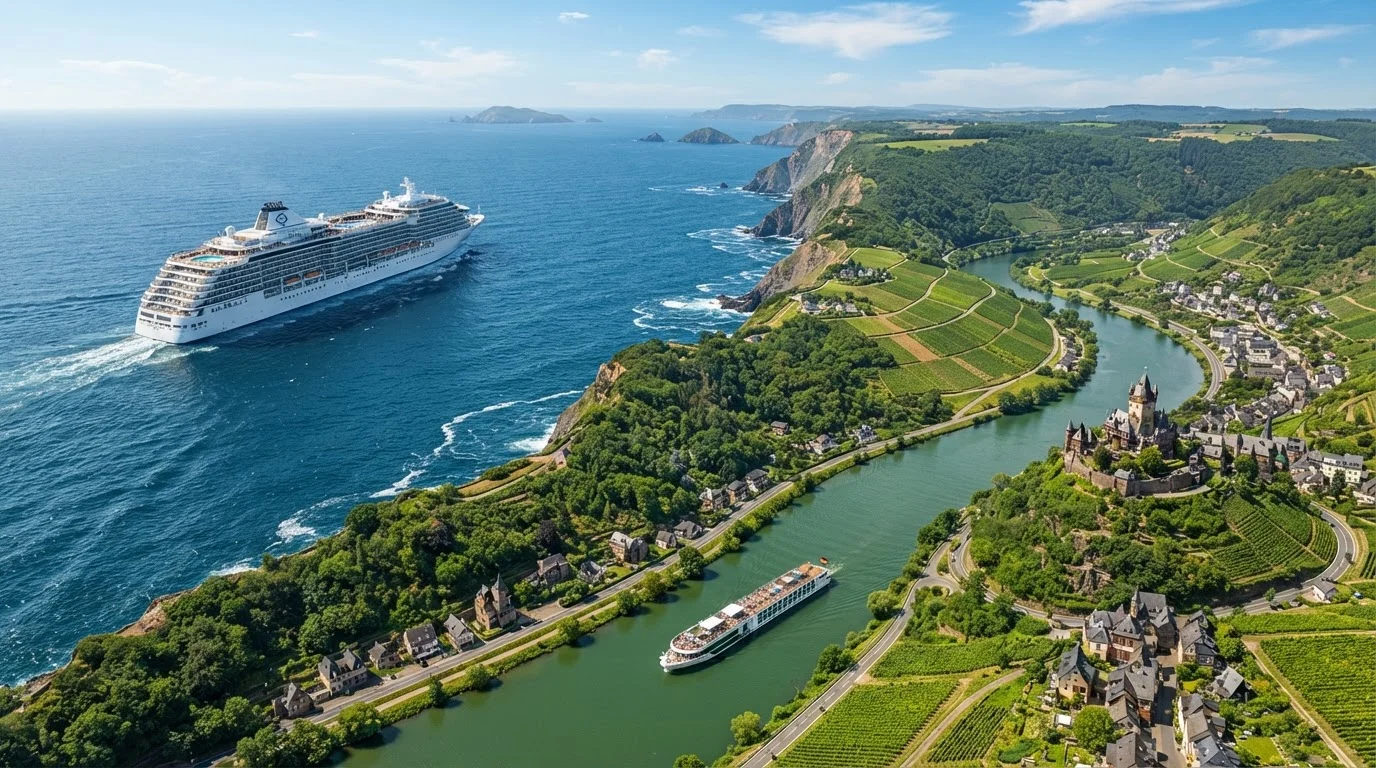
Key Takeaways
Option A
Ocean Cruising
The grand, resort-at-sea experience on open waters.
Best for: Travelers who want a wide variety of onboard amenities, entertainment, and access to far-flung international ports.
Option B
River Cruising
The intimate, destination-immersive journey through inland waterways.
Best for: Travelers who prefer smaller ships, culturally rich itineraries, and waking up docked in the heart of a historic city.
If you want onboard entertainment, pools, and resort-style amenities
Ocean Cruising
Large ocean ships are floating resorts with Broadway-style shows, multiple specialty restaurants, casinos, and activities that rival land-based vacation spots.
If you're prone to seasickness or prefer calm water travel
River Cruising
Inland waterways are sheltered from ocean swells, making river voyages a far steadier experience for passengers sensitive to motion.
If cultural immersion and historic city access matter most to you
River Cruising
River ships dock directly in town centers — often within walking distance of UNESCO sites, local markets, and centuries-old architecture.
If you want to cover multiple continents or far-flung destinations in one trip
Ocean Cruising
Ocean itineraries span the globe, from the Caribbean and Mediterranean to Alaska and Southeast Asia, covering distances no river route can match.
If you're traveling with a multigenerational group with varied interests
Ocean Cruising
The breadth of onboard programming — kids' clubs, fitness facilities, nightlife, and quiet retreats — makes it easier for diverse groups to each find their niche.
Ship Size and Passenger Experience
The most immediate difference between ocean and river cruising is sheer scale. Ocean vessels range from several hundred passengers on smaller boutique ships to well over 5,000 on the largest modern mega-ships. River cruise ships, by contrast, typically carry between 100 and 200 passengers, with some boutique vessels holding fewer than 50. That size gap shapes almost every aspect of the experience.
On a large ocean ship, you'll find multiple pools, full-scale theaters, sprawling spa complexes, rock-climbing walls, and dozens of dining venues. The ship itself competes for your attention alongside the destinations. River ships trade that scale for intimacy — communal lounges feel like living rooms, dining is often at a single shared venue, and fellow passengers become familiar faces within the first day.
For a deeper look at how ocean vessels are categorized by size and style, see our guide to cruise ship categories.
| Criterion | Ocean Cruising | River Cruising |
|---|---|---|
| Ship capacity | 300–5,000+ passengers | Typically under 200 passengers |
| Onboard amenities | Pools, theaters, gyms, many restaurants | Intimate lounges, single dining venue |
| Destination range | Global — ocean and sea routes | Regional — specific river systems |
| Port proximity | Often requires transfer to city center | Docks in or near historic city centers |
| Motion/seasickness risk | Higher — open ocean conditions vary | Very low — sheltered inland waters |
| Excursion inclusions | Usually sold separately | Often bundled into fare |
| Ideal trip length | 7–14+ days typical | 7–14 days typical |
Itineraries, Ports, and Destination Access
Ocean cruises can travel virtually anywhere there's navigable open water — the Caribbean, Mediterranean, Norwegian fjords, Alaska, Asia, and beyond. A single voyage might call at five countries across two weeks. However, ocean ships typically dock at purpose-built cruise terminals that can be several miles from a city's historic core, meaning guests often need a shuttle, taxi, or organized excursion to reach the main attractions.
River itineraries are geographically constrained — Europe's Rhine, Danube, and Douro rivers are among the most popular, along with Egypt's Nile, Southeast Asia's Mekong, and the Mississippi in the United States. But what river routes lack in geographic range, they compensate for in access. River ships tie up at town quays and city embankments, often steps from cathedral squares, medieval old towns, and local wine regions. Port time is typically generous, and guided excursions are frequently included in the fare rather than offered as add-ons.
Curious about what different sailing regions actually look like on the ground? Our overview of popular cruise regions of the world covers the highlights of each major zone.
~200
Max passengers on most river ships
The majority of purpose-built river cruise vessels are designed to navigate narrow locks and shallow channels, capping capacity at around 200 guests.
~300
UNESCO sites near European river ports
Europe's major river corridors — Rhine, Danube, Moselle — pass through some of the continent's highest concentrations of UNESCO World Heritage Sites.
12–15
Countries river Danube itineraries can span
The Danube flows through or borders around 10 countries, with extended itineraries touching cities from Germany to Romania across Central and Eastern Europe.
Comfort, Motion, and Who Each Style Suits
Motion sickness is a legitimate concern for many travelers, and it's one area where river cruising holds a clear practical advantage. Inland waterways are sheltered from ocean swells and open-sea chop, so the ride is almost always glassy-smooth. Ocean voyages — particularly in regions like the North Atlantic, the Drake Passage near Antarctica, or the open Pacific — can involve significant wave action, even on large ships.
River cruising tends to attract passengers who prioritize destination depth over onboard spectacle. The demographic skews slightly older on average, though this is shifting as operators introduce more active excursion options. Ocean cruising casts a wider net — it works for honeymooners, families, solo travelers, and group charters alike.
If you're weighing how much time to spend ashore versus aboard, our comparison of ship-organized tours versus independent exploration is worth reading before you book. And for travelers drawn to something even more remote, expedition and polar cruising represents a third category altogether — one built around wilderness rather than culture or resort amenities.
This article is for general informational purposes only. Travel conditions, itineraries, pricing, and availability vary by operator and season. Always verify details directly with cruise lines and check current government travel advisories before booking.
Pricing Structures Can Differ Significantly
River cruise fares often appear higher at first glance but frequently include shore excursions, gratuities, and beverages that would be add-ons on an ocean voyage. When comparing costs, it's worth totaling the full anticipated spend rather than comparing base fares alone. Neither format is inherently more or less expensive — it depends heavily on the operator, itinerary, and what's bundled into the package.